FSD Fluor™ 555 NHS ester
Size of product (mg)
-
Trial

-
1 mg

-
5 mg

-
25 mg

FSD Fluor™ 555 NHS ester
Cat. No. List below
Description
FSD Fluor™ 555 NHS ester readily reacts with amine-modified oligonucleotides, proteins (ε-amino groups of lysine or N-terminus), peptides, antibodies, ligands, and amplification substrates.
It has excellent fluorescence intensity after biomolecule conjugation. It is ideal for single-molecule detection in fluorescence correlation spectroscopy and optimal for fluorescence polarization measurements. It hsd high sensitivity for low-abundance biomolecule detection. It forms stable amide bonds with target molecules, ensuring long-lasting labeling.
Unique Advantages:
1. Enhanced Brightness: Outperforms spectrally similar dyes in fluorescence intensity
2. High Molar Ratio Labeling: Allows for sensitive detection of low-abundance targets
3. Versatility: Suitable for a wide range of biomolecules and applications
4. Stability: Resistant to photobleaching, enabling extended imaging sessions
5. Compatibility: Spectral properties similar to widely-used dyes, allowing easy integration into existing protocols
6. High Extinction Coefficient: Ensures bright fluorescence signals even at low concentrations
FSD Fluor™ 555 NHS ester represents a significant advancement in fluorescent labeling technology, offering researchers a powerful tool for exploring biological systems with unprecedented sensitivity and clarity. Its combination of bright fluorescence, high photostability, and versatile reactivity makes it an invaluable asset in modern biomedical research, particularly for applications requiring high sensitivity, resolution, and multiplexing capabilities.
- Fluorophore: FSD Fluor™ 555
- Reactive group: NHS ester
- Excitation/Emission Max.(nm): 554/565
- Spectrally similar dyes: Alexa555, DyLight549, Cy3, ATTO550
- Extinction coefficient: ≥ 141,000 cm-1M-1
- CF280: 0.08
- Appearance: Red Liquid
- Molecular Weight: 1228.82 g/mol
- Solubility: DMF, DMSO
- Storage conditions: -20 ℃, protect from light
| Quick link (Cat.#) | FSD series | EXmax (nm) | EMmax (nm | Spectrally similar dyes |
| KOSC1002 | FSD Fluor™ 488 | 495 | 519 | Alexa Fluor 488, FAM, Cy2 |
| KOSC1003 | FSD Fluor™ 555 | 554 | 565 | Alexa Fluor 555, DyLight 549, Cy3, ATTO 550 |
| KOSC1001 | FSD Fluor™ 594 | 591 | 617 | Alexa Fluor 594, DyLight 594 |
| KOSC1315 | FSD Fluor™ 647 | 651 | 667 | Alexa Fluor 647, Cy5, ATTO 647N, DyLight 650 |
| KOSC1515 | FSD Fluor™ 680 | 679 | 696 | Alexa Fluor 680, Cy5.5, DyLight 680, IRDye 680 |
| KOSC1702 | FSD Fluor™ 750 | 749 | 774 | Alexa Fluor 750, DyLight 755, Cy7, IRDye 750 |
| POSC1803 | FSD Fluor™ 800 | 774 | 790 | Cy7.5, DyLight 800, IRDye 800 |
Background
FSD Fluor™
FSD Fluor™ is a new generation of dye series with superb fluorescence intensity and high quantum yield comparing to traditional dyes. The fluorescence intensity after binding to biomolecules such as antibody, nucleotide, and protein maintains still excellent, FSD Fluor™ series is ideal for variety of biochemical and biological analytical applications with a less amount of dye conjugate. FSD Fluor™ series equipped with a variety of reactive groups and covers the full fluorescence spectral range from UV to NIR, hence the series is ideal for any applications in fluorescence spectroscopies and biological studies. With superior fluorophores and the wide spectral range, FSD Fluor™ dyes are suitable for every filter and are designed to meet the requirements for complex detection in the field of life science research.
- Superior fluorescence intensity than any other spectrally similar dyes
- Maintaining excellent fluorescence after conjugated to biomolecules, surpassing that of any other spectrally similar fluorophore
conjugated biomolecules. - Higher quantum yield comparing to traditional dyes
- Equipped with variety of reactive group
- Covering the full fluorescence spectral range from visible to NIR

Figure 1. Fluorescence intensity comparison of FSD Fluor™ and other dyes

Figure 2. Fluorescence intensity comparison in varying dye/protein ratio

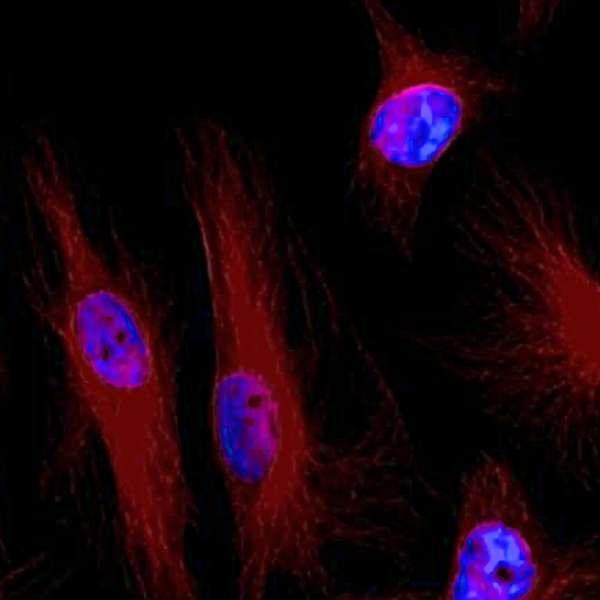
Figure 3. Immunofluorescence comparison of dye-antibody conjugates and photostability test of fluorescent secondary antibodies

Figure 4. Biodistribution images of FSD Fluor™ 750 and FSD Fluor™ 800
Citation & Reference
2. Ibrahim, Basma M. A strategy to deliver genes to cystic fibrosis lungs: a battle with environment. Journal of controlled release 155.2 (2011): 289-295.
3. Oh, Keun Sang. Accurate sequential detection of primary tumor and metastatic lymphatics using a temperature-induced phase transition nanoparticulate system. International journal of nanomedicine 9 (2014): 2955.
4. Yhee, Ji Young. Tumor-targeting transferrin nanoparticles for systemic polymerized siRNA delivery in tumor-bearing mice. Bioconjugate chemistry 24.11 (2013): 1850-1860.
5. Yoon, Hong Yeol. Glycol chitosan nanoparticles as specialized cancer therapeutic vehicles: Sequential delivery of doxorubicin and Bcl-2 siRNA. Scientific reports 4 (2014).
6. Ryu, Ju Hee. Early diagnosis of arthritis in mice with collagen?induced arthritis, using a fluorogenic matrix metalloproteinase 3–specific polymeric probe. Arthritis & Rheumatism 63.12 (2011): 3824-3832.
7. Hollis, Christin P. In vivo investigation of hybrid paclitaxel nanocrystals with dual fluorescent probes for cancer theranostics. Pharmaceutical research 31.6 (2014): 1450-1459.
8. Koo, Heebeom. The movement of self-assembled amphiphilic polymeric nanoparticles in the vitreous and retina after intravitreal injection. Biomaterials 33.12 (2012): 3485-3493.
9. Zhu, Lei. Real-time monitoring of caspase cascade activation in living cells. Journal of controlled release 163.1 (2012): 55-62.
10. Yoon, Hong Yeol. Bioreducible hyaluronic acid conjugates as siRNA carrier for tumor targeting. Journal of Controlled Release 172.3 (2013): 653-661.
11. Yhee, Ji Young. Cancer-targeted MDR-1 siRNA delivery using self-cross-linked glycol chitosan nanoparticles to overcome drug resistance. Journal of Controlled Release 198 (2015): 1-9.
12. Park, Jin Woo. Wide-Ranged Fluorescent Molecular Weight Size Markers for Electrophoresis. Bulletin of the Korean Chemical Society 34.1 (2013): 29-30.
13. Huang, Xinglu. Multiplex Imaging of an Intracellular Proteolytic Cascade by using a Broad?Spectrum Nanoquencher. Angewandte Chemie International Edition 51.7 (2012): 1625-1630.