Anti-MID1 Rabbit Polyclonal antibody
Anti-MID1 Rabbit Polyclonal antibody
General information
| Cat. No. | :SB-GB112569 |
| Size | :100 uL |
| Protein full name | :E3 ubiquitin-protein ligase Midline-1 |
| Synonym | :Midin, RING finger protein Midline-1, RING-type E3 ubiquitin transferase Midline-1, Tripartite motif-containing protein 18, Mid1, Fxy, Trim18 |
| Immunogen | :KLH conjugated Synthetic peptide corresponding to Mouse MID1 |
| Isotype | :IgG |
| Purity | :Affinity purification |
| Predicted MW. | :76 kDa |
| Observed MW. | :76 kDa |
| Uniprot ID | :O15344, O70583, P82458 |
| Long Term Storage | :-20 ℃ or below |
| Shipping Condition | :Dry Ice |
| Storage Buffer | :PBS with 0.02% sodium azide,100 μg/ml BSA and 50% glycerol. |
Application
| Applications | Species | Dilution | Positive Tissue |
| WB | Human, Mouse, Rat | 1: 2000-1: 3000 |
heart, brain, testis, liver |
Description
Has E3 ubiquitin ligase activity towards IGBP1, promoting its monoubiquitination, which results in deprotection of the catalytic subunit of protein phosphatase PP2A, and its subsequent degradation by polyubiquitination.
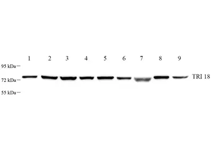 |
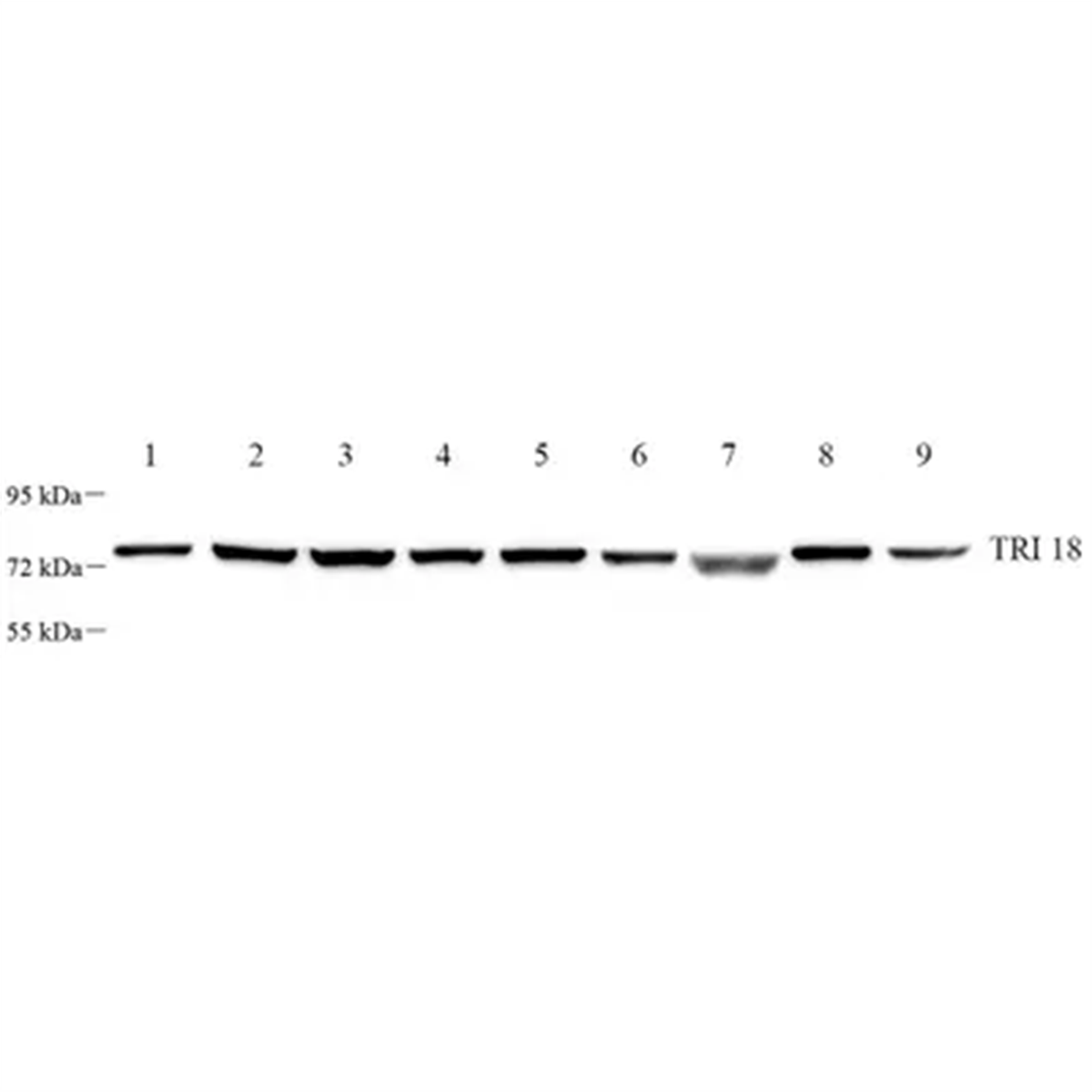
Western blot analysis of MID1 (GB112569) at dilution of 1: 3000 Lane 1: HeLa cell lysate Lane 2: A549 cell lysate Lane 3: K562 cell lysate Lane 4: Mouse heart tissue lysate Lane 5: Mouse brain tissue lysate Lane 6: Mouse testis tissue lysate Lane 7: Rat heart tissue lysate Lane 8: Rat brain tissue lysate Lane 9: Rat testis tissue lysate |
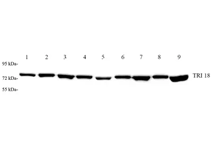 |
Western blot analysis of MID1 (GB112569) at dilution of 1: 3000 Lane 1: HeLa cell lysate Lane 2: HUVEC cell lysate Lane 3: HepG2 cell lysate Lane 4: MCF7 cell lysate Lane 5: HEK293 cell lysate Lane 6: Mouse brain tissue lysate Lane 7: Mouse liver tissue lysate Lane 8: Rat brain tissue lysate Lane 9: Rat liver tissue lysate |
Antigen Characterization
- Type: Primary
- Application: ELISA,Western Blot
- Species: Human
- Recombinant: Yes
Human Diseases
- X-Linked Opitz Syndrome: Mutations in MID1 are linked to this condition, characterized by midline defects and other developmental issues.
- Spinal and Bulbar Muscular Atrophy (SBMA): MID1 expression affects motor neuron vulnerability.
Cellular Signaling Pathways
- Ubiquitin-Proteasome Pathway: MID1 functions as an E3 ubiquitin ligase, playing a crucial role in protein degradation.
- MAPK Pathway: MID1 is involved in signaling pathways that regulate cell growth and differentiation.
- GeneCards Symbol: MID1 2
- Midline 1 2 3 5
- TRIM18 2 3 4 5
- RNF59 2 3 4 5
- FXY 2 3 4 5
- OS 2 3 5
- RING-Type E3 Ubiquitin Transferase Midline-1 3 4
- Tripartite Motif-Containing Protein 18 3 4
- E3 Ubiquitin-Protein Ligase Midline-1 3 4
- Putative Transcription Factor XPRF 3 4
- RING Finger Protein Midline-1 3 4
- RING Finger Protein 59 3 4
- Opitz/BBB Syndrome 2 3
- XPRF 3 4
- Zinc Finger On X And Y, Mouse, Homolog Of 3
- Tripartite Motif Protein TRIM18 3
- Midline 1 RING Finger Protein 3
- EC 2.3.2.27 4
- BBBG1 3
- GBBB1 3
- MIDIN 3
- ZNFXY 3
- Midin 4
- OGS1 3
- OSX 3
References
- Schweiger, S, et al. “The Opitz Syndrome Gene Product, MID1, Associates with Microtubules.” Proceedings of the National Academy of Sciences of the United States of America, U.S. National Library of Medicine, 16 Mar. 1999, www.ncbi.nlm.nih.gov/pmc/articles/PMC15848/.
- Baldini, Rossella, et al. “The MID1 Gene Product in Physiology and Disease.” Gene, U.S. National Library of Medicine, 15 July 2020, www.ncbi.nlm.nih.gov/pmc/articles/PMC8011326/.
- Mid1 Gene: Medlineplus Genetics.” MedlinePlus, U.S. National Library of Medicine, medlineplus.gov/genetics/gene/mid1/.
- Mid1 Protein, MID1 Antibody and MID1 Cdnas General Information | Sino Biological, www.sinobiological.com/resource/mid1.
- Account - Genecards Suite, www.genecards.org/cgi-bin/carddisp.pl?gene=MID1.