

PLEASE INQUIRE! PIPA for Human LOX-1 (100 ug )
PIPA for Human LOX-1
Cat. No. HPLH05
Size 100ug 1 mg
| Product No. | Size | Link |
| FNK-HPLH05-100 ug | 100 µg |  |
| FNK-HPLH05-1 mg | 1 mg | |
Description
From small to large scale Production
Professional expertize in peptide science, using own know-how and technologies in solid-phase syntheses, characterization and purification technologies allow production of high quality of polyamides (peptides) containing pyrrole and imidazole (PIPA).
HiPep Laboratories has been founded for industrial applications of bio-molecular recognition
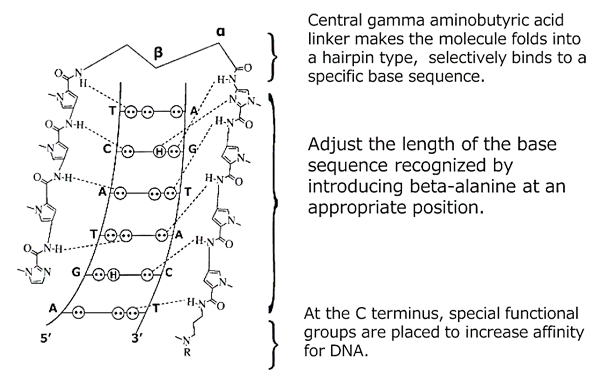
PIPA (Py-Im-Polyamide) is a gene expression control reagent, consisting of all non-proteinogenic amino acids, such as N-methylpyrrole (Py), N-methylimidazole (Im), β-Alanine (βAla) and γ-aminobutyric acid (γAbu).
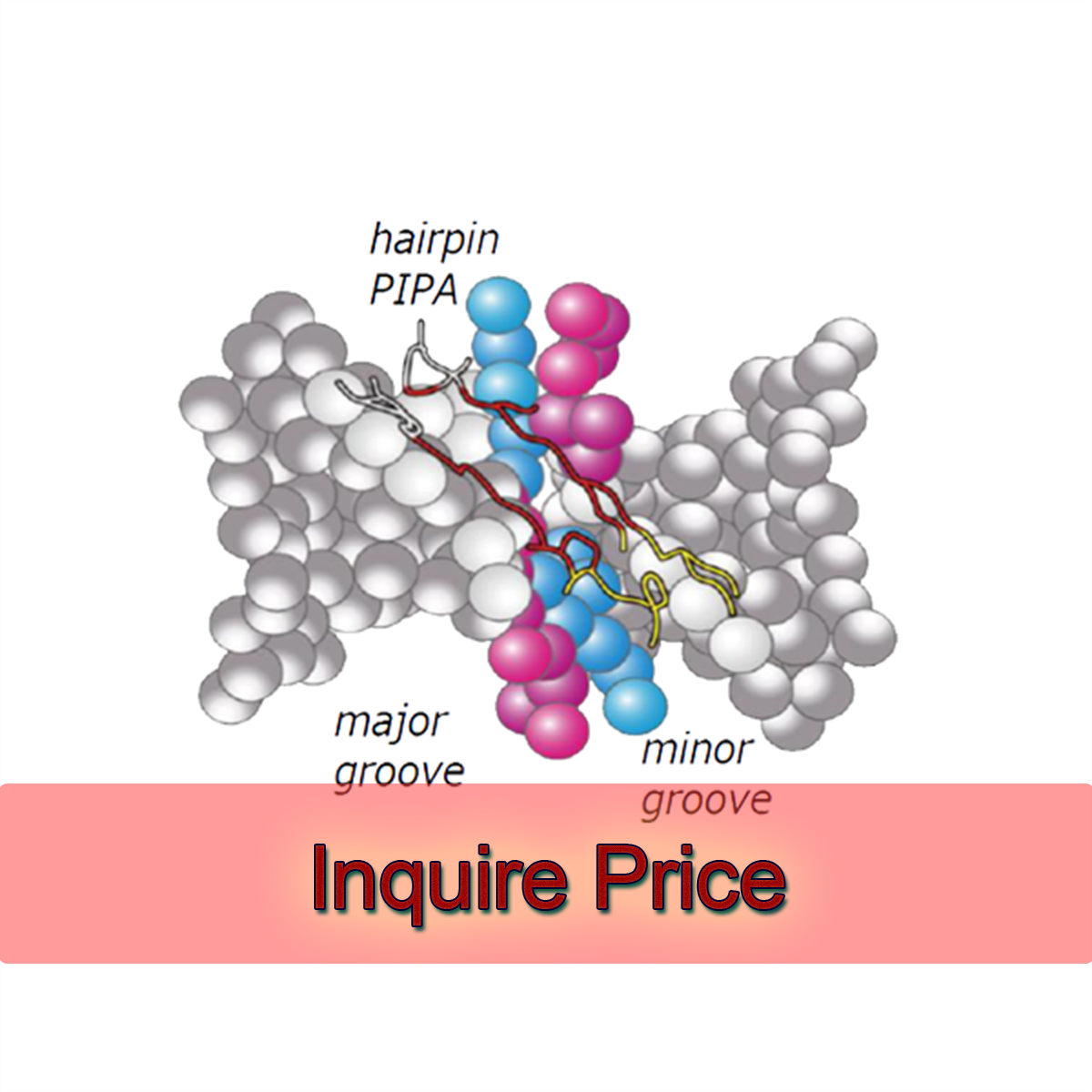
PIPA can bind to specific nucleotide sequences in the minor groove of double-helical DNA with high affinity and specificity, suggesting that PIPA blocks binding of transcription factors inhibiting gene expression, thus PIPA can be used for gene-control.
Binding site specificity is dependent on the side-by-side pairing of Py and Im and gives a hairpin motif.
PIPA are generally difficult to prepare, since they may possess structures during assembly, which involves complicated reaction procedures with many steps and the characteristics of Py and Im as building blocks are not simple with respect to stability and solubility.
Features
- Alternative gene silencer other than siRNA or PNA
- Stable in cells or bodies because of nuclease resistance
- Specifically binds to the target double strand DNA
- Flexible Design against any gene
- No-toxicities have been found in animal experiments
- Form : Freeze dried powder
- No additives
|
Code |
Structure (C-terminal amide) |
Mol. Weight |
Target Gene |
Reference |
|
HPTB01 |
Ac-Im-Py-Py-βAla-Im-Py-Py-gAbu-PyPy-Py-βAla-Py-Py-βAla-Dp |
1787.9 |
Human TGF-β1 |
1 |
|
HPTB02 |
Ac-Im-Im-βAla-Im-Py-Im-gAbu-Py-Py-Py-βAla-Py-Py-βAla-Dp |
1667.75 |
Human TGF-β1 |
1 |
|
HPTB03 |
Ac-Im-Py-Im-βAla-Py-Py-Py-gAbu-Im-Py-Im-βAla-Py-Py-Py-βAla-Dp |
1912 |
Human TGF-β1 |
1 |
|
HPTB04 |
Ac-Py-Py-βAla-Py-Im-Py-gAbu-Py-Py-Py-βAla-Im-Py-βAla-Dp |
1665.78 |
Rat TGF-β1 |
2 |
|
HPLH05 |
Ac-Im-Py-Im-βAla-Py-Py-Im-gAbu-Py-Py-Py-βAla-Py-Py-Py-βAla-Dp |
1911.01 |
Human LOX-1 |
3 |
|
HPLR06 |
Ac-Py-Py-βAla-Py-Py-Im-gAbu-Py-Im-Im-βAla-Py-Im-βAla-Dp |
1667.75 |
Rat LOX-1 |
4 |
|
HPCT07 |
Ac-Im-Py-Py-βAla-Py-Py-Py-gAbu-Im-Py-Im-βAla-Im-Py-Py-βAla-Dp |
1912 |
Human CTGF |
5 |
|
HPTE08 |
Ac-Py-Im-βAla-Im-Im-Im-gAbu-Im-Py-Py-βAla-Py-Py-βAla-Dp |
1668.74 |
TMPRSS2-ERG |
6* |
|
HPTE09 |
Ac-Py-Im-βAla-Im-Im-Im-gAbu-Py-Py-Py-βAla-Py-Py-βAla-Dp |
1667.75 |
TMPRSS2-ERG |
6* |
* Published patent
Gene Control Reagent : PIPA
Alternative gene silencer other than siRNA or PNA
PIPA (Py-Im-Polyamide)
Reference
- Igarashi, J. et. al., PLoS One. 2015,10, e0125295.
- Matsuda, H. et. al., Kidney Int. 2011, 79, 46-56.
- Kamei, T. et. al., J. Biomed. Biotechnol., 2012, 2102:715928.
- Yao, E. H. et. al., Hypertension, 2008, 52, 86-92.
- Wan, J. X.et. al., Biol. Pharm. Bull. 2011, 34, 1572-1577.
- Obinata, D. et. al., Cancer Sci., 2014, 105, 1272-1278.
- P. B. Dervan et. al., Nature (1998) 391 468-471
- P. B. Dervan and R. W. Burli, Current Opinion in Chemical Biology 3 (1999) 688-693
- P. B. Dervan, Bioorganic & Medicinal Chemistry 9 (2001) 2215-2235.
