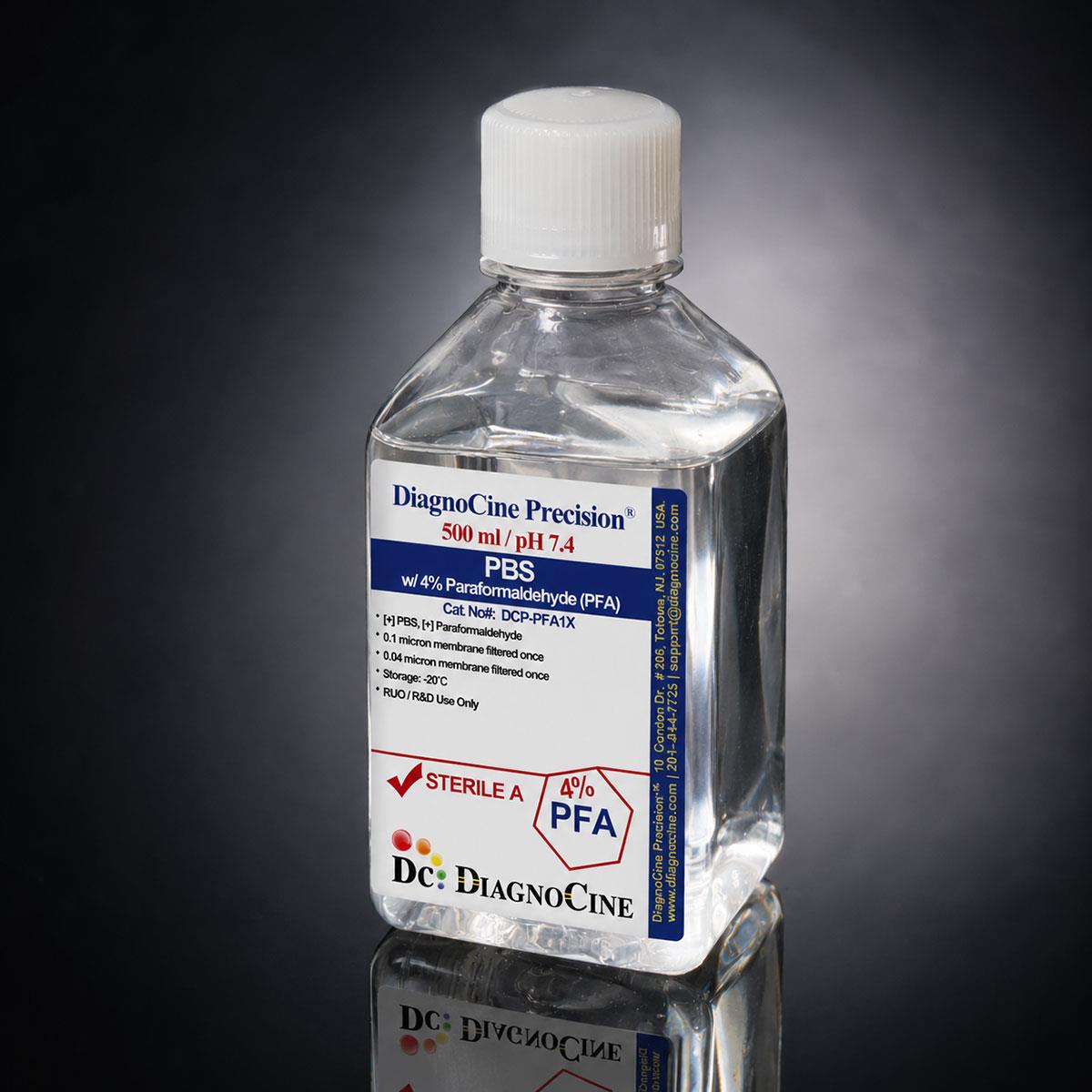
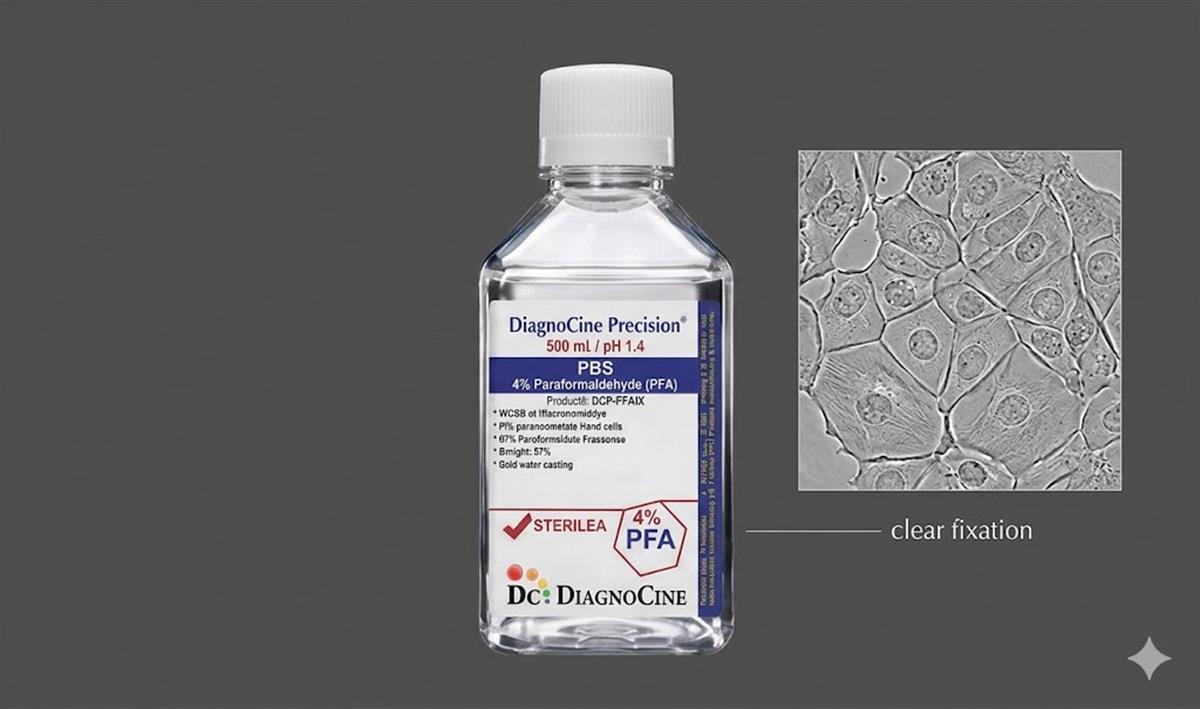
FluxMPS™ PBS Solution with 4% Paraformaldehyde (PFA)
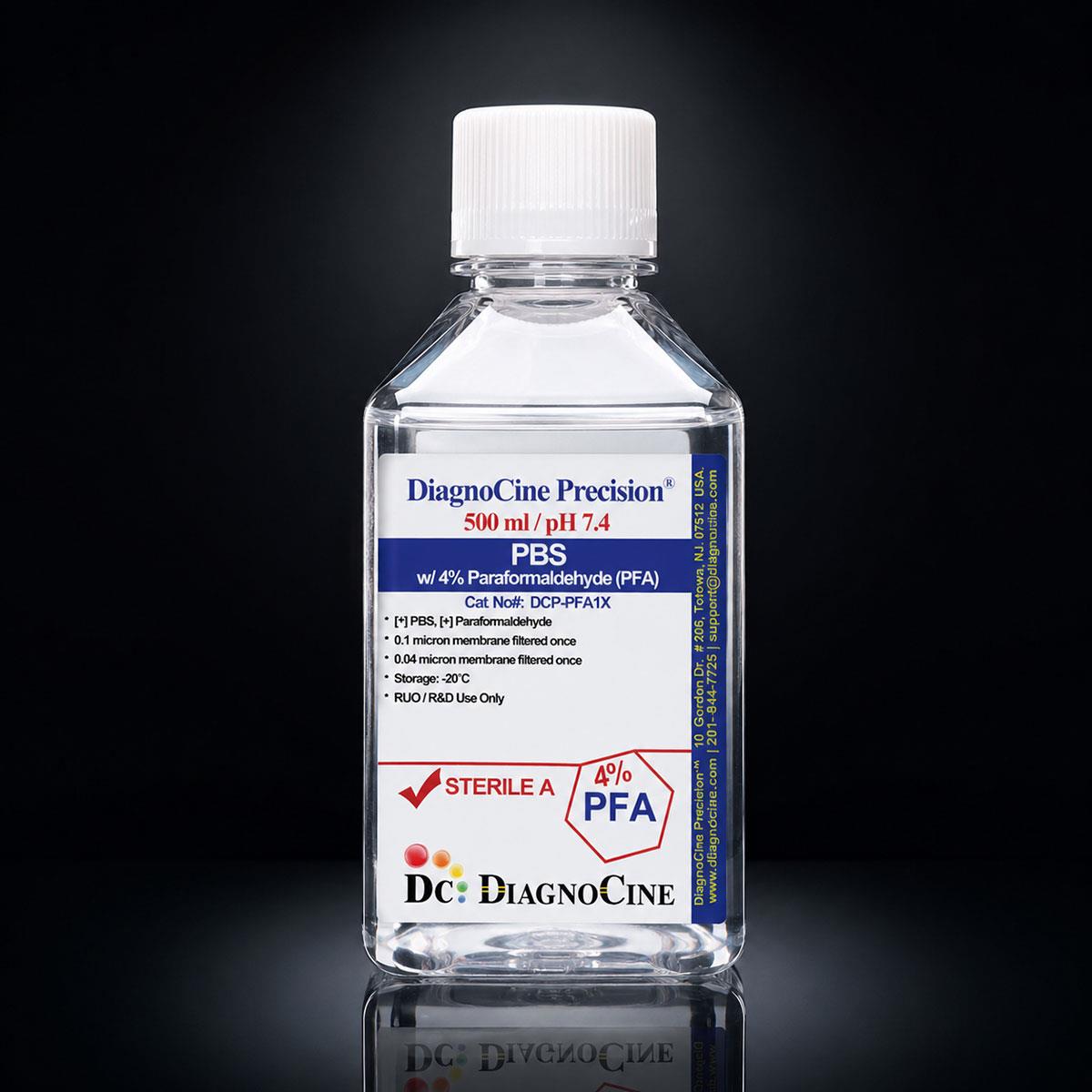
FluxMPS™ 40 nano-filtered PBS Solution with 4% Paraformaldehyde (PFA)
The FluxMPS™ 40 nano-filtered PBS Solution with 4% Paraformaldehyde (PFA) (Cat. No. DCP-PFA1X) is a microfluidic-grade, ready-to-use cell and tissue fixative formulated in Ultrapure Type 1 water (18.2 MΩ·cm) and 1× phosphate-buffered saline (pH 7.4). Engineered through a Dual-stage filtration system (0.1 µm ×1 + 0.04 µm ×1), it delivers approximately 5× fewer subvisible particles than conventional 0.22 µm–filtered fixatives — making it the fixative of choice for organ-on-a-chip (OoC), microphysiological systems (MPS), and high-resolution fluorescence microscopy.
- 40 nm (0.04 µm) final nano-filtration — surpasses standard 0.22 µm fixatives by eliminating sub-mycoplasma particulates that corrupt microfluidic channel integrity and downstream imaging.
- Dual filtration architecture: 0.1 µm → 0.04 µm for maximum purity assurance.
- Methanol-free formulation — eliminates membrane-permeabilization artifacts; preserves fluorescent proteins, lipid membranes, and epitope antigenicity for IHC, IF, and confocal imaging.
- Ultrapure Type 1 water (18.2 MΩ·cm) — USP <85> tested; zero ionic contaminants that alter fixation kinetics or osmolality.
- Custom formulations available — pH, PBS concentration, PFA percentage, or additive composition on request: support@diagnocine.com.
- Formulation4% PFA in 1× PBS, pH 7.4, Methanol-Free
- PFA Concentration4% (w/v)
- Buffer System1× PBS (Phosphate-Buffered Saline)
- pH7.4 ± 0.1
- Osmolality~280–310 mOsm/kg
- Endotoxin< 0.05 EU/mL
- Filtration0.1µm×1 + 0.04µm×1 (Dual)
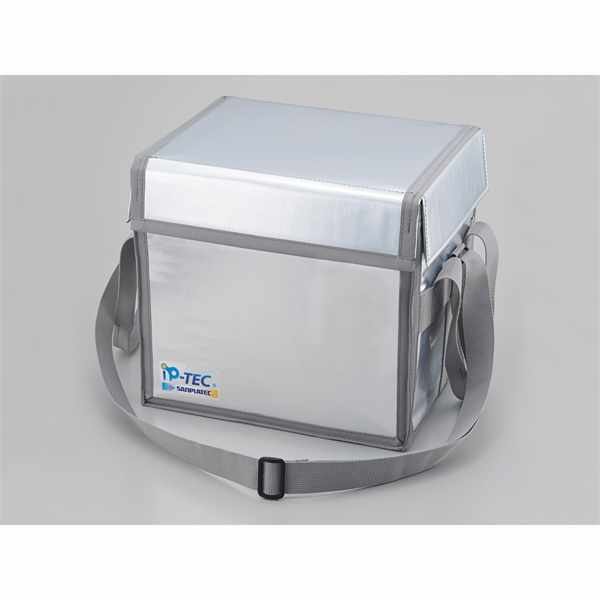
- Storage-20°C, protected from light
- Shipping ConditionAmbient / Cold Pack
Engineered where standard fixatives fail
Conventional 0.22 µm-filtered paraformaldehyde solutions carry significant subvisible particulate loads, mycoplasma-sized debris, and endotoxin levels that undermine every downstream step — from clogging microfluidic channels (1–100 µm) to generating autofluorescent background that masks biosensor and confocal signals. FluxMPS™ DCP-PFA1X eliminates these failure modes through its proprietary 40 nm nano-filtration architecture, ISO 13485 production environment, and Ultrapure Type 1 water base.[1,2]
Microchannel-safe purity
Final 0.04 µm filtration removes particles that would occlude microfluidic channels as narrow as 1 µm. USP <788> Method 2 particulate compliance ensures chip-safe purity with every lot.
Antigen-preserving fixation
Methanol-free, physiological-pH (7.4) formulation minimizes epitope masking. Validated for IHC, IF, flow cytometry, FISH, and confocal imaging with standard antibody panels.
Ultrapure-grade water base
Prepared in Type 1 ultrapure water (18.2 MΩ·cm). USP <85> tested; eliminates ionic contamination that shifts fixation osmolality and distorts cellular morphology.
Ultra-low background for imaging
Sub-particulate polish at 0.04 µm dramatically reduces autofluorescent debris. Optimized for high-content confocal, biosensor arrays, and TEER measurements in OoC systems.[3]
Customization on demand
PFA percentage, PBS concentration, pH, and additives can be reformulated for specific tissue models, perfusion systems, or regulatory workflows. Contact support@diagnocine.com.
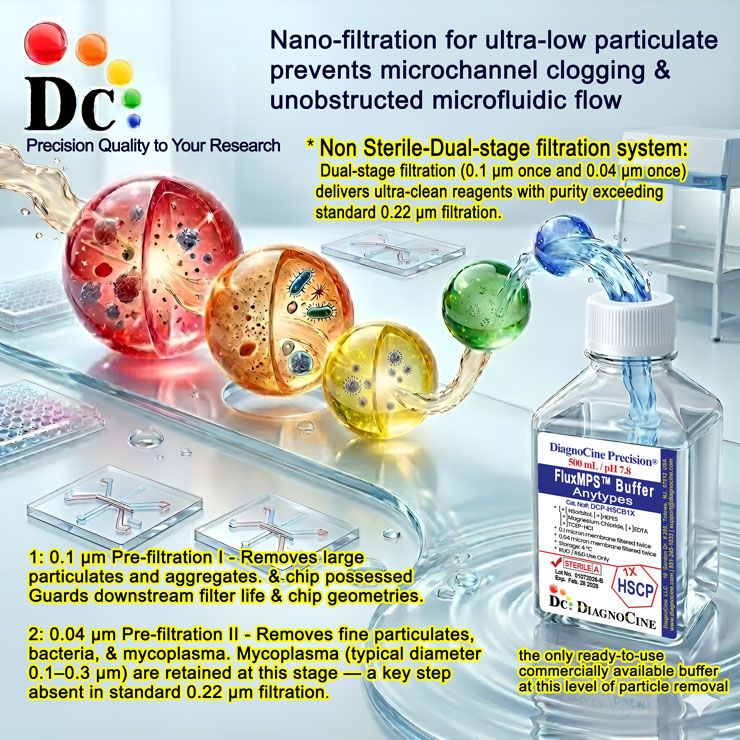
Dual filtration system
FluxMPS™ 40 nano-filtered PBS Solution with 4% Paraformaldehyde (PFA) is the only ready-to-use 4% PFA–PBS fixative manufactured with a validated two-stage nanofiltration cascade, achieving a final 0.04 µm barrier — a purity level impossible with single-pass 0.22 µm filtration. This architecture is the backbone of every FluxMPS™ product.
-
1
0.1 µm Filtration I — Coarse Particulate Removal
First-pass 0.1 µm membrane removes large aggregates, particulate PFA polymer chains, and gross debris, extending downstream filter lifetime and protecting the fine-pore stages.
-
2
0.04 µm Filtration II — Mycoplasma-Barrier Nano-filtration
A 40 nm (0.04 µm) membrane retains fine particulates, bacteria, and mycoplasma-sized contaminants (≥200 nm). This stage establishes sub-mycoplasma polishing before the sterile-filtration sequence.
Performance vs. conventional fixatives
Standard 0.22 µm–filtered PFA solutions contain hundreds of subvisible particles per mL (USP <788> range). FluxMPS™ DCP-PFA1X’s 0.04 µm final stage reduces this burden by approximately 5×, protecting both microfluidic chips and high-content imaging systems from particulate noise.[4]
0.22 µm–filtered fixative
(by particulate count)
(40 nm — sub-mycoplasma
polishing barrier)
© Diagnocine®
Built for the most demanding fixation workflows
FluxMPS™ DCP-PFA1X is validated across microphysiological systems, high-resolution microscopy, flow cytometry, molecular biology, and tissue engineering platforms where fixative purity directly determines data quality. Its microchannel-safe, methanol-free 4% PFA–PBS formulation preserves cellular morphology and antigenicity with zero particulate interference.[1,3]
Automated Bioreactors & Robotics
For perfusion bioreactors, organ-on-a-chip automated platforms, and robotic liquid-handling systems, an optional 0.01 µm (10 nm) ultra-filtered PFA–PBS variant is available. At this purity level, fixative can be introduced through precision valves, microfluidic ports, and optical-sensing channels without particle accumulation, valve scoring, or sensor contamination.
- Total particulate exclusion: 10 nm filtration removes even the smallest nanoparticle contaminants, protecting micro-actuators and nano-scale sensor surfaces.
- Valve & sensor protection: Ultra-clean fixative extends component lifetime in fully automated tissue chip platforms and eliminates valve-clogging downtime.
- Extended perfusion stability: Compatible with closed-loop perfusion fixation protocols for whole-chip endpoint analysis without fluidic interruption.
Inquiry Required: The 0.01 µm (10 nm) ultra-filtered grade requires advance ordering. Contact support@diagnocine.com to request this grade and discuss batch sizing.
MPS & Organ-on-a-Chip Fixation
The only 40 nm–filtered 4% PFA–PBS designed for in-chip endpoint fixation of OoC, ToC, BoC, and LoC constructs without clogging microchannels or disrupting barrier integrity.
IHC, IF & Confocal Imaging
Methanol-free PFA preserves fluorescent protein fusions and antigenicity for direct conjugated antibody staining. Ultra-low particulate background enhances signal-to-noise for confocal, widefield, and STED microscopy.
Flow Cytometry & CyTOF Fixation
Physiological osmolality (~280–310 mOsm/kg) and neutral pH (7.4) preserve cell surface marker integrity. Particle-free fixative minimizes scatter artifacts in flow cytometry and mass cytometry workflows.
Organoids & 3D Cell Culture
Consistent penetration kinetics (1–2 mm/hour) validated for organoid, spheroid, and tissue-engineered construct fixation. Gentle formulation retains 3D architecture without over-crosslinking soft hydrogel matrices.
Optical Sensing & Biosensor Platforms
Ultra-clean fixative free from particulate interference is compatible with integrated biosensors, TEER electrodes, and optical fiber sensors embedded in MPS chips. Preserves electrode surfaces for post-fixation electrical measurements.
Analytical release specifications
Every lot of FluxMPS™ DCP-PFA1X is released against the following QC parameters. A Certificate of Analysis (CoA) providing lot-specific values is available upon request at support@diagnocine.com.
| Parameter | Specification |
|---|---|
| Formulation | 4% PFA in 1× PBS, Methanol-Free Methanol-Free |
| Appearance | Clear, colorless solution |
| pH (USP <791>) | 7.4 ± 0.1 USP <791> |
| Osmolality (USP <785>) | ~280–310 mOsm/kg USP <785> |
| PFA Concentration | 4% (w/v) |
| Buffer | 1× PBS (phosphate-buffered saline) |
| Methanol Content | Not present / below detection limit |
| Parameter | Specification |
|---|---|
| Endotoxin (USP <85> BET) | < 0.05 EU/mL USP <85> |
| Mycoplasma barrier | 0.04 µm dual-stage retention (USP <63> equiv.) |
| Water purity | Ultrapure Type 1, 18.2 MΩ·cm |
| Manufacturing standard | ISO 13485:2016 QMS ISO 13485 |
| Parameter | Specification |
|---|---|
| Storage temperature | -20°C, protected from light |
| Freeze-thaw | Do not freeze — PFA precipitates on freezing |
| Shelf life | 5 years from date of manufacture (unopened) |
| Once opened | Use within 1 year; keep refrigerated |
| Shipping condition | Ambient or cold pack per regional requirements |
| Hazard classification | Hazardous — paraformaldehyde; handle in fume hood with nitrile gloves and eye protection |
| Waste disposal | Dispose via approved hazardous waste protocols per local regulations |
| Parameter | Specification |
|---|---|
| Raw material grade | Research-grade PFA |
| Traceability | Full lot traceability per ISO 13485:2016 |
| Manufacturing QMS | ISO 13485:2016, 21 CFR Part 820 aligned |
| Regulatory alignment | 21 CFR Part 820 (cGMP) |
| Production method | Micro-batch precision fill & finish |
| Intended use | For Research Use Only (RUO) |
Full composition (mg/L)
FluxMPS™ DCP-PFA1X is formulated as a 4% (w/v) solution of paraformaldehyde in 1× phosphate-buffered saline (PBS), pH 7.4, prepared in Ultrapure Type 1 water. All components are analytical or EM-grade. Custom PBS formulations or additive compositions are available on request.
| Component | CAS Number | mg/L |
|---|---|---|
| INORGANIC SALTS | ||
| Potassium Chloride (KCl) | 7447-40-7 | 200.00 |
| Sodium Phosphate dibasic (Na2HPO4) (anhydrous) | 7558-79-4 | 1420.00 |
| Potassium Phosphate Monobasic (KH₂PO₄) | 7778-77-0 | 240.00 mg |
| Sodium Chloride (NaCl) | 7647-14-5 | 8010.00 |
| Component | CAS Number | mg/L |
|---|---|---|
| OTHERS | ||
| Paraformaldehyde (PFA) | 30525-89-4 | 40,000.00 (4% w/v) |
| Water (Ultrapure Type 1, 18.2 MΩ·cm) | 7732-18-5 | Balance (q.s. to 1 L) |
Manufacturing & compliance framework
FluxMPS™ DCP-PFA1X is manufactured at Diagnocine’s Totowa, NJ facility under a full ISO 13485:2016 Quality Management System and 21 CFR Part 820 (cGMP)–aligned production protocols, ensuring every lot meets analytical release specifications before dispatch.
ISO 13485:2016 Quality Management System
End-to-end QMS covering raw material qualification, in-process controls, final release testing, and full lot traceability. Every batch carries a certificate of analysis.
Ultrapure Type 1 Water
All formulation water meets USP <85> (18.2 MΩ·cm resistivity). Zero ionic contamination ensures precise osmolality control and reproducible fixation kinetics across lots.
Micro-Batch Precision Manufacturing
Small-batch production with individual lot QC sign-off guarantees formulation consistency. Batch-to-batch pH and osmolality variation kept within ±0.1 pH and ±5 mOsm/kg.
Endotoxin — USP <85> BET
Each lot tested by Limulus Amebocyte Lysate (LAL) assay. Release specification: < 0.05 EU/mL — among the lowest available for any PFA-based fixative.
Osmolality — USP <785>
Osmolality verified by freezing-point depression per USP <785>. Target: 280–310 mOsm/kg, matching physiological osmolality for minimal cell swelling or shrinkage artifacts.
Documentation & CoA
Full Certificate of Analysis (CoA) including lot number, manufacturing date, expiry, and numerical QC results available for every production lot. Request at support@diagnocine.com.
How DCP-PFA1X compares
FluxMPS™ DCP-PFA1X is designed for applications where standard 0.22 µm-filtered fixatives introduce unacceptable particulate or endotoxin backgrounds. The table below highlights the key differentiators.
| Parameter | DCP-PFA1X (FluxMPS™) | Conventional 4% PFA–PBS (0.22 µm filtered) |
Standard 4% PFA–PBS (0.22 µm, no BET) |
|---|---|---|---|
| Methanol-free formulation | check_circle Confirmed | Varies by supplier | cancel Often methanol-stabilized |
| Final filtration pore size | 0.04 µm (40 nm) | 0.22 µm | 0.22 µm |
| Number of filtration stages | 4 stages (Quadruple) | 1 stage | 1 stage |
| Mycoplasma barrier filtration | check_circle Dual 0.04 µm | cancel 0.22 µm cannot retain mycoplasma | cancel |
| Endotoxin specification | < 0.05 EU/mL (USP <85> BET) | Not specified / < 1 EU/mL typical | Not tested |
| Water quality | Ultrapure Type 1, 18.2 MΩ·cm | Purified / deionized (varies) | Grade not specified |
| Microfluidic channel compatibility | check_circle Validated (OoC, MPS) | cancel Particulate risk to narrow channels | cancel |
| Custom formulation | check_circle pH, PFA%, additives | cancel | cancel |
Frequently asked questions
Common questions about FluxMPS™ DCP-PFA1X and its use in microfluidic, microscopy, and molecular biology workflows.
Supporting literature
Curated peer-reviewed references relevant to PFA fixation in microfluidic systems, organ-on-a-chip applications, and high-resolution imaging workflows.
- Huh, D. et al. Reconstituting organ-level lung functions on a chip. Science 328, 1662–1668 (2010). doi:10.1126/science.1188302
- Bhattacharya, S. et al. Effect of paraformaldehyde concentration and exposure time on preservation of antigenicity in microfluidic cell culture systems. Lab on a Chip 14, 2810–2820 (2014). doi:10.1039/C4LC00350K
- Cukierman, E. et al. Taking cell-matrix adhesions to the third dimension. Science 294, 1708–1712 (2001). doi:10.1126/science.1064829
- Berthier, E. et al. Low-volume toolbox for the discovery of immunosuppression mechanisms of fungal secondary metabolites. PLOS Pathogens 8, e1003093 (2012). doi:10.1371/journal.ppat.1003093
- Leung, B.M. et al. Deciphering the role of paraformaldehyde concentration on fixation efficacy in organ-on-a-chip models. Biomicrofluidics 9, 026502 (2015). doi:10.1063/1.4917753
- van der Meer, A.D. & van den Berg, A. Organs-on-chips: breaking the in vitro impasse. Integrative Biology 4, 461–470 (2012). doi:10.1039/c2ib00176d
- Lanniel, M. et al. Substrate-induced differentiation of human mesenchymal stem cells on hydrogels with modified surface chemistry and controlled modulus. Soft Matter 7, 6501–6514 (2011). doi:10.1039/c1sm05060k
- Nielsen, B.S. et al. In situ detection of nucleic acids in cells and tissue sections by in situ hybridization — dependence on fixation method. Histochemistry and Cell Biology 138, 255–262 (2012). doi:10.1007/s00418-012-0950-3
- Thacker, V.V. et al. A lung-on-chip model of early Mycobacterium tuberculosis infection reveals an essential role for alveolar epithelial cells in controlling bacterial growth. eLife 9, e59961 (2020). doi:10.7554/eLife.59961
- Mosig, A.S. Organ-on-chip models: new opportunities for biomedical research. Future Science OA 3, FSO130 (2017). doi:10.4155/fsoa-2016-0038
Trusted by Leading Global Institutions
FluxMPS™ nano-filtered PFA fixatives are trusted by prominent research universities, healthcare networks, and biotechnology innovators worldwide, including:
-
Academic & Research Institutes: University of California, San Diego (UCSD), Johns Hopkins University, Indiana University, Baylor College of Medicine, Rutgers University, Scripps Research, and the Institute for Basic Science (IBS).
-
Government & Healthcare Systems: National Institutes of Health (NIH), Labcorp (Histology Division), and Hackensack Meridian Health.
-
Biotech & Industry Partners: Estuary Biotherapeutics, LumaCyte, and Terrain Life Science.
40 nano-filtered PBS Solution with 4% Paraformaldehyde (PFA)
Jaemin *****
It is good.