

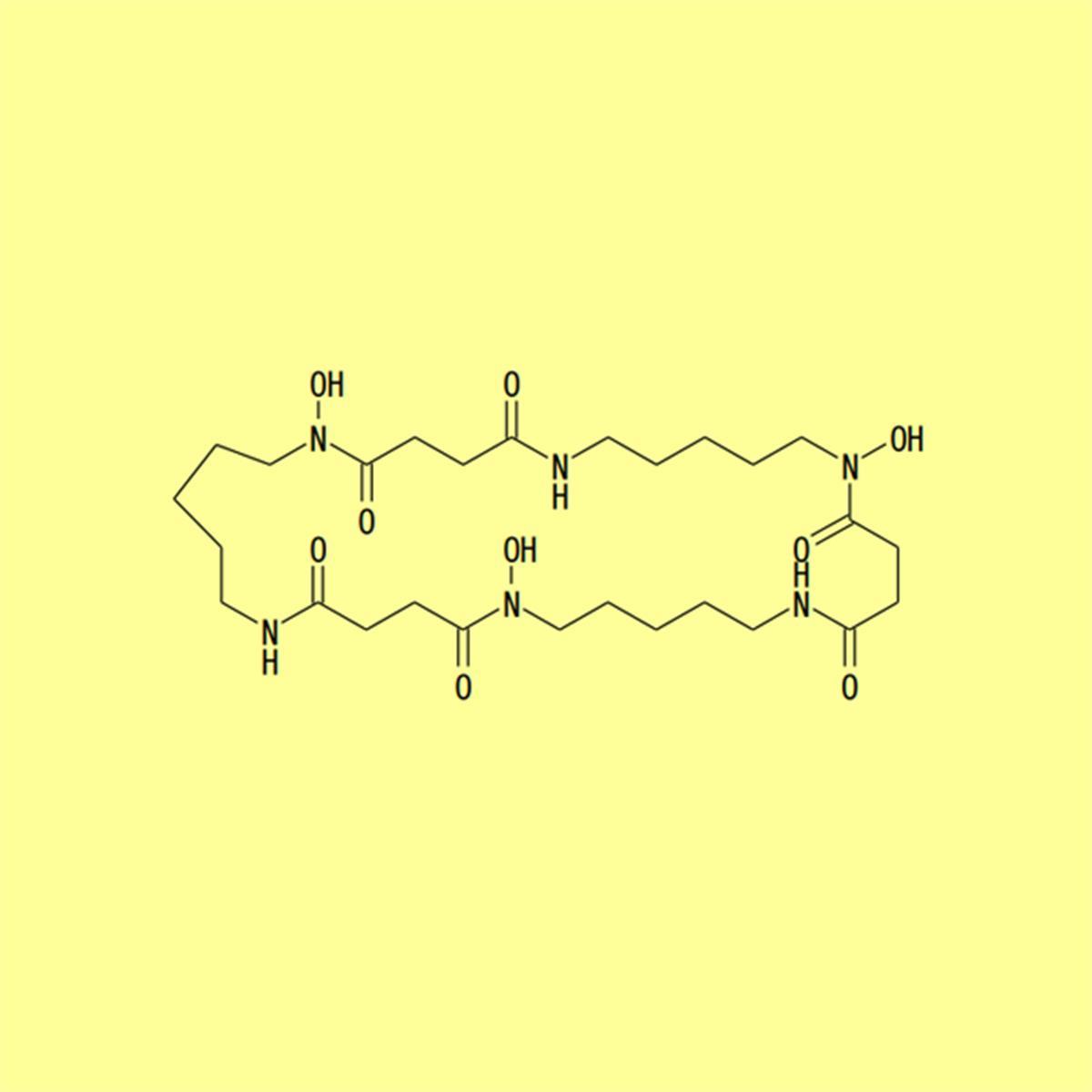
Nocardamine, 1 mg
Product#: FNK-BLK-0680-1mg
$175.41
Availability:
Ships in 1-2 Weeks
Nocardamine (1mg)
Cat No: FNK-BLK-0680-1mg
Product ID and Size
| Cat No. | Description | Size | Link |
| FNK-BLK-0680-100µg | Nocardamine | 100μg |  |
| FNK-BLK-0680-1mg | Nocardamine | 1mg | |
| FNK-BLK-0680-5mg | Nocardamine | 5mg | |
Description
Nocardamin (desferrioxamine E) is a cyclic siderophore consisting of three units of 5-succinylated-1-aminohydroxyamino-pentane belonging to the ferrioxamine group. Nocardamin is produced by species of Nocardia1,2), Chromobacterium3), Pseudomonas4), and several other Streptomyces species5,6). It is known that desferrioxamines act as siderophres and have important clinical applications7). In addition, nocardamin stimulates secondary metabolite formation and morphological differentiation in various actinomycete strain8) .
Origin: Streptomyces sp.
CAS Registry Number: 26605-16-3
Appearance: off-white solid
Molecular Formula/ Weight: C27H48N6O9=600.71
Purity: 95>% by HPLC
Solubility: Sol. DMSO, hot MeOH, water Insol. Chloroform, EtOAc, Hexane
Handling and Storage: Store at -20℃.
Clinical Significance
- Antioxidant Properties: Nocardamine has been shown to mitigate oxidative stress-induced cellular dysfunction, particularly in periodontal ligament stem cells (PDLSCs). Oxidative stress is a significant factor in periodontal tissue destruction, and nocardamine's ability to protect against this stress suggests potential therapeutic applications in treating periodontal diseases.
- Anti-Cancer and Anti-Bacterial Effects: Nocardamine exhibits anti-cancer and anti-bacterial properties, which may be attributed to its ability to chelate iron, thereby depriving cancer cells and bacteria of this essential nutrient. This makes it a compound of interest in the development of treatments for cancer and bacterial infections.
ERK/Wnt Signaling Pathway:
Nocardamine has been found to modulate the ERK/Wnt signaling pathway. This modulation plays a significant role in protecting periodontal ligament stem cells (PDLSCs) from oxidative stress-induced dysfunction. Specifically, nocardamine increases the levels of phosphorylated ERK (p-ERK) and promotes the translocation of β-catenin into the nucleus. This activity is crucial for maintaining cell viability and promoting osteogenic differentiation under stress conditions.
Oxidative Stress Mitigation:
Nocardamine effectively inhibits oxidative stress (OS) in PDLSCs by enhancing antioxidant factor expression and reducing reactive oxygen species (ROS) levels. This protective effect is vital for restoring cellular functions such as alkaline phosphatase (ALP) activity and mineralized nodule formation, which are essential for osteogenic differentiation.
Nocardamine has been found to modulate the ERK/Wnt signaling pathway. This modulation plays a significant role in protecting periodontal ligament stem cells (PDLSCs) from oxidative stress-induced dysfunction. Specifically, nocardamine increases the levels of phosphorylated ERK (p-ERK) and promotes the translocation of β-catenin into the nucleus. This activity is crucial for maintaining cell viability and promoting osteogenic differentiation under stress conditions.
Oxidative Stress Mitigation:
Nocardamine effectively inhibits oxidative stress (OS) in PDLSCs by enhancing antioxidant factor expression and reducing reactive oxygen species (ROS) levels. This protective effect is vital for restoring cellular functions such as alkaline phosphatase (ALP) activity and mineralized nodule formation, which are essential for osteogenic differentiation.
References:
- Stoll A. et al. Allg. Pathol. Bakteriol . 14, 225-233 (1951).
- Zlhner H. et al. Pathol. Microbiol . 25, 708-736 (1962).
- Miller A and Zahner H. Arch Mikrobiol. 62, 257-263 (1968).
- Meyer JM and Abdallah MA. J. Gen. Microbiol. 118, 125-129 (1980).
- Bickel HR. et al. Helv Chim Acta. 43, 2118-2128 (1960).
- Zlhner H. et al. Pathol Microbiol . 25, 708-736 (1962).
- Tam TF. et al. Curr Med Chem . 10, 983-995 (2003).
- Yamanaka K. Microbiol . 151, 2899-2905 (2005).
