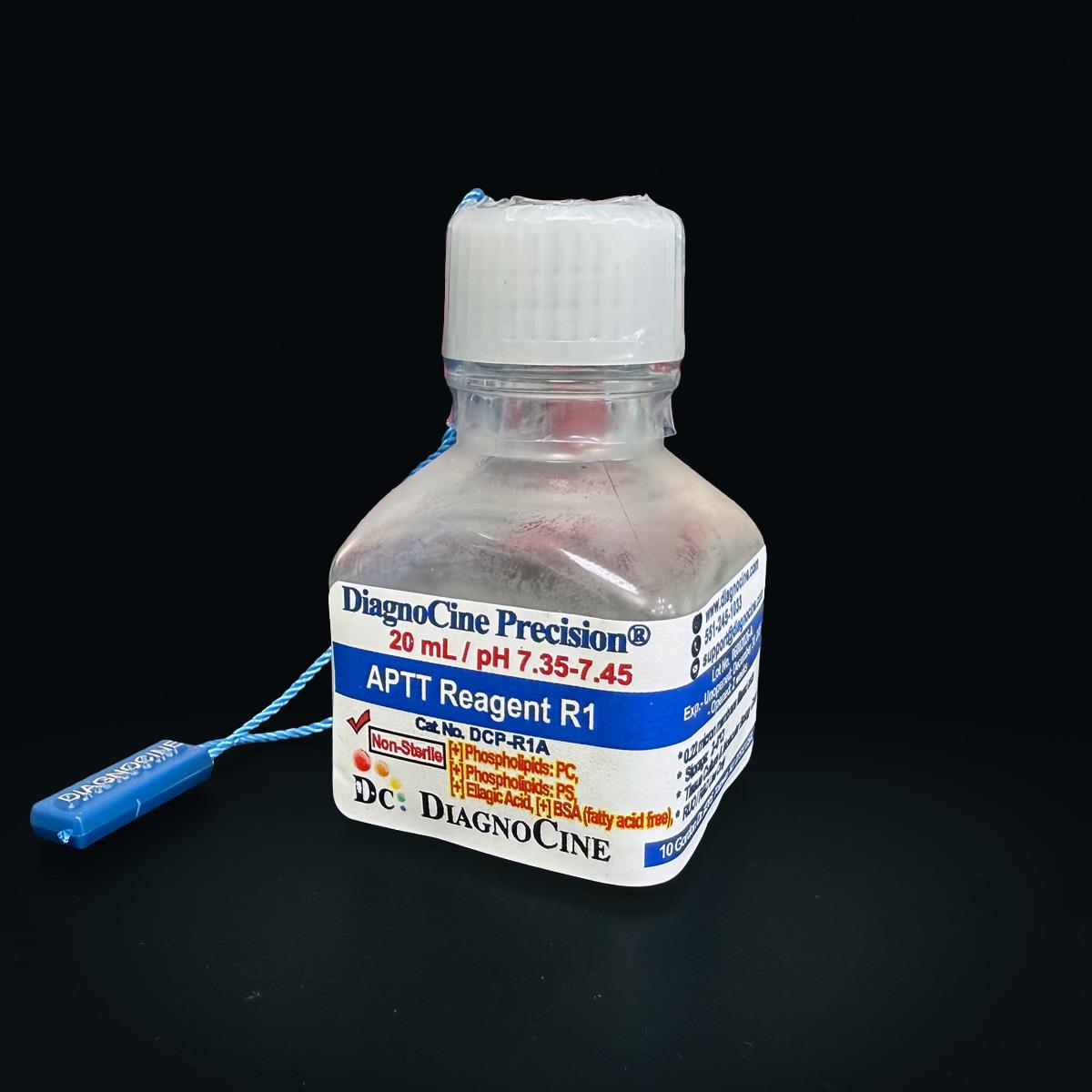
APTT Reagent R1
Catalog No.: DCP-R1A
Size:
20 mL
Non-Sterile: Filtered 0.1-micron membrane ONCE
Storage: 2–8°C
Shelf Life: Unopened: 6 months
Opened: 2 weeks
*Use before the expiry date given on the product label.
Description:
A reagent fully compatible (not exclusive) with the Blood Coagulation Analyzer (Catalog No.: DCBio-SACA)
[Link]
A ready-to-use liquid coagulation reagent constituting the first component (R1) of a two-reagent Activated Partial Thromboplastin Time (APTT) system. Contains a precisely formulated mixture of procoagulant phospholipids — principally phosphatidylserine (PS), phosphatidylcholine (PC), and phosphatidylethanolamine (PE) — combined with a contact phase activator (ellagic acid, micronized silica, or colloidal silica) in an isotonic physiological buffer.
When combined with citrated patient plasma at 37°C (R1 incubation step), the activator triggers contact phase activation of Factor XII (FXII) while the phospholipid vesicles provide the negatively charged membrane scaffold for the tenase and prothrombinase complexes. Addition of 0.025 M calcium chloride (R2) initiates timed clot formation.
The APTT assay evaluates the functional integrity of the intrinsic coagulation pathway (contact activation) and the common pathway. The term "partial thromboplastin" derives from the original 1953 nomenclature: unlike complete tissue thromboplastin (used in the PT), the APTT reagent contains phospholipid but no tissue factor (TF) or coagulation proteins — it is a "partial" substitute for the full thromboplastin complex. The term "activated" refers to the inclusion of a contact activator that standardizes and maximizes FXII contact-phase activation.
The test proceeds in two stages:
- Stage 1 — Contact Activation and Tenase Assembly (R1 incubation at 37°C, 3–5 min): The contact activator (negatively charged surface) binds and activates zymogen FXII to FXIIa, which in turn cleaves FXI to FXIa. Simultaneously, the phospholipid vesicles assemble onto the developing FXIa, and subsequently provide the procoagulant membrane scaffold for the intrinsic tenase complex (FIXa + FVIIIa + Ca²+ + phospholipid). The absence of calcium during this incubation period holds the cascade in a fully primed, reproducibly initiated state — preventing premature thrombin generation.
- Stage 2 — Recalcification and Clot Formation (R2 addition): Addition of 0.025 M CaCl₂ (APTT Reagent R2) simultaneously restores ionized calcium and starts the timer. The now-complete tenase complex activates FX to FXa; FXa with FVa on the phospholipid surface (prothrombinase complex) converts prothrombin to thrombin, which cleaves fibrinogen to fibrin, forming the detectable clot endpoint.
**The single most analytically consequential manufacturing step in APTT R1 production is the extrusion of the phospholipid mixture through a 100 nm polycarbonate track-etched membrane filter.
Composition:
| Ingredients |
| Phospholipids: PC (phosphatidylcholine) |
| Phospholipids: PS (phosphatidylserine) |
| Ellagic Acid (contact activator) |
| Imidazole buffer |
| BSA |
* All DiagnoCine Precision Sterile filtered-sterilized with 40 nanometer. Thus, mycoplasma contamination is prevented. The smallest size mycoplasma type can be about 0.2 microns.
* This product is manufactured under ISO 13485-certified and CE-approved facilities (Suppliers of DiagnoCine Precision). All final packaging, quality assurance, and testing are done at the DiagnoCine R&D and Quality Testing Center. All specific customization requests and assembly were accomplished at DiagnoCine Precision in Totowa, New Jersey, USA