
Ultrapure Water, Type I
Select See the table below
- See the table below
Ultrapure Water, Type I — Grade & Configuration Guide
Two grades, eleven catalog numbers, one page. Find your exact Cat. No below and go straight to its product page — specifications, applications, and QC detail follow underneath.
| Cat. No | Size | Sterile or non-sterile | pH | Product Page |
|---|---|---|---|---|
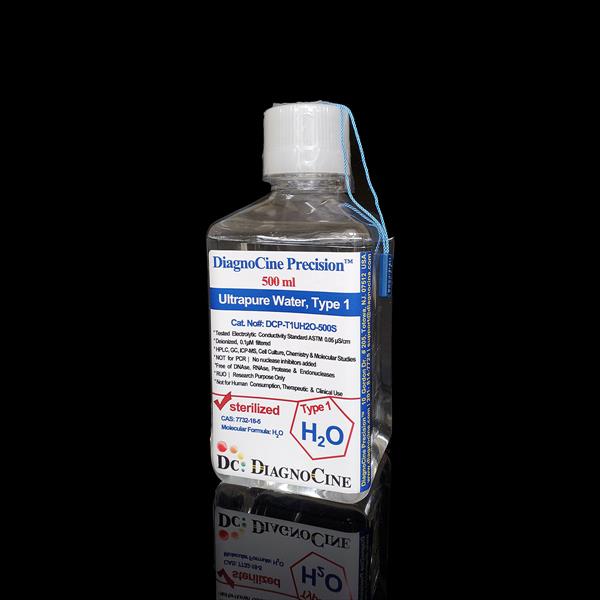

Ultrapure Water, Type 1
|
||||
| DCP-T1UH2O-500S_pH 5 | 500 ml | Sterile | 5 | Viewarrow_forward |
| DCP-T1UH2O-500S_pH 7.4 | 500 ml | Sterile | 7.4 | Viewarrow_forward |
| DCP-T1UH2O-500N_pH 5 | 500 ml | non-sterile | 5 | Viewarrow_forward |
| DCP-T1UH2O-500N_pH 7.4 | 500 ml | non-sterile | 7.4 | Viewarrow_forward |
| DCP-T1UH2O-1000S_pH 5 | 1000 ml | Sterile | 5 | Viewarrow_forward |
| DCP-T1UH2O-1000S_pH 7.4 | 1000 ml | Sterile | 7.4 | Viewarrow_forward |
| DCP-T1UH2O-1000N_pH 5 | 1000 ml | non-sterile | 5 | Viewarrow_forward |
| DCP-T1UH2O-1000N_pH 7.4 | 1000 ml | non-sterile | 7.4 | Viewarrow_forward |
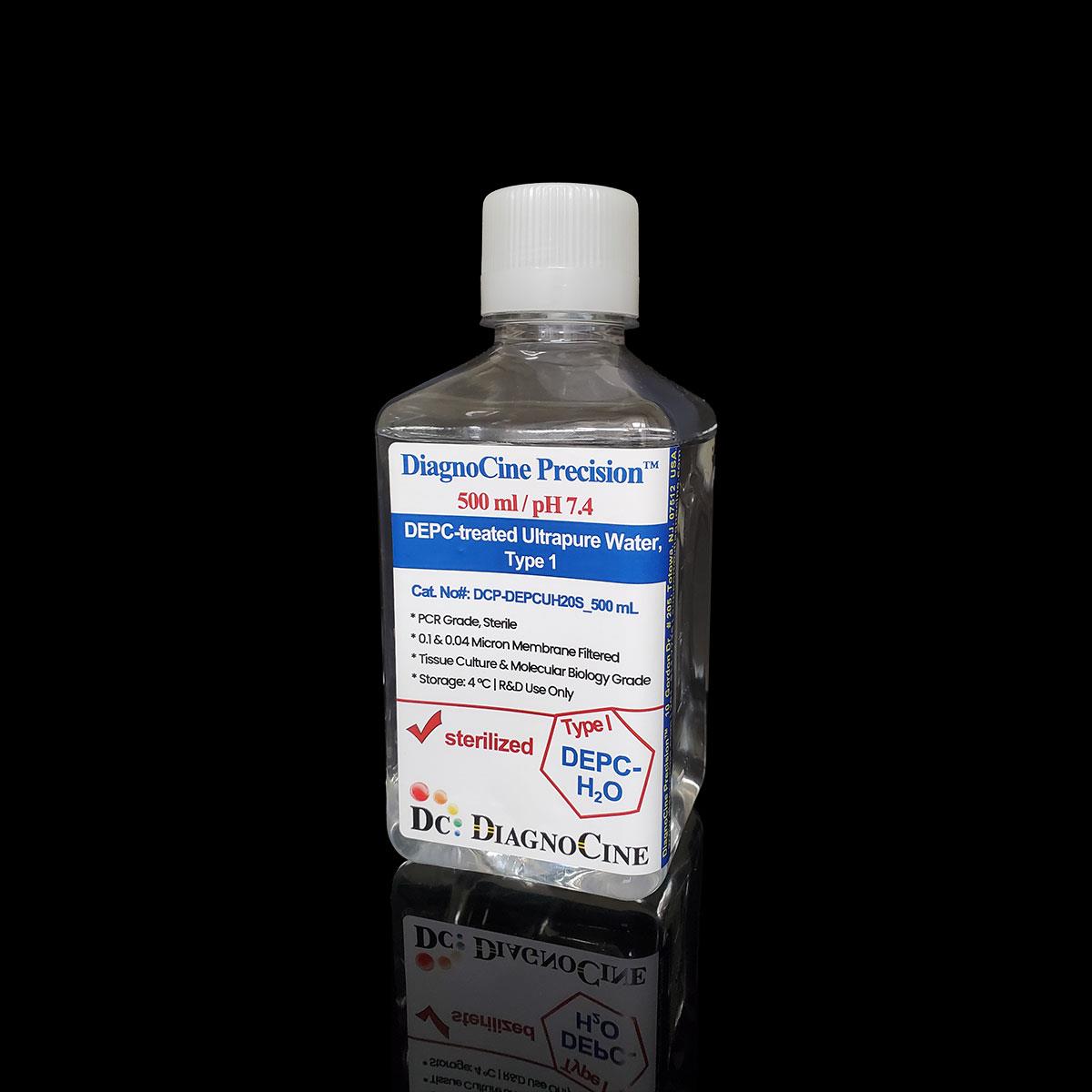
DEPC treated Ultrapure Water, Type 1
|
||||
| DCP-DEPCUH20S_100 ml | 100 ml | Sterile | 7.4 | Viewarrow_forward |
| DCP-DEPCUH20S_500 ml | 500 ml | Sterile | 7.4 | Viewarrow_forward |
| DCP-DEPCUH20S_1000 mlSource link resolves to a catalog search, not a product page — reproduced as published and flagged for review. | 1000 ml | Sterile | 7.4 | Viewarrow_forward |
Not sure which grade? Compare the published specifications · See applications by grade · Read the FAQ
The numbers behind the two grades
High-purity water engineered for molecular biology and PCR-based research.
Diagnocine’s DEPC-treated Ultrapure Water (Type I) is designed for highly sensitive molecular biology applications such as PCR, qPCR, RNA extraction, and protein analysis. Each batch is manufactured under stringent ISO-controlled conditions to guarantee RNase-free, DNase-free, endotoxin-free, and mycoplasma-free quality for your most critical experiments.
- Two grades stocked: Ultrapure Water, Type 1 and DEPC-treated Ultrapure Water, Type 1.
- Nuclease control (Type 1): free of DNase, RNase, protease & endonucleases.
- Nuclease and bioburden control (DEPC grade): endotoxin-free, DNase/RNase-free, mycoplasma-free.
- Ionic purity: tested electrolytic conductivity standard ASTM 0.05 µS/cm (Type 1); ≤ 0.055 µS/cm @ 25 °C (DEPC grade).
- Total Organic Carbon (TOC): ≤ 10 ppb (DEPC grade).
- Membrane filtration: deionized, 0.1 µm filtered (Type 1); 0.1 µm and 0.04 µm membrane passes (DEPC grade).
- pH and sterility are ordering choices: Type 1 ships at pH 5 or pH 7.4, sterile or non-sterile; the DEPC grade ships at pH 7.4, sterile (autoclaved).
- Documentation: a lot-specific Certificate of Analysis is provided.
- Purity typeASTM Type I (Ultrapure)
- Conductivity — DEPC grade≤ 0.055 µS/cm @ 25 °C
- Tested electrolytic conductivity — Type 1ASTM 0.05 µS/cm
- Total Organic Carbon (TOC)≤ 10 ppb
- Filtration — Type 1deionized, 0.1 µm filtered
- Filtration — DEPC grade0.1 µm + 0.04 µm membrane
- Treatment — DEPC grade0.1% DEPC, then autoclave
- pH options5 or 7.4 (Type 1); 7.4 (DEPC)
- Fill volumes100 / 500 / 1000 mL
- Sterilitysterile (autoclaved) or non-sterile
Six specifications decide whether a bottle fits your protocol
Resistivity alone will not tell you whether water is safe for RNA work, and a nuclease certificate will not tell you whether it is clean enough for ICP-MS. Each specification below controls a different failure mode.
Nuclease and protease control
Ultrapure Water, Type 1 is free of DNase, RNase, protease & endonucleases — the enzyme classes that silently degrade template, probe, and product.
Endotoxin and mycoplasma
The DEPC-treated grade is endotoxin-free, DNase/RNase-free, and mycoplasma-free — the contaminant classes that matter once cells, not just nucleic acids, are in the workflow.
Ionic purity
Type 1 water is tested against the ASTM electrolytic conductivity standard at 0.05 µS/cm; the DEPC grade is specified at ≤ 0.055 µS/cm @ 25 °C. Ions are what trace-metal and ion-chromatography work cannot tolerate.
Total Organic Carbon
TOC is specified at ≤ 10 ppb. Organic carbon is the specification that separates chromatography- and MS-capable water from water that merely reads clean on a resistivity meter.
Membrane filtration
Type 1 water is deionized and 0.1 µm filtered. The DEPC-treated grade adds 0.04 µm membrane filtration on top of the 0.1 µm pass.
pH and sterility as ordering options
Type 1 water is cataloged at pH 5 and pH 7.4, sterile and non-sterile, in 500 mL and 1000 mL. The DEPC grade is cataloged at pH 7.4, sterile, in 100, 500, and 1000 mL.
The specification most often skipped on a purchase order
Nuclease status. A bottle can meet an ultrapure ionic specification and still carry RNase. Diagnocine states nuclease control explicitly for both grades — free of DNase, RNase, protease & endonucleases for Type 1, and DNase/RNase-free plus endotoxin-free and mycoplasma-free for the DEPC-treated grade — so the certificate, not an inference from resistivity, is what you order against.
What each lot goes through
The stages the source specifies, in the order it specifies them. Stages 3 and 4 apply to the grades that carry them.
-
1
TYPE I Purification to ASTM Type I
Water is deionized and brought to ASTM Type I (Ultrapure) purity. Type 1 water is tested against the ASTM electrolytic conductivity standard at 0.05 µS/cm; the DEPC-treated grade is specified at ≤ 0.055 µS/cm @ 25 °C with TOC ≤ 10 ppb.
-
2
MEMBRANE Membrane filtration
Ultrapure Water, Type 1 is deionized and 0.1 µm filtered. The DEPC-treated grade is filtered through a 0.1-micron membrane and a 0.04-micron membrane.
-
3
DEPC DEPC treatment — DEPC grade only
0.1% DEPC treatment, followed by autoclave sterilization. This is the grade Diagnocine describes as highly recommended for PCR, RT-PCR and qPCR.
-
4
QC Sterilization, testing, and release
Sterile configurations are autoclaved and filled into sterile bottles (100 mL, 500 mL, 1000 mL). Lots are tested RNase-free / DNase-free / endotoxin-free / mycoplasma-free, and a lot-specific Certificate of Analysis is provided.
Published specifications
Reproduced from the Diagnocine product specification sheet for DEPC-treated Ultrapure Water (Type I), value-for-value.
| Parameter | Specification |
|---|---|
| Purity Type | ASTM Type I (Ultrapure) |
| Filtration | 0.1 µm membrane ×2 + 0.04 µm membrane ×2 Value reproduced exactly as published. The product table in the same source states one pass of each; flagged for confirmation, not edited. |
| Treatment | 0.1% DEPC treatment followed by autoclave sterilization |
| Testing | RNase-free / DNase-free / Endotoxin-free / Mycoplasma-free |
| Conductivity | ≤ 0.055 µS/cm @ 25 °C |
| Total Organic Carbon (TOC) | ≤ 10 ppb |
| Packaging | Sterile bottles (100 mL, 500 mL, 1000 mL) |
| Applications | PCR, RT-PCR, qPCR, RNA/DNA extraction, enzyme reactions |
| COA Availability | Lot-specific Certificate of Analysis provided |
| Nuclease / protease status | Free of DNase, RNase, Protease & Endonucleases |
| Ionic purity | Tested Electrolytic Conductivity Standard ASTM 0.05 µS/cm |
| Purification & filtration | Deionized, 0.1 µm filtered |
| Applications | Can be used for HPLC, GC, ICP-MS, Cell Culture, Chemistry & Molecular Studies |
| pH options | 5 or 7.4 |
| Fill volumes | 500 mL, 1000 mL |
| Sterility | Sterile or non-sterile |
What each grade is for
Applications exactly as Diagnocine states them for each grade.
- HPLC
- GC
- ICP-MS
- Cell Culture
- Chemistry & Molecular Studies
- Highly recommended for PCR, RT-PCR and qPCR
- RNA/DNA extraction
- Enzyme reactions
- RNA extraction and protein analysis
Comparison with other leading brands
Reproduced from the source comparison table. Third-party rows were re-verified against each manufacturer’s own published specification; corrections and open items are marked in the cells.
| Brand / Product | Purification | Nuclease Test | Filtration | Endotoxin Test | Typical Use |
|---|---|---|---|---|---|
| Diagnocine (DEPC-treated Ultrapure Water Type I) | Type I, DEPC-treated, autoclaved | RNase/DNase-free | 0.1 µm ×2 + 0.04 µm ×2 | Tested | PCR, RNA, Molecular Biology |
| Thermo Fisher (AM9916 / AM9920) | Type I, DEPC-treated | RNase/DNase-free | 0.2 µm | ± Pyrogen-free Reproduced as published; the manufacturer’s published QC panel lists nuclease and visual-inspection tests only. Flagged for confirmation, not edited. | RNA & cDNA work |
| Millipore/Merck (Milli-Q + Biopak) | Type I (18.2 MΩ·cm), ultrafiltration | RNase-free | 0.01–0.1 µm Reproduced as published. Merck specifies the Biopak polisher by retention (RNases, DNases, pyrogens, bacteria) rather than by pore size; second check inconclusive, so not edited. | Pyrogen reduced Reproduced as published; Merck’s own datasheet states a pyrogen level below 0.001 EU/mL. Flagged for confirmation, not edited. | HPLC, Molecular Biology |
Frequently asked questions
The questions that come up most often when a purchasing spec meets a bench protocol.
Standards and supporting documents
The controlling standard behind the Type I designation, and the manufacturer documents consulted when verifying the comparison table.
- ASTM D1193-06(2018). Standard Specification for Reagent Water. ASTM International, West Conshohocken, PA. — Defines reagent-water Types I–IV, including the Type I limits on conductivity, resistivity, and TOC and the 0.2 µm polishing filter.
- Thermo Fisher Scientific. DEPC-treated Water — Product Information (Catalog Numbers AM9906, AM9915G, AM9916, AM9920, AM9922). — Manufacturer specification consulted to verify the filtration and QC entries in the comparison table.
- Merck / MilliporeSigma. Biopak® Polisher — Ultrafilter for pyrogen-, nuclease- and bacteria-free water (product datasheet). — Manufacturer specification consulted to verify the Milli-Q + Biopak entries in the comparison table.
- Bureau International des Poids et Mesures. The International System of Units (SI), 9th edition. — Reference for the distinction between the micrometre (µm) and micromolar (µM) used in the filtration-unit correction on this page.