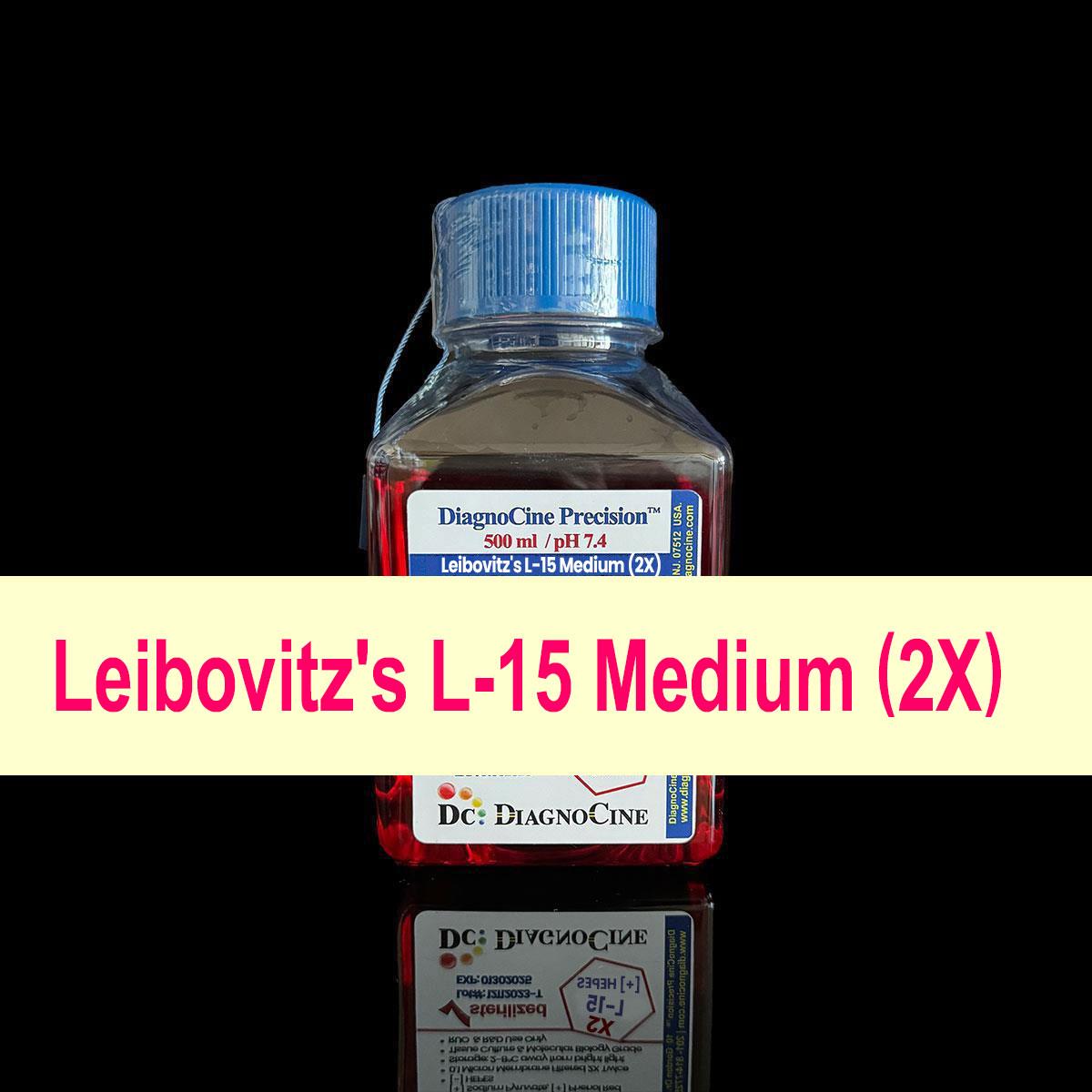
Leibovitz's L-15 Medium, 2X
Select L-15Medium2X
- see the table below
FluxMPS™ Leibovitz's L-15 Medium, 2X Family
Leibovitz's Medium was specifically designed to grow cells in a CO2-free atmosphere. The standard sodium bicarbonate/CO2 buffering system is replaced by a combination of free basic amino acids, phosphate buffers and higher levels of galactose and sodium pyruvate, so the medium does not require supplementation with sodium bicarbonate and can be used under conditions of free gaseous exchange with the atmosphere. FluxMPS™ supplies it as a 2X liquid in sixteen supplement configurations, purified through a quadruple-stage filtration architecture to 0.04 microns for organ-on-chip, tissue-on-chip and lab-on-chip workflows.
- Sixteen 2X liquid configurations in two parallel series — a canonical CO2-free series (DCP-LL152X…) and a 25 mM HEPES series (DCP-LL15H2X…) — varying by L-Glutamine, Sodium Pyruvate, HEPES and Phenol Red.
- No sodium bicarbonate at all — buffering comes from high concentrations of free-base L-arginine, L-histidine and L-cysteine together with an elevated Na2HPO4/KH2PO4 phosphate system, holding an operating pH near 7.0–7.4.
- D-Galactose replaces D-glucose at 900 mg/L; slower galactose metabolism via the Leloir pathway, paired with an elevated sodium pyruvate level of 550 mg/L, reduces lactic-acid output so the medium resists acidification in open air.
- Exceptionally high amino acid density — several times that of MEM or RPMI-1640 — with L-arginine, L-histidine and L-cysteine supplied as free bases so they can act as physiological buffers. L-15 contains no proline.
- Purified to 0.04 microns — finer than any ready-to-use cell culture media currently available — through two 0.1 micron pre-filtration stages and two 0.04 micron sterile-filtration stages.
- Validated across CO2-free workflows — human tumor and embryonic cells, HeLa and HEp-2, diagnostic virology, L929, MRC-5, LLC-MK2, neuronal and glial isolation, poikilothermic lines such as RTG-2 and BF-2, and live-cell imaging. Leibovitz's medium obviates the need of frequent medium change.
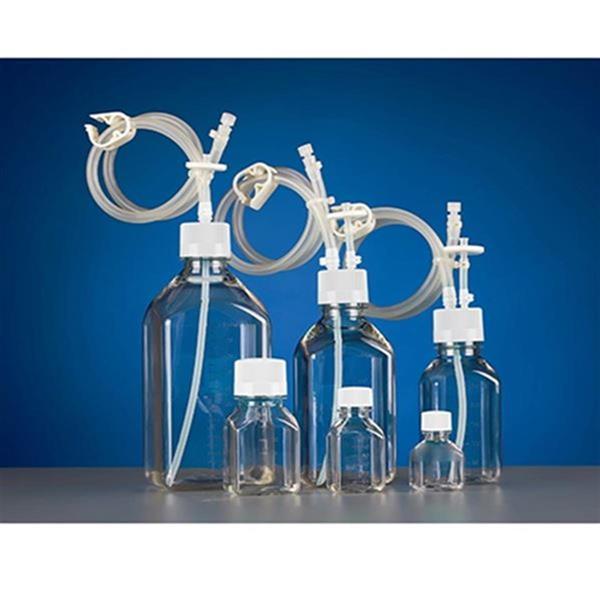
- 500 mL and 1000 mL sizes, stored at 2–8 °C away from bright light; concentration, galactose, HEPES, pH and supplement customizations available on request.
- Concentration2X standard concentration
- Primary carbohydrateD-Galactose 900 mg/L
- Sodium bicarbonate0 mg/L (none)
- BufferingFree-base AA + phosphate
- Operating pH~7.0 - 7.4
- Sodium pyruvate (where incl.)550 mg/L
- L-Glutamine (where incl.)300 mg/L
- HEPES (HEPES series)25 mM
- Gas phaseAtmospheric air, no CO2
- Configurations16
- Sizes500 mL, 1000 mL
- Storage2-8 C, away from light
Sixteen L-15 2X configurations — filter by the supplements you need
Tick the supplement or supplements your protocol requires and press Search; every configuration that includes all of them is highlighted, and Clear resets the table. Each row links straight through to its product page from both the catalog number and the View button. The source table's Special column carries no entries for this family, so it is not reproduced as a column here. One source-level note is preserved rather than corrected: the first row's catalog entry carries product ID 87190 and a product URL ending -2X-Liquid-Cell-Culture-Medium, outside the 954xx sequence used by the other fifteen configurations; it is reproduced exactly as published.
| Name | Cat No. | L-Glutamine | Sodium Pyruvate | HEPES | Phenol Red | Product Page |
|---|---|---|---|---|---|---|
| L-15source catalog ID 87190; product URL differs from the 954xx sequence | DCP-LL152X | check | check | remove | check | Viewarrow_forward |
| L-15 w/o Glutamine | DCP-LL15-Q2X | remove | check | remove | check | Viewarrow_forward |
| L-15 w/o Pyruvate | DCP-LL15-P2X | check | remove | remove | check | Viewarrow_forward |
| L-15 w/o Phenol Red | DCP-LL15-R2X | check | check | remove | remove | Viewarrow_forward |
| L-15 w/o Glutamine, Pyruvate | DCP-LL15-QP2X | remove | remove | remove | check | Viewarrow_forward |
| L-15 w/o Glutamine, Phenol Red | DCP-LL15-QR2X | remove | check | remove | remove | Viewarrow_forward |
| L-15 w/o Pyruvate, Phenol Red | DCP-LL15-PR2X | check | remove | remove | remove | Viewarrow_forward |
| L-15 w/o Glutamine, Pyruvate, Phenol Red | DCP-LL15-QPR2X | remove | remove | remove | remove | Viewarrow_forward |
| L-15 + HEPES | DCP-LL15H2X | check | check | check | check | Viewarrow_forward |
| L-15 + HEPES w/o Glutamine | DCP-LL15H-Q2X | remove | check | check | check | Viewarrow_forward |
| L-15 + HEPES w/o Pyruvate | DCP-LL15H-P2X | check | remove | check | check | Viewarrow_forward |
| L-15 + HEPES w/o Phenol Red | DCP-LL15H-R2X | check | check | check | remove | Viewarrow_forward |
| L-15 + HEPES w/o Glutamine, Pyruvate | DCP-LL15H-QP2X | remove | remove | check | check | Viewarrow_forward |
| L-15 + HEPES w/o Glutamine, Phenol Red | DCP-LL15H-QR2X | remove | check | check | remove | Viewarrow_forward |
| L-15 + HEPES w/o Pyruvate, Phenol Red | DCP-LL15H-PR2X | check | remove | check | remove | Viewarrow_forward |
| L-15 + HEPES w/o Glutamine, Pyruvate, Phenol Red | DCP-LL15H-QPR2X | remove | remove | check | remove | Viewarrow_forward |
Formulated for CO2-free gas-phase environments and fastidious cell systems
Leibovitz's L-15 Medium is a chemically defined synthetic basal formulation developed in 1963 by Albert L. Leibovitz. It is a fundamental departure from classical media design: it operates entirely without a sodium bicarbonate / carbon dioxide (NaHCO3/CO2) buffering system. Engineered to sustain cell lines, primary explants and fastidious tissues in free gas exchange with ordinary atmospheric air, its distinctiveness rests on two changes — it replaces D-glucose with D-galactose, and it replaces bicarbonate buffering with a combination of high concentrations of free-base amino acids (chiefly L-arginine, L-histidine and L-cysteine) and an elevated phosphate buffer system (Na2HPO4 and KH2PO4).
Slower galactose metabolism reduces the rapid accumulation of lactic acid typical of glucose-driven glycolysis, so the medium resists acidification in open air. This makes it a benchmark for CO2-free cell maintenance, diagnostic virology and specimen transport, neural tissue isolation, live-cell imaging, and the culture of cold-blooded (poikilothermic) animal cells. The medium can be used to grow human tumor cells and embryonic cells and also established cell lines like HeLa and Hep-2, and it is frequently used in diagnostic virology where tissue cell lines or strains need to be grown in closed systems. Leibovitz's medium obviates the need of frequent medium change.
Albert Leibovitz and the CO2 infrastructure problem
In the early 1960s, cell culture depended on specialized CO2 incubators or tightly sealed, gas-flushed vessels to hold physiological pH (7.2–7.4) in bicarbonate-buffered media. That requirement made field collection, diagnostic processing, large-scale viral work and viable-specimen transport logistically demanding. Working at the Southwest Foundation for Research and Education (San Antonio, Texas), Albert L. Leibovitz set out to build a basal medium that could support long-term proliferation and viral replication under ordinary atmospheric conditions, without supplemental carbon dioxide.
The 1963 paper
The formulation was published as Leibovitz, A. (1963), "The growth and maintenance of tissue cultures in free gas exchange with the atmosphere," American Journal of Hygiene 78(2): 173–180.[1] Leibovitz recognized that the main driver of rapid acidification in open air was lactic acid from glucose glycolysis. By omitting glucose and substituting D-galactose — which is metabolized more slowly via the Leloir pathway — along with elevated sodium pyruvate, he reduced organic acid output, and he paired this with free-base basic amino acids and phosphate to buffer the medium without bicarbonate.
Legacy in virology and tissue work
L-15 supported established lines and primary human explants directly in unsealed, room-air vessels, and it became a standard for diagnostic virology, where host monolayers must be maintained in closed systems without gas monitoring. It later became a default base for neurobiology dissection and isolation under open-hood conditions, for poikilothermic (fish, amphibian, reptile) cell lines cultured at room temperature without CO2,[2] and for live-cell / time-lapse microscopy on open-atmosphere stages.
Where L-15 sits among cell culture media
L-15 is defined less by descent from another formulation than by what it deliberately removes. Its position is best understood against the bicarbonate-buffered mainstream it was built to escape.
- The bicarbonate-buffered mainstream (the constraint) — classical media hold physiological pH through a NaHCO3/CO2 system and therefore require a CO2 incubator or sealed, gas-flushed vessels. Buffer selection for mammalian cell culture is treated directly in the classical literature.[3]
- L-15, 1963 (the departure) — a chemically defined synthetic basal formulation that removes bicarbonate entirely and substitutes free-base amino acid plus phosphate buffering, with D-galactose in place of D-glucose.
- Amino acid density — L-15's amino acid content is exceptionally high, several times that of MEM or RPMI-1640, because those amino acids serve a buffering role as well as a nutritional one.
- Poikilothermic cell lines — L-15 became preferred for fish, amphibian and reptile cells grown at room temperature without CO2, a lineage of work that traces to the establishment of eurythermic fish cell lines in vitro.[2]
- Position in media history — L-15 is a recognized landmark in the broader development of animal-cell culture media.[4]
Standard L-15 formulation
Values below are the canonical Leibovitz L-15 formulation as supplied by HiMedia (AT011A, base; AL011A, with L-glutamine) and its US distributor Diagnocine, cross-checked against Sigma-Aldrich (L4386) and Gibco/Thermo Fisher. Values are mg/L. Salts are shown in anhydrous form for comparability; HiMedia lists several as hydrated salts of equivalent molar amount, noted below the table. L-15 is supplied both with and without L-glutamine; the with-glutamine version carries 300 mg/L. These are the canonical Leibovitz L-15 formulation values as published; the source does not state separate per-liter values for the 2X format, and none are inferred here. The customization specification for this family records 2X standard concentration.
L-15 contains no sodium bicarbonate. Buffering under ambient air is instead provided by an elevated sodium/potassium phosphate system together with free-base amino acids. Note the unusual presence of both magnesium chloride and magnesium sulfate, as well as the high sodium chloride level.
| Ingredient | mg/L |
|---|---|
| Calcium Chloride, anhydrous (CaCl2) | 140.00 |
| Magnesium Chloride, anhydrous (MgCl2) | 93.66 |
| Magnesium Sulfate, anhydrous (MgSO4) | 97.67 |
| Potassium Chloride (KCl) | 400.00 |
| Potassium Phosphate Monobasic, anhydrous (KH2PO4) | 60.00 |
| Sodium Chloride (NaCl) | 8000.00 |
| Sodium Phosphate Dibasic, anhydrous (Na2HPO4) | 190.00 |
L-15's amino acid content is exceptionally high, several times that of MEM or RPMI-1640. Critically, L-arginine, L-histidine and L-cysteine are supplied as free bases so they can act as physiological buffers. L-15 contains no proline.
| Ingredient | mg/L |
|---|---|
| Glycine | 200.00 |
| L-Alanine | 225.00 |
| L-Arginine (free base) | 500.00 |
| L-Asparagine, anhydrous | 250.00 |
| L-Cysteine (free base) | 120.00 |
| L-Glutamine | 300.00 |
| L-Histidine (free base) | 250.00 |
| L-Isoleucine | 125.00 |
| L-Leucine | 125.00 |
| L-Lysine hydrochloride | 93.70 |
| L-Methionine | 75.00 |
| L-Phenylalanine | 125.00 |
| L-Serine | 200.00 |
| L-Threonine | 300.00 |
| L-Tryptophan | 20.00 |
| L-Tyrosine (free base) | 300.00 |
| L-Valine | 100.00 |
L-15 carries a lean, consolidated vitamin set for steady-state maintenance. Two forms are distinctive to L-15: riboflavin is supplied as flavin mononucleotide (FMN, riboflavin-5'-phosphate sodium) and thiamine as thiamine monophosphate rather than the more common thiamine HCl.
| Ingredient | mg/L |
|---|---|
| Choline chloride | 1.00 |
| D-Calcium pantothenate | 1.00 |
| Folic acid | 1.00 |
| myo-Inositol | 2.00 |
| Niacinamide | 1.00 |
| Pyridoxine hydrochloride | 1.00 |
| Riboflavin-5'-phosphate, sodium (FMN·Na) | 0.10 |
| Thiamine monophosphate | 1.00 |
The metabolic core of L-15 is the exclusion of glucose. D-Galactose serves as the hexose, and an elevated sodium pyruvate level supplies direct energy to the citric acid cycle, together slowing lactic-acid generation.
| Ingredient | mg/L |
|---|---|
| D-Galactose | 900.00 |
| Phenol red sodium salt | 10.00 |
| Sodium pyruvate | 550.00 |
Physical specifications
| Appearance (powder) | Off-white to creamish homogeneous powder |
| Operating pH | ~7.0 - 7.4 |
| Osmolality | ~300 - 340 mOsm/kg H2O (Gibco specification) |
| Storage | 2-8 C, protected from light |
Leibovitz's L-15 vs. key counterparts
How the CO2-free design differs from the three bicarbonate-buffered media most often considered alongside it.
| Feature | Leibovitz's L-15 | Williams' Medium E | DMEM (High-Glucose) | RPMI-1640 |
|---|---|---|---|---|
| Buffering strategy | CO2-free: free-base amino acids + phosphate | Bicarbonate / CO2 (2.2 g/L NaHCO3) | Bicarbonate / CO2 (3.7 g/L NaHCO3) | Bicarbonate / CO2 (2.0 g/L NaHCO3) |
| Primary carbohydrate | D-Galactose (900 mg/L) | D-Glucose (2000 mg/L) | D-Glucose (4500 mg/L) | D-Glucose (2000 mg/L) |
| Sodium bicarbonate | 0 mg/L (none) | 2200 mg/L | 3700 mg/L | 2000 mg/L |
| Sodium pyruvate | High (550 mg/L) | Low (25 mg/L) | Optional add-on | Absent (standard) |
| Amino acid density | Exceptionally high, free-base buffering profile | Balanced NEAA matrix | High essential profile | Standard suspension profile |
| Intended gas phase | Atmospheric air (no CO2) | 5–10% CO2 | 5–10% CO2 | 5% CO2 |
Built for the architecture of the future. Not the flask of the past.
Traditional cell culture media were formulated for static well plates and flasks — environments that tolerate impurities, precipitates and particle loads that would immediately compromise a microfluidic system. FluxMPS™ was designed from the ground up for platforms where the medium itself is part of the instrument.
Purified to 0.04 microns
Finer than any ready-to-use cell culture media currently available. Microscopic particulates and protein aggregates are eliminated before the media ever reaches your chip.
Engineered for flow, not just growth
Every component is optimized for consistent, laminar flow performance across complex micro-channel geometries and capillary-bed or vascular simulations.
Zero-clogging as a baseline
Zero-clogging performance is not a feature — it is the baseline specification. Your platform stays operational and your data stays clean.
Optical clarity for live imaging
Optical clarity for real-time imaging and integrated biosensing — directly complementing L-15's role as an open-atmosphere time-lapse microscopy medium.
Stability over long perfusion runs
Consistent formulation stability over weeks of continuous flow, supporting long-term automated perfusion studies that run without interruption.
Configurable to your protocol
Sixteen stocked L-15 2X configurations, plus other concentrations, added compounds, proteins, supplements, a different pH and further modifications on request.
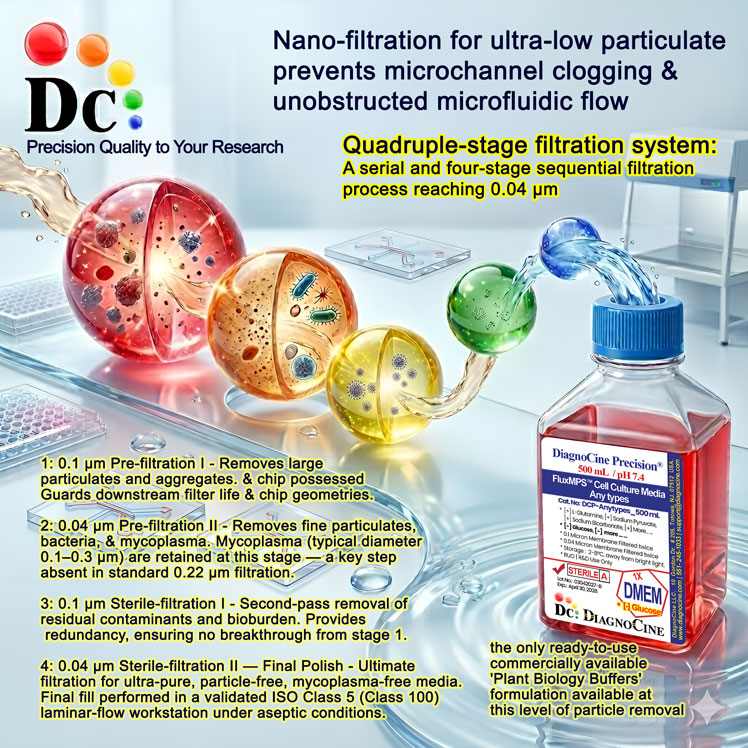
Quadruple-stage filtration
FluxMPS™ media pass through four sequential filtration stages — two 0.1 micron pre-filtration stages followed by two 0.04 micron sterile-filtration stages.
-
01
0.1 micronPre-filtration, stage 1
First reduction of the particulate and aggregate load carried by a freshly formulated medium.
-
02
0.1 micronPre-filtration, stage 2
Second pass at the same rating, conditioning the stream before the sterile stages.
-
03
0.04 micronSterile filtration, stage 3
The stage that takes the medium below the threshold at which micro-channel blockage and flow disruption originate.
-
04
0.04 micronSterile filtration, stage 4
Final pass delivering media purified to 0.04 microns — finer than any ready-to-use cell culture media currently available.
Why 0.04 microns matters for L-15 workflows
L-15 is the medium of choice precisely where cultures run long and open — prolonged time-lapse observation, extended specimen transport, perfusion without gas monitoring. Those are the conditions in which accumulated particulates and protein aggregates cause channel blockage, disrupted laminar flow and false biological signals. Filtering below that threshold protects the platform and the optical readout, not just the culture.
Where L-15 is the medium of record
Six workflows in which the absence of a bicarbonate/CO2 requirement is not a convenience but the enabling condition.
CO2-free explant and specimen transport
A common vehicle for collecting, storing and shipping primary tissue biopsies and diagnostic viral swabs without pH drift.
Diagnostic virology
Long-term maintenance of host monolayers in closed or open systems for viral isolation without gas monitoring.
Continuous and primary lines in atmospheric culture
Supports lines such as HEp-2, L929, MRC-5 and LLC-MK2, as well as primary explants of embryonic and adult human tissue, in open-air or gas-permeable systems, including human tumor cells.
Primary neuronal and glial isolation
Widely used for dissection and manipulation of brain tissue under ambient hood conditions.
Cold-blooded animal cell biology
Preferred for fish, amphibian and reptile cells grown at room temperature in the absence of CO2.
Live-cell imaging and time-lapse microscopy
A practical imaging medium for prolonged open-atmosphere observation where CO2 enclosures are impractical.
Working with L-15 in the laboratory
Four handling points determine whether an L-15 culture behaves as the CO2-free design intends.
Galactose adaptation
Shifting glucose-adapted lines from DMEM or RPMI into L-15 can cause a transient lag as cells upregulate galactose-metabolizing enzymes (Leloir pathway); a stepwise adaptation is sometimes needed.
Do not use a CO2 incubator
With no bicarbonate to buffer it, ambient CO2 dissolving into the medium will severely acidify it. L-15 cultures belong in a standard, non-CO2-injected incubator or in sealed / vented vessels in air.
Requires supplementation
L-15 contains no proteins, lipids or growth factors; it is typically supplemented with serum, commonly around 10% FBS, or with defined supplements for a given cell type.
Light sensitivity
FMN (riboflavin phosphate) and other components are light-sensitive; store in the dark, at 2–8 °C away from bright light.
Frequently asked questions
Selection, formulation and handling questions researchers ask most often about FluxMPS™ Leibovitz's L-15 Medium, 2X.
L-15 operates entirely without a sodium bicarbonate / carbon dioxide buffering system. Its distinctiveness rests on two changes: it replaces D-glucose with D-galactose, and it replaces bicarbonate buffering with a combination of high concentrations of free-base amino acids — chiefly L-arginine, L-histidine and L-cysteine — together with an elevated phosphate buffer system (Na2HPO4 and KH2PO4). Slower galactose metabolism reduces the rapid accumulation of lactic acid typical of glucose-driven glycolysis, so the medium resists acidification in open air and can be used under conditions of free gaseous exchange with the atmosphere.
No. With no bicarbonate to buffer it, ambient CO2 dissolving into the medium will severely acidify it. L-15 cultures belong in a standard (non-CO2-injected) incubator, or in sealed or vented vessels in air. The medium does not require supplementation with sodium bicarbonate, and the operating pH is maintained near 7.0–7.4.
The metabolic core of L-15 is the exclusion of glucose. D-galactose serves as the hexose and an elevated sodium pyruvate level supplies direct energy to the citric acid cycle, together slowing lactic-acid generation. Galactose is metabolized more slowly via the Leloir pathway. Shifting glucose-adapted lines out of DMEM or RPMI into L-15 can therefore cause a transient lag as cells upregulate galactose-metabolizing enzymes; a stepwise adaptation is sometimes needed.
Start from the variables your protocol constrains. Select a configuration without L-Glutamine when you intend to add glutamine yourself or substitute a stabilized dipeptide. Select a configuration without sodium pyruvate when pyruvate would interfere with your metabolic readout. Select a configuration without phenol red for fluorescence and estrogen-sensitive readouts, and for prolonged imaging. Select a HEPES-containing configuration when additional pH control is wanted on top of the phosphate and free-base amino acid buffering. Check the supplements you require in the filter above and press Search; every matching configuration is highlighted with its catalog number and product page link.
The FluxMPS™ L-15 2X catalog is organized as two parallel series of eight configurations each. The first series carries the canonical Leibovitz buffering alone — free-base amino acids plus the elevated phosphate system, with no bicarbonate and no HEPES. The second series adds a 25 mM HEPES buffer on top of it. Within each series the same three variables are offered in every combination: L-Glutamine, Sodium Pyruvate and Phenol Red. Use the supplement filter to check HEPES if your workflow calls for the zwitterionic buffer, or leave it unchecked to see the canonical series.
Yes. L-15 contains no proteins, lipids or growth factors; it is typically supplemented with serum — commonly around 10% FBS — or with defined supplements chosen for the cell type in question. L-15 is supplied both with and without L-glutamine, and the with-glutamine version carries 300 mg/L.
L-15 is a practical imaging medium for prolonged open-atmosphere observation where CO2 enclosures are impractical, and it is widely used for time-lapse microscopy. FluxMPS™ media are purified to 0.04 microns — finer than any ready-to-use cell culture media currently available — through two 0.1 micron pre-filtration stages followed by two 0.04 micron sterile-filtration stages. At this level the microscopic particulates and protein aggregates that silently block micro-channels, disrupt laminar flow and generate false biological signals are eliminated before the media ever reaches the chip, and the resulting optical clarity supports real-time imaging and integrated biosensing.
These sixteen configurations are supplied at 2X standard concentration, as stated in the source customization specification, in 500 mL and 1000 mL sizes. The composition table on this page reproduces the canonical Leibovitz L-15 formulation values published in the supplier technical data; the source does not state separate per-liter values for the 2X format, and none are inferred here. Store at 2–8 °C, away from bright light; FMN (riboflavin phosphate) and other components are light-sensitive. The customization specification records 2X standard concentration, 900 mg/L standard galactose concentration and 25 mM standard HEPES buffer concentration; other concentrations, additions of chemicals, compounds, proteins and supplements, a different pH, and modifications as needed are available on request from support@diagnocine.com.
Verified references
The primary literature and authoritative supplier formulations underlying the descriptions and composition tables on this page.
- Leibovitz A. The growth and maintenance of tissue cultures in free gas exchange with the atmosphere. Am J Hyg. 1963;78(2):173–180.
- Wolf K, Quimby MC. Established eurythermic line of fish cells in vitro. Science. 1962;135(3508):1065–1066. doi:10.1126/science.135.3508.1065
- Eagle H. Buffer combinations for mammalian cell culture. Science. 1971;174(4008):500–503. doi:10.1126/science.174.4008.500
- Review — Yao T, Asayama Y. Animal-cell culture media: history, characteristics, and current issues. Reprod Med Biol. 2017;16(2):99–117. doi:10.1002/rmb2.12024
FluxMPS™ — Precision Cell Culture Media for Microphysiological Systems
Built for the architecture of the future. Not the flask of the past.
Traditional cell culture media were formulated for static well plates and flasks — environments that tolerate impurities, precipitates, and particle loads that would immediately compromise a microfluidic system. FluxMPS™ was designed from the ground up for Organ-on-Chip (OoC), Tissue-on-Chip (ToC), and Lab-on-Chip (LoC) platforms, where the medium itself is part of the instrument.
Purity That Protects Your Platform
FluxMPS™ is purified to 0.04 microns — finer than any ready-to-use cell culture media currently available. At this level, the microscopic particulates and protein aggregates that silently block micro-channels, disrupt laminar flow, and generate false biological signals are eliminated before the media ever reaches your chip.
The result: your platform stays operational, your data stays clean, and your biology drives the result — not your media.
Engineered for Flow, Not Just Growth
The name FluxMPS™ reflects its core design principle. Every component is optimized for consistent, laminar flow performance across:
- Complex micro-channel geometries
- Capillary-bed and vascular simulations
- Long-term automated perfusion studies running continuously for weeks
Zero-clogging performance is not a feature — it is the baseline specification.
Applications & Performance
| Application | What FluxMPS™ Delivers |
|---|---|
| Microfluidics | Stable shear stress; no channel blockage |
| Metabolic Tracing | Ultra-pure matrix with no contaminant interference |
| Long-term Perfusion | Consistent formulation stability over weeks of continuous flow |
| Organ-on-Chip | Optical clarity for real-time imaging and integrated biosensing |
Regulatory Foundation
FluxMPS™ is formulated to support FDA-recognized physiological modeling standards, providing a validated, reproducible media foundation for drug discovery, toxicology screening, and translational research. When your downstream data needs to stand up to regulatory scrutiny, your upstream media cannot be an afterthought.
The Bottom Line
Microfluidic platforms are precision instruments. They require precision inputs.
FluxMPS™ is the only ready-to-use cell culture medium engineered specifically to meet that standard — protecting your chip, your cells, and your science.