
Benzonase Nuclease
Select ServiceBio
- See below table
Description:
Benzonase Nuclease, also known as broad-spectrum Nuclease, is a nonspecific endonuclease derived from Serratia Marcescen. This endonuclease can attack and degrade all forms of DNA and RNA (single-stranded, double-stranded, linear, cyclized) under very broad conditions, cutting at any position within the nucleic acid chain, and completely degrading the nucleic acid to 5 '-monophosphate-oligonucleotide 3-5 bases in length. The working pH range is pH 6-10, the optimum pH is 8.0, the working temperature range is 0-42℃, the optimum temperature is 37℃. Benzonase Nuclease is widely used to remove nucleic acids from recombinant proteins, viral vaccines and other biological products. Benzonase Nuclease can effectively reduce the viscosity of protein lysates such as cells, tissues and microorganisms.
| Image | Cat.No: | Size | Storage | Link |
 |
SB-G3461-50KU | 200μL | Transport with wet ice; Store at -20℃, valid for 12 months. |  |
| SB-G3406-50KU | 50KU | |
- Definition of enzyme activity: The amount of enzyme required to change △A260 absorption value by 1.0 (equivalent to complete digestion of 37 μg salmon sperm DNA as oligonucleotide) in 2.625 mL reaction system at 37℃, pH 8.0, within 30 min was defined as one enzyme active unit.
- Purity: ≥95% by SDS-PAGE, no protease, ≥250 U/μL.
- Enzyme storage buffer: 20 mM Tris-HCl, 2 mM MgCl2 , 2 mM NaCl, 50% Glycerol, pH 8.0.
- Dilution buffer : 20 mM Tris-HCl, 2 mM MgCl2 , 2 mM NaCl, pH 8.0.
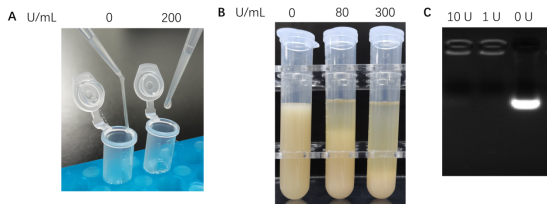
Figure 1. Effect diagram of the use of Benzonase nuclease. A. After analysis of 293 cells by RIPA lysate, a large amount of genomic DNA was released from the samples without the addition of Benzonase nuclease and was viscous, while the samples with the addition of Benzonase nuclease were not viscous because the released genomic DNA was degraded; B. Add 5 mL RIPA lysate to 1 g of E. coli wet bacteria, mix well, and add appropriate amount of Benzonase nuclease (0, 80, 300 U/mL ) respectively. Take photos for observation after treatment at room temperature for 30 min; C. Take 40 μg of salmon sperm DNA, add an appropriate amount of Benzonase nuclease, and incubate at 37°C for 30 min to detection on agarose gel.
Assay Protocol / Procedures
1. For reducing the viscosity of cell, tissue or bacterial lysate:
Cell samples: A, Adherent cell samples were washed again with PBS after removal of medium. 1-2 μL of Benzonase nuclease was added to 1 mL of RIPA lysate ( G2033, G2002 was recommended ) and then used for analysis of adherent cells according to The instructions for the lysate. After incubation at room temperature or on ice for 5-30 min, the lysate was collected and centrifuged, and the supernatant was taken for subsequent experiments.
B, Supernatant was removed by centrifugation of the suspended cell sample. 1-2 μL of Benzonase nuclease was added to 1 mL of RIPA lysate ( G2033, G2002 was recommended ) and then used for analysis of suspended cells according to the instructions for use of the lysate. After incubation at room temperature or on ice for 5-30 min, the lysate was collected and centrifuged, and the supernatant was taken for subsequent experiments.
Tissue samples: Tissue blocks were washed with pre-cooled PBS to remove blood stains and cut into small pieces. 1 mL lysate ( G2033, G2002 was recommended ) was added per 50 mg of tissue, and 1-2 μL of Benzonase nuclease was added at the same time. The tissue was ground with a lapping instrument ( KZ-III, KZ-III-F, KZ-III-FP was recommended) until full cleavage. After sufficient tissue analysis, the tissue was incubated for 5-30 min At room temperature or on ice, the lysate was collected and centrifuged, and the supernatant was taken for subsequent experiments.
Bacterial and fungal sam ples: Bacteria or fungi are collected after centrifugation. 1-2 μL of Benzonase nuclease was added to 1 mL lysate (G2033, G2002 was recommended). Then the lysate is used for bacterial or fungal lysis according to the instructions for use. After incubation at room temperature or on ice for 5-30 min, the lysate was collected and centrifuged, and the supernatant was taken for subsequent experiments.
Note: The commonly used lysates contain different concentrations of Triton X-100 or NP-40, SDS and sodium deoxycholate, etc. These reagents have certain effects on the Benzonase nuclease, so it is necessary to increase the amount of enzyme appropriately or pro long the Incubation time for different experiments .
2. For improving the renaturation rate of inclusion body protein: it is recommended that the concentration of Benzonase nuclease in cell lysate is 1 U/mL, which can effectively reduce the protease adhesion due to genomic DNA, improve the purity of inclusion bodies, and Finally improve the renaturation rate of inclusion body proteins.
Note:
- Mg2+ is the key catalytic cofactor of universal nuclease, and the reaction buffer containing 1-2 mM Mg2+ is necessary for the activity of Benzonase nuclease.
- The recommended conditions for the use of all-purpose nuclease are shown in the following table.
- For your safety and health, please wear lab coat and disposable gloves when operating.