Anti-SOD1(ALS-related mutants), Human, Rat-Mono (MS27)
Anti-SOD1 (ALS-related mutants) Cocktail, Human, Rat-Mono (MS27)
DiagnoCine offers excellent SOD1 antibody to researchers studying pathways involving binding of copper and zinc ion, free superoxide radicals in the body, and familial amyotrophic lateral sclerosis.
Human diseases associated with SOD1 include Amyotrophic Lateral Sclerosis 1 (ALS), Spastic Tetraplegia, and Axial Hypotonia.
The anti-SOD1 antibody has excellent quality and this highly pure antibody can be adapted for Western Blots, ELISA, Immunohistochemistry, Immunofluorescence research with optimization.
- Anti-SOD1 (ALS-related mutants) Cocktail, Human, Rat-Mono (MS785)
- Anti-SOD1 (ALS-related mutants) Cocktail, Human, Rat-Mono (MS27)
- Anti-SOD1 (ALS-related mutants) Cocktail, Human, Rat-Mono (MS785/MS27)
General information
| Cat. No. | :FNK-FDV-0021C |
| Size | :100 μg |
| Form | :FDV-0021C (100 μg of MS27) |
| Concentration | :0.5 mg/ml |
| Volume | :200 μL |
| Clone No. | :MS27 |
| Host Species and Clonality | :Rat monoclonal |
| Isotype and Subclass | :Clone MS27 IgG2a/μ |
| Formulation | :1x Phosphate Buffered Saline (PBS) containing 50% glycerol |
| Purification | :Protein G Purified |
| Specificity | :Clone MS785 human SOD1 8-14 amino acids :Clone MS27 human SOD1 30-40 amino acids |
| Application | :1. Immunoprecipitation to detect mutant SOD1s :2. Immunocytochemistry and immunohistochemistry to detect mutant SOD1s :3. ELISA to detect mutant SOD1s :4. Western blotting to detect both mutant and wild-type SOD1 :5. Immunoprecipitation to detect wild type SOD1 under the zinc-related ER-stress |
| Shipping and Storage | :Ship at 4℃ and store at -20℃. Avoid repeated freeze-thaw cycles |
Background
SOD1 (Cu/Zn superoxide dismutase) is a ubiquitously expressed protein and generally forms homo-dimer. Its primary function is thought to be as a cytosolic and mitochondrial antioxidant enzyme, converting superoxide to molecular oxygen and hydrogen peroxide. Many lines of evidence suggest that SOD1 is one of the major causative genes of Amyotrophic Lateral Sclerosis (ALS), which is a fatal adult-onset neurodegenerative disease. Although nearly 90% of ALS cases are caused sporadically, around 10% of ALS cases are familial and of the familial ALS ~20% are caused by genetic mutation of SOD1. Over 100 mutations in SOD1 have been reported so far, and transgenic mice bearing some mutant SOD1s such as G93A and A4V are frequently used as ALS model animals. However, pathophysiological functions of mutant SOD1 are still unclear. Elucidation of the causal relationship between mutation of SOD1 and ALS is a topic of neuropathology to develop medicines of SOD1-related ALS pathogenesis.
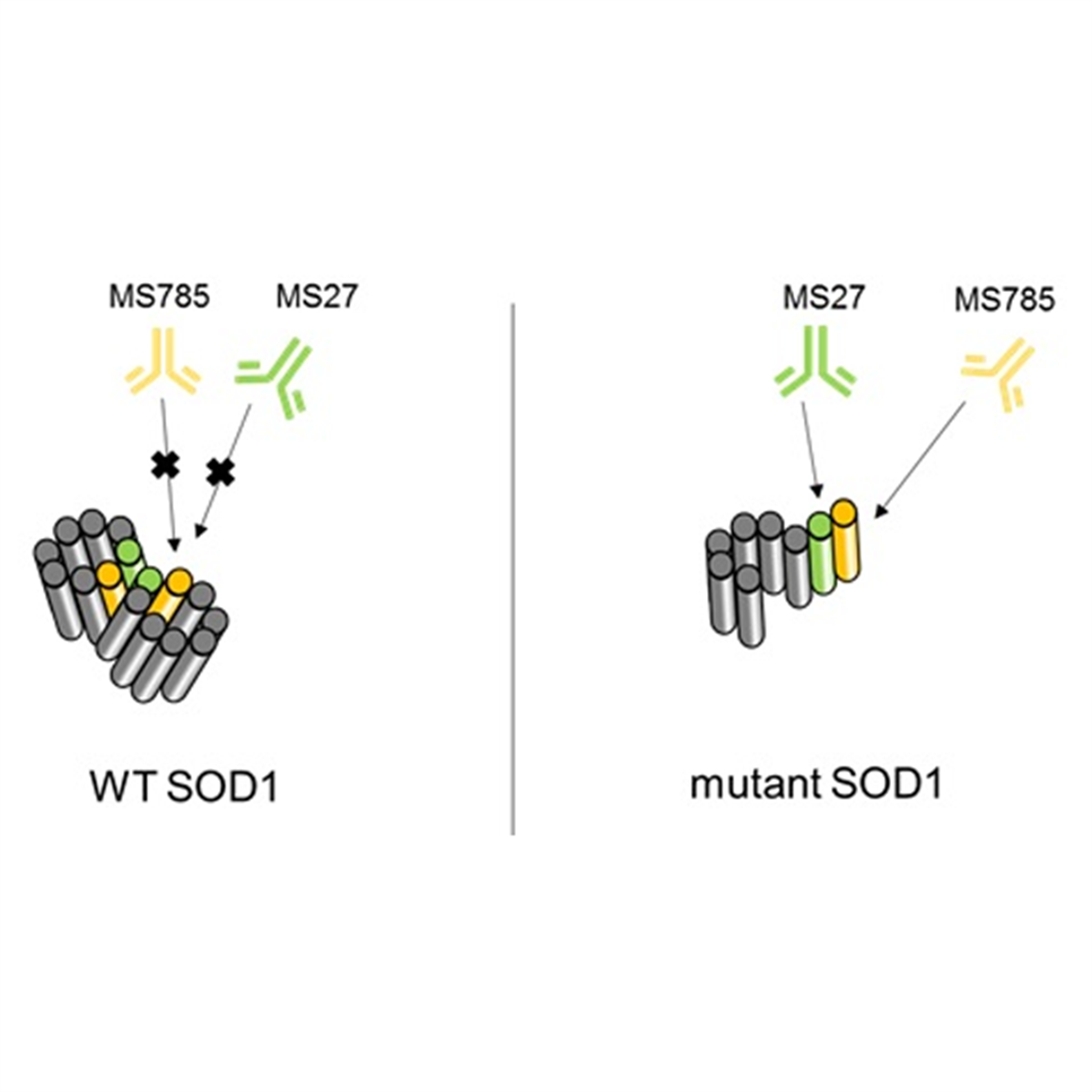
Recent progresses show that SOD1 mutant proteins causes ALS through a gain of toxic function. Prof. Ichijo and co-workers reported almost all SOD1 mutants cause a similar conformational change, and acquire neural toxicity through a binding to Derlin-1, an ER-associated degradation (ERAD) machinery protein Ref.1 . They also developed the novel rat monoclonal anti-SOD1 antibodies, clone MS785 and MS27, which specifically bind to conformationally altered SOD1 mutants, not detecting wild type SOD1 homo-dimer (Fig.1). Although both clones are succeeded in specifically detecting over 100 SOD1 mutants Ref.2 , these antibodies failed to detect some specific mutants which have mutation located on each epitope region. Anti-SOD1 (ALS-related mutants) Cocktail is a cocktail of MS785 and MS27 and compensates the above problem. This product is a powerful tool to investigate pathophysiological roles of SOD1 mutants in ALS patients.
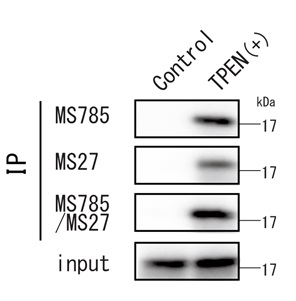
ALS is considered as an ER-stress disease. Zincdeficiency is one of the causes of ER-stress and depletion of zinc from SOD1 induces conformational change dramatically. Under the zinc-deficient condition, endogenous wild-type SOD1 takes the conformation similar with ALS-related mutants. Actually both MS785 and MS27 could recognize wild-type SOD1 under the zinc-deficiency specifically. These antibodies also powerful tools to investigate zinc-related ER-stress research.
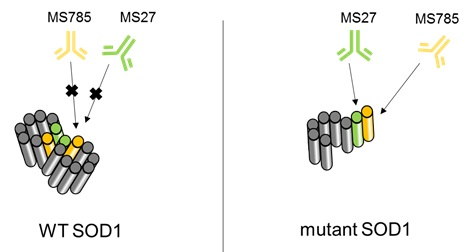
Fig. 1 SOD1 recognition by MS785 and MS27
Application data
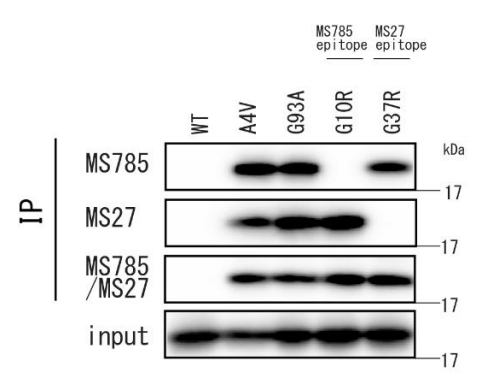
| Detection of SOD1 mutants by immunoprecipitation assay SOD1 wild type or mutants-expressing HEK293 cells were lysed by 1% Triton X100/TBS buffer. After lysis, add MS785 (5 μg), MS27 (2 μg) or cocktail (1 μg) and incubate for 12 hours. Subsequently, SOD1-antibody complexes were captured by Protein G-beads. Neither MS785 nor MS27 single detected some specific mutants which have the mutation on the antibody’s epitope. MS785/MS27 cocktail overcame this problem. Validated SOD1 mutants were listed in “Appendix” (see manual). |
 |
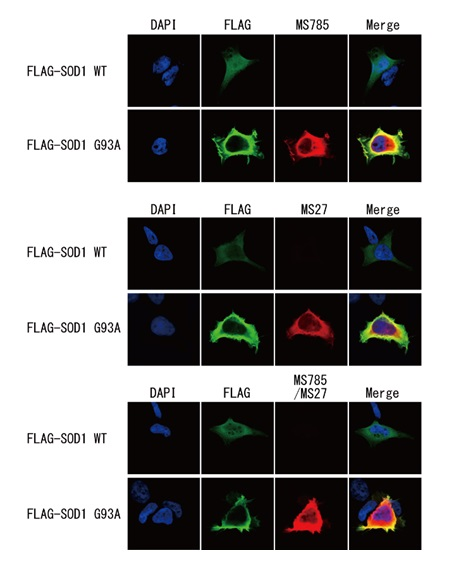
| Detection of SOD1 mutants by immunocytochemistry Flag-tagged SOD1 wild type (WT) or G93A mutant-expressing HEK293 cells were fixed with 4% paraformaldehyde/PBS for 10 min at R.T. Subsequently, cells were incubated with PBS containing 0.2% Triton X-100 for 5 min and washed three times with PBS. After blocking with PBS containing 5% BSA, cells were incubated with primary antibodies (1 ug/ml MS785, MS27 or cocktail) for 12 hours at 4 ℃, with secondary antibody for 2 hours at R. T. sequentially. Cells were washed and stained with DAPI. Although anti-FLAG antibody clearly visualized either WT and G93A mutant, MS785, MS27 and MS785/MS27 cocktail only detected G93A mutant. |
 |
| Detection of endogenous SOD1 wild type under ER-stress HEK293 cells were cultured in the presence and absence of 10 uM TPEN, a potent zinc-specific chelator, for 8 hours. After treatment, cells were lysed and immunoprecipitated with 1-5 μg of MS785, MS27 or cocktail. Subsequently, SOD1-antibody complexes were captured by Protein G-beads. Under the zinc-deficient ER-stress, these antibodies could recognize endogenous SOD1 wild type with mutant like conformation. |
 |
Product Information
|
Product Name |
Size |
Code |
Storage |
Maker |
|
Anti-SOD1(ALS-related mutants) Cocktail, Human, Rat-Mono (MS785/MS27) |
100 μg |
FDV-0021A |
-20 |
FNA |
|
100 μg |
FDV-0021B |
-20 |
FNA |
|
|
100 μg |
FDV-0021C |
-20 |
FNA |
References
- Fujisawa et al., Ann. Neurol., 72, 739-749 (2012) A novel monoclonal antibody reveals a conformational alteration shared by amyotrophic lateral sclerosis-linked SOD1 mutants.
- Fujisawa et al., Neurobiol. Dis., 82, 478-486 (2015) A systematic immunoprecipitation approach reinforces the concept of common conformational alterations in amyotrophic lateral sclerosis-linked SOD1 mutants.
Aliases for SOD1 Gene
- Superoxide Dismutase 1 2 3 4 5
- Superoxide Dismutase 1, Soluble 2 3
- Superoxide Dismutase [Cu-Zn] 3 4
- EC 1.15.1.1 4 51
- HSod1 3 4
- IPOA 2 3
- Amyotrophic Lateral Sclerosis 1 (Adult) 2
- Epididymis Secretory Protein Li 44 3
- Superoxide Dismutase, Cystolic 3
- Cu/Zn Superoxide Dismutase 3
- Indophenoloxidase A 3
- SOD, Soluble 3
- Homodimer 3
- HEL-S-44 3
- STAHP 3
- ALS1 3
- SOD1 5
- ALS 3
- SOD 3