Anti-Coxsackie Adenovirus Receptor/hCAR Rabbit Polyclonal Antibody
Anti-Coxsackie Adenovirus Receptor/hCAR Rabbit Polyclonal Antibody
General information
| Cat. No. | :SB-GB113658 |
| Size | :100 uL |
| Protein full name | :Coxsackievirus and adenovirus receptor homolog |
| Synonym | :CAR, CVB3 binding protein, CXADR, HCAR, HCVADR, mCAR, Coxsackie virus B receptor, 46 kD coxsackievirus and adenovirus receptor protein, CAR4/6 |
| Immunogen | :Recombinant protein corresponding to Mouse Coxsackie Adenovirus Receptor/hCAR |
| Isotype | :IgG |
| Purity | :Affinity purification |
| Predicted MW. | :40 kDa |
| Observed MW. | :50 kDa |
| Uniprot ID | :P78310, P97792 |
| Storage | :Store at -20 ℃ for one year. Avoid repeated freeze/thaw cycles. |
| Storage Buffer | :PBS with 0.02% sodium azide,100 μg/ml BSA and 50% glycerol. |
Application
| Applications | Species | Dilution | Positive Tissue |
| WB | Human, Mouse | 1: 1000-1: 2000 |
Caco-2, HepG2, HaCat, NIH/3T3 |
Description
Component of the epithelial apical junction complex that may function as a homophilic cell adhesion molecule and is essential for tight junction integrity. Also involved in transepithelial migration of leukocytes through adhesive interactions with JAML a transmembrane protein of the plasma membrane of leukocytes. The interaction between both receptors also mediates the activation of gamma-delta T-cells, a subpopulation of T-cells residing in epithelia and involved in tissue homeostasis and repair. Upon epithelial CXADR-binding, JAML induces downstream cell signaling events in gamma-delta T-cells through PI3-kinase and MAP kinases. It results in proliferation and production of cytokines and growth factors by T-cells that in turn stimulate epithelial tissues repair.
 |
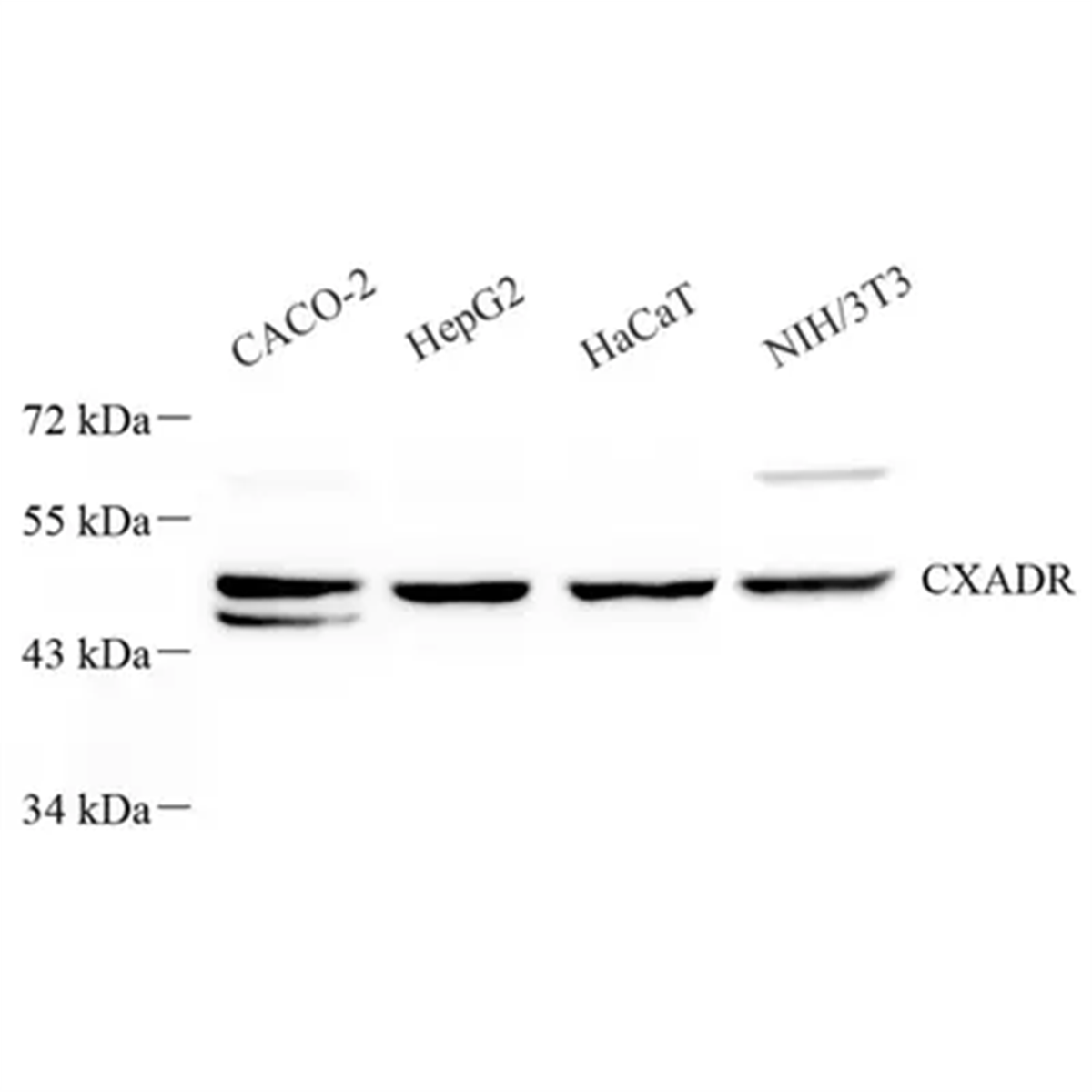
Western blot analysis of CXADR (GB113658) at dilution of 1: 2000 |
Aliases for CXADR Gene
- GeneCards Symbol: CXADR 2
- CXADR Ig-Like Cell Adhesion Molecule 2 3 5
- CAR 2 3 4 5
- Coxsackie Virus And Adenovirus Receptor 2 3
- Coxsackievirus And Adenovirus Receptor 3 4
- Coxsackievirus B-Adenovirus Receptor 3 4
- CVB3-Binding Protein 3 4
- HCVADR 3 4
- HCAR 3 4
- 46 KD Coxsackievirus And Adenovirus Receptor (CAR) Protein 3
- CXADR, Ig-Like Cell Adhesion Molecule 2
- CAR4/6 3