
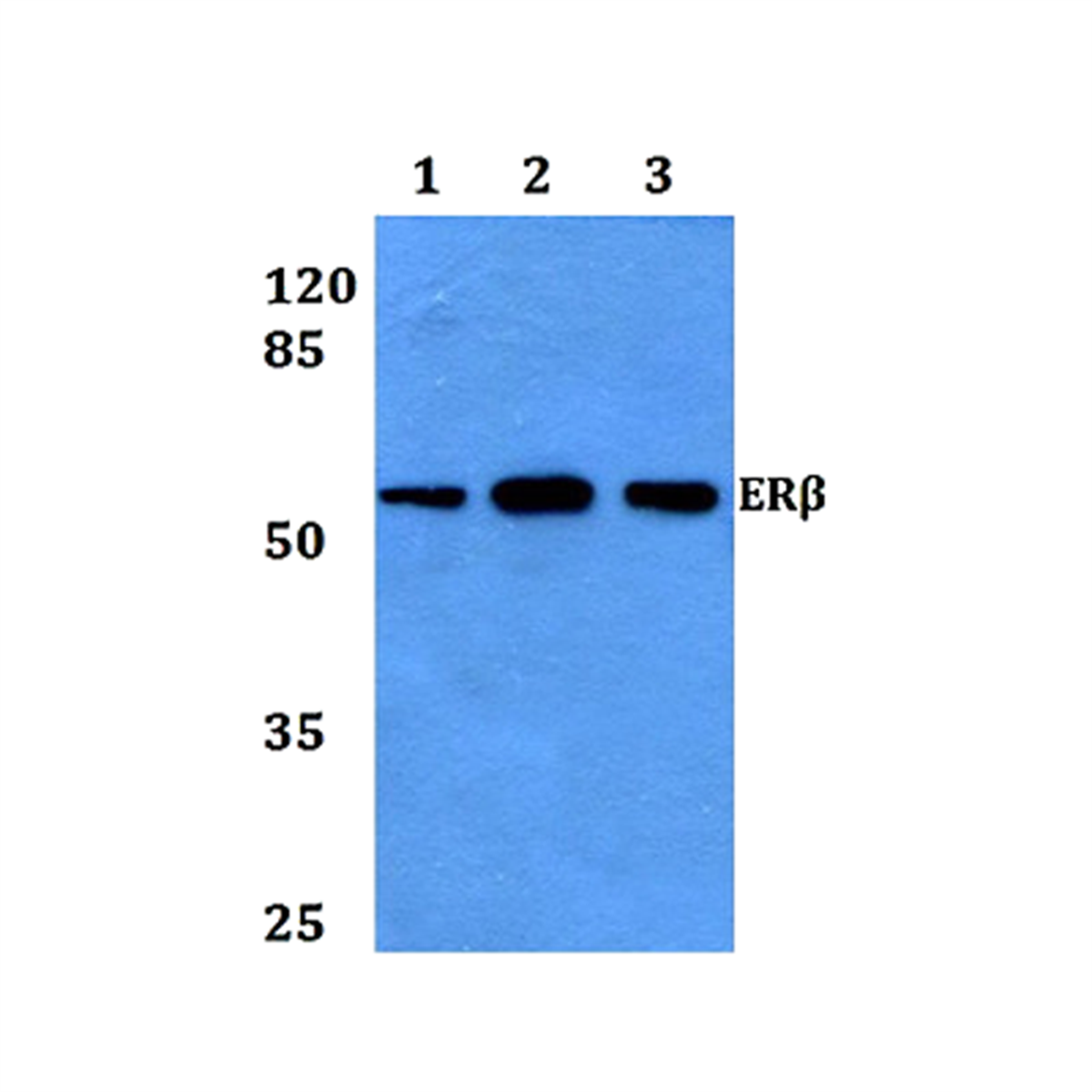
Anti Human ER beta mouse monoclonal antibody (PPZ0506)
Anti Human ER beta mouse monoclonal antibody (PPZ0506)
ER beta: Estorgen Receptor beta
DiagnoCine offers excellent ER Beta | Estrogen Receptor Beta Antibodies to researchers studying Estrogenic responses, Estrogenic secretion, Hormonal gene regulation, Cellular Metabolism, Auto-immune Diseases, Cancer-associated Signal Transduction, and Cell Proliferation.
Human diseases include prostate cancer, breast cancer, cardiovascular diseases, autism spectrum disorder, medullary thyroid carcinoma, de quervain Disease and neurological disorders.
ER Beta| Estrogen Receptor Beta Antibodies has excellent quality and this highly pure antibody can be adapted for Western Blots, ELISA, and Immunoprecipitation research with optimization.
General information
| Cat. No. | :FNK-PP-PPZ0506-00 |
| Size | :100 ul |
| Antigen Species | :Human |
| Host Species | :Mouse |
| Cross Reactivity | :Human |
| Purification | :Ammonium sulfate fractionation |
| Clone No | :PPZ0506 |
| Lot. | :A-2 |
| Concentration | :1 mg/mL |
| Ig Class | :G2b |
| Nomenclature | :NR3A2 |
| Application | :Western Blot (1 ug/mL) :ELISA (0.2 ug/mL (A450=0.1)), :IP (Decide by use), |
| Specificity |
:This antibody specifically recognizes human ER beta but does not recognize human ER alpha.
Not yet tested in other species. |
| Storage | :Store at 2 - 8 ºC up to one month. For long-term storage, the solution may be frozen in working aliquots. Repeated freezing and thawing is not recommended. Storage in a frost-free freezer is not recommended. |
| Form | :Physiologic saline with 0.1 % NaN3 |
| Genbank | :AB006590 |
Description
Estrogen receptor alpha (ERa, ER; NR3A1) is a member of steroid receptor (AR, GR, MR, PR). The natural ligand for ER is the classical estrogenic compound 17b-estradiol. ERa is expressed in a wide variety of tissues. Expression was found at variable levels in bones, in uterus, bladder, ovary, prostate, testis, epididymys, kidney, breast, heart, vessel wall, pituitary and hypothalamus. ER has a variety of central physiological roles, including those involved in maintenance of the reproductive, cardiovascular, musculoskeletal and central nervous systems. ERa has been shown to form homodimers as well as heterodimers with ERb. Both ERa and ERb can give rise to numerous isoforms.
Origin
Produced in BALB/c mouse ascites after inoculation with hybridoma of mouse myeloma cells (NS-1) and spleen cells derived from a BALB/c mouse immunized with Baculovirus-expressed recombinant human ER beta (2-88 aa).
Notes
Sodium azide may react with lead and copper plumbing to form explosive metal azides. Flush with large amounts of water during disposal.
Aliases for ESR2 Gene
- Estrogen Receptor 2 2 3 5
- Nuclear Receptor Subfamily 3 Group A Member 2 2 3 4
- Estrogen Receptor Beta 2 3 4
- NR3A2 2 3 4
- Oestrogen Receptor Beta 2 3
- ER-Beta 2 4
- ESTRB 3 4
- Erb 2 3
- Estrogen Receptor Beta Splice Variant, ERbeta2delta7 3
- Estrogen Receptor Beta Splice Variant, ERbeta4delta7 3
- Estrogen Receptor Beta Splice Variant, ERbeta6delta7 3
- Estrogen Receptor Beta Splice Variant, ERbeta7delta7 3
- Estrogen Receptor Beta Splice Variant, ERbetaEx. 4L 3
- Estrogen Receptor Beta Splice Variant, ERbetaEx. 6L 3
- Estrogen Receptor Beta Splice Variant, ERbeta6 3
- Estrogen Receptor Beta Splice Variant, ERbeta7 3
- Estrogen Receptor 2 (ER Beta) 2
- Estrogen Receptor Beta 4 3
- ESR-BETA 3
- ER Beta 2
- ER-BETA 3
- ESRB 3
- ODG8 3
- ESR2 5