
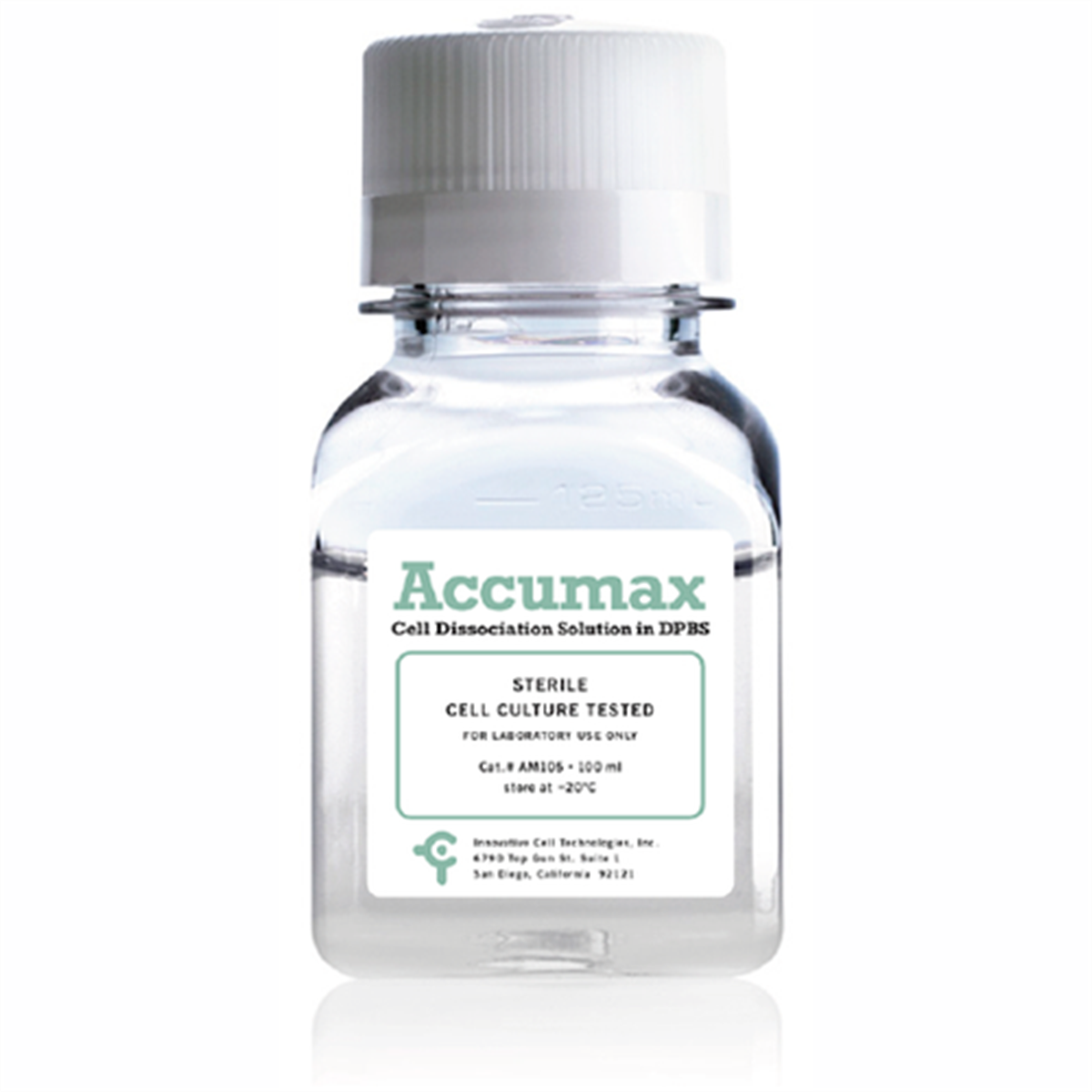
Accumax, 500 ml
Accumax
Cat. No. FNK-AM105-500
Store at -20°C
Size : 500 mL
Product ID and Size
| Product | Accumax | Accumax |
| Cat No. | FNK-AM105-100 | FNK-AM105-500 |
| Size | 100ml | 500ml |
| Link |  |
|
Description
Accumax is a solution of proteolytic and collagenolytic enzymes formulated at a concentration ideal for the following applications: Creating single cell suspensions from clumped cell cultures for accurate cell counting, dissociation of spheroids into single cell suspensions, extension of sort times of clumpy cell samples on a fluorescence activated cell sorter, removal of cells from primary tissue and the routine detachment of sticky cells from standard tissue culture plastic ware and adhesion coated plastic ware. Cell lines tested for Accumax applications includes fibroblasts, keratinocytes, vascular endothelial cells, hepatocytes, vascular smooth muscle cells, hepatocyte progenitors, primary chick embryo neuronal cells, bone marrow stem cells, adherent CHO and BHK cells, macrophages, 293 cells, L929 cells, immortalized mouse testicular germ cells, MRC5, 3T3, Vero, COS, HeLa, NT2, MG63, M24 and A375 metastatic melanoma, gliomas U251, D54, HT1080 fibrosarcoma cells, Sf9 insect ceils, human embryonic stem cells, human mesenchymal stem cells and human neural stem cells. ACCUMAX does not contain mammalian or bacterial derived products.
Intended Use
Accumax is direct replacement for a collagenase solution or a trypsin cell detachment solution, For research use only.
CAUTION: Not intended for human or animal diagnostic or therapeutic uses.
Precautions
Do not store Accumax at room temperature. Accumax is stable when stored at 2 to 8℃ for 2 months. It is recommended to thaw
Accumax at 4℃ overnight or in a bath of cool water. Do not thaw at 37℃.
Storage & Shelf Life
Store at -20℃ frozen. 2-8℃ defrosted. 24 month shelf life frozen.
Formulation:
1 x ACCUMAX enzymes in Dulbecco's PBS (0.2 g/L KCI, 0.2 g/L KH2PO4, 8 g/L NaCl, and 1.15 g/L Na2HPO4) containing 0.5mM EDTA · 4Na
Use:
Cell Counting:
When counting cells with either a manual or automated method, the accuracy of the counts will be increased if the cells are not clumped together. By adding Accumax to a sample before counting, this result will be accomplished.
1. Harvest a representative sample of clumped cells, 0.5 or 1.0 ml, and place in a 12x75 mm tube.
2. Add an equal volume of ACCUMAX to the sample of cells, and incubate for 5 to 10 minutes at room temperature.
3. Count the cells by your normal procedure. Note that the cells have been diluted an extra 2 fold.
Flow Cytometric Analysis of Clumpy Cells:
Accumax will not declump cells if the cells are already fixed. Cells can be fixed after the addition of Accumax, but clumping may occur. Accumax can be added to unfixed cells before or after immunological staining. Whether a cell surface protein is negatively affected by the addition of Accumax, is strictly a function of the protein being measured. In general, cell surface proteins are not affected, but each should be tested empirically. Often Accumax is added after trypsin is used to detach the cells. Better results will be achieved if Accutase, our cell detachment product, is used first instead of trypsin and then Accumax is used post detachment. Accumax may be added to a washed cell suspension to remove cellular debris. Any serum in the cell suspension will inactivate the Accumax, The recommended procedure for preventing clumping of cells prior to flow cytometry analysis is to:
1. Ascertain that the cells are at a concentration 1 x 10⁶ to 1×10⁷ per ml of PBS.
2. Add an equal volume of cold Accumax relative to cell suspension volume to the cells after they have been stained. This concentration can be adjusted as needed.
3. Gently mix.
4. Store tubes on ice until running on flow cytometer
5. Run samples on flow cytometer as soon as possible.
Dissociation of Spheroids
Spheroids are characterized by high cell-density and a closely packed, 3-D tumor like structure. Typically a 1 week old spheroid contains about 1000eells. Spheroids can be loosely attached or free floating. The media must be removed from the spheroids before Accumax can be used to dissociate them.
1. If the spheroids are attached to the tissue culture flask, the media should be poured off and a quantity of cold Accumax added to the flask to just cover the attachment layer. Wait a few minutes for the spheroids to detach. Then proceed to step 3.
2. Free floating spheroids should be poured off Into a 50 cc centrifuge tube. The media should be carefully aspirated from the tube.
3. Add 15-20 mls.of cold Accumax into the 50cc tube. It is hard to specify the required volume of Accumax without knowing the size and quantities of spheroids in the tube. This must be determined empirically. There should be enough Accumax that the spheroids can freely float around and are not all packed in the bottom of the tube.
4. Gently rock the tube back and forth on a tube rocker and observe the structure of the floating spheroids over time, checking every 5 minutes. This does not need to be done at 37℃ but at room temp.
5. The structure of the spheroids should start to break down with them looking like flaps of tissue. At this point, try gently pipetting the flaps up and down several times to see if this causes them to fall apart. Repeat this process every few minutes until the spheroids have dissolved.
Powerful but gentle cell dissociation solution, Accutase/Accumax
Accumax is a ready to use non-mammalian, non-bacterial replacement for all applications of trypsin and collagenase in tissue dissociation, cell counting, and dissolving cell clumps such as spheroids.
Accumax contains the same enzymes as Accutase and is a direct replacement for collagenase.
Accumax can be used to increase the accuracy of a cell count. It can also be added to a clumpy sample on a cell sorter to extend the sort time of the sample.
Features of Accutase/Accumax
- Natural enzyme mixture with proteolytic and collagenolytic enzyme activity
- Works gently and promptly
- Dissociates tissue
- Increases accuracy of manual or automated cell counts
- Used to dissolve neuronal and prostate spheroids
- Removes cells from 3-D matrixes
- Removes cells from hollow fiber cell reactors
- Extends the sort time of clumpy cell on a sorting flow cytometer
- Non-mammalian and non-bacterial components contained
- Ready to use format (prepared by Dulbecco's PBS)
- No need to be neutralized when passaging adherent cells
Regardless of what the manufacturers of cell counters tell you, when counting cells with either a manual or automated method, the accuracy and the reproducibily of the counts will be increased if the cells are not clumped together. Accumax solution can be used to dissociate clumpy cells that are being counted. Accumax is gentle enough that an aliquot of it can be added to an aliquot of cells and allowed to set for a period of time without damaging the cells.
- Harvest a representative sample of clumped cells to be counted, 0.5 or 1.0 ml, and place in a 12x75 mm tube.
- Add an equal volume of ACCUMAX to the sample of cells, and incubate for 5 to 10 minutes at room temperature.
- Count the cells by your normal procedure. Note that the cells have been diluted an extra 2 fold.
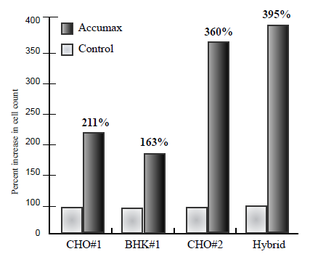
Tested Cell Lines of Accumax
|
hESCs |
vascular smooth muscle cells |
primary chick embryo neuronal cells |
HeLa |
NT2 |
|
bone marrow stem cells |
vascular endothelial cells |
immortalized mouse testicular germ cells |
293 |
COS |
|
hepatocyte progenitors |
hepatocytes |
M24 and A375 metastatic melanoma |
MG63 |
Sf9 |
|
fibroblasts |
macrophages |
gliomas U251 and D54 |
3T3 |
Vero |
|
keratinocytes |
HT1080 fibrosarcoma cells |
adherent CHO and BHK cells |
L929 |
|