rTaq DNA Polymerase
rTaq DNA Polymerase
The most widely used thermostable DNA polymerase from Thermus aquaticus (Taq) YT-1 — tolerant of varied PCR protocols, hot start compatible, and suitable for TA cloning.
Cold-chain shipping required. This product has ICE or DRY ICE shipping requirements — do not select Ground Shipping.
Product Overview
Description
Taq DNA polymerase is the most widely used thermostable DNA polymerase derived from the thermophilic bacteria Thermus aquaticus (Taq) YT-1. The enzyme possesses a 5’→3’ polymerase activity and a double-strand specific 5’→3’ exonuclease activity.
Features
Applicable for hot start technology by adding anti-Taq antibody (Code No. TCP-101).
PCR products can be cloned by using a TA cloning method.
Incorporates dUTP, dITP, and fluorescently-labeled nucleotides.
Applications
- PCR
- Primer extension
Source
E. coli strain carrying the cloned Taq DNA polymerase gene from Thermus aquaticus (Taq) YT-1.
Unit Definition
One unit is defined as the amount of enzyme that will incorporate 10 nmoles of dNTP into an acid insoluble material in 30 min at 75 °C.
Storage Condition
Store at -20 °C, 20 mM Tris-HCl (pH 8.0), 100 mM KCl, 0.1 mM EDTA, 0.5% Nonidet® P-40, 0.5% Tween® 20, 50% Glycerol.
Components
This reagent includes the following components for 100-200 reactions;
- rTaq DNA Polymerase (2.5U/µl)
- 10× Buffer
- 25 mM MgCl2
- 2 mM dNTPs
Typical PCR Reaction Setup
| Component | Volume | Final Concentration |
|---|---|---|
| 10x Buffer | 5 µl | 1× |
| 2 mM dNTPs | 5 µl | 0.2 mM each |
| 25 mM MgCl2 | 3 µl | 1.5 mM |
| 10 pmol/ul Primer #1 | 1.0 µl | 0.2 µM |
| 10 pmol/ul Primer #2 | 1.0 µl | 0.2 µM |
| Template DNA | X µl | Genomic DNA 10~1000 ng/50 µl; Plasmid DNA 1~50 ng/50 µl; cDNA ~200 ng (RNA equiv.)/50 µl |
| PCR grade water | Y µl | |
| Diluted rTth DNA polymerase (1.0U/µl) | 1.25-2.5 µl | 1.25-2.5 U / 50 µl |
| Total reaction volume | 50 µl |
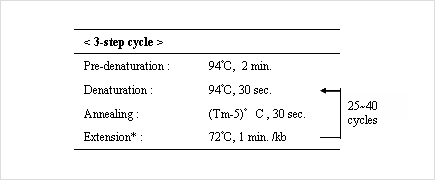
PCR Cycle Conditions
Application Data
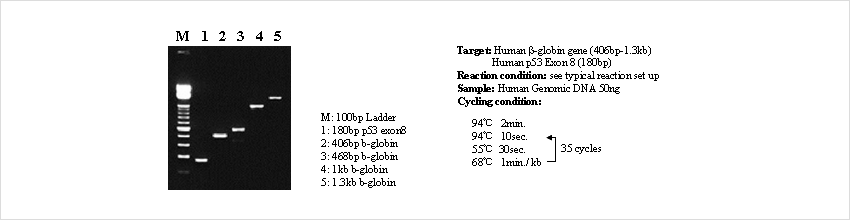
Example 1. Amplification of 180 bp–1.3 kb genes from human genomic DNA
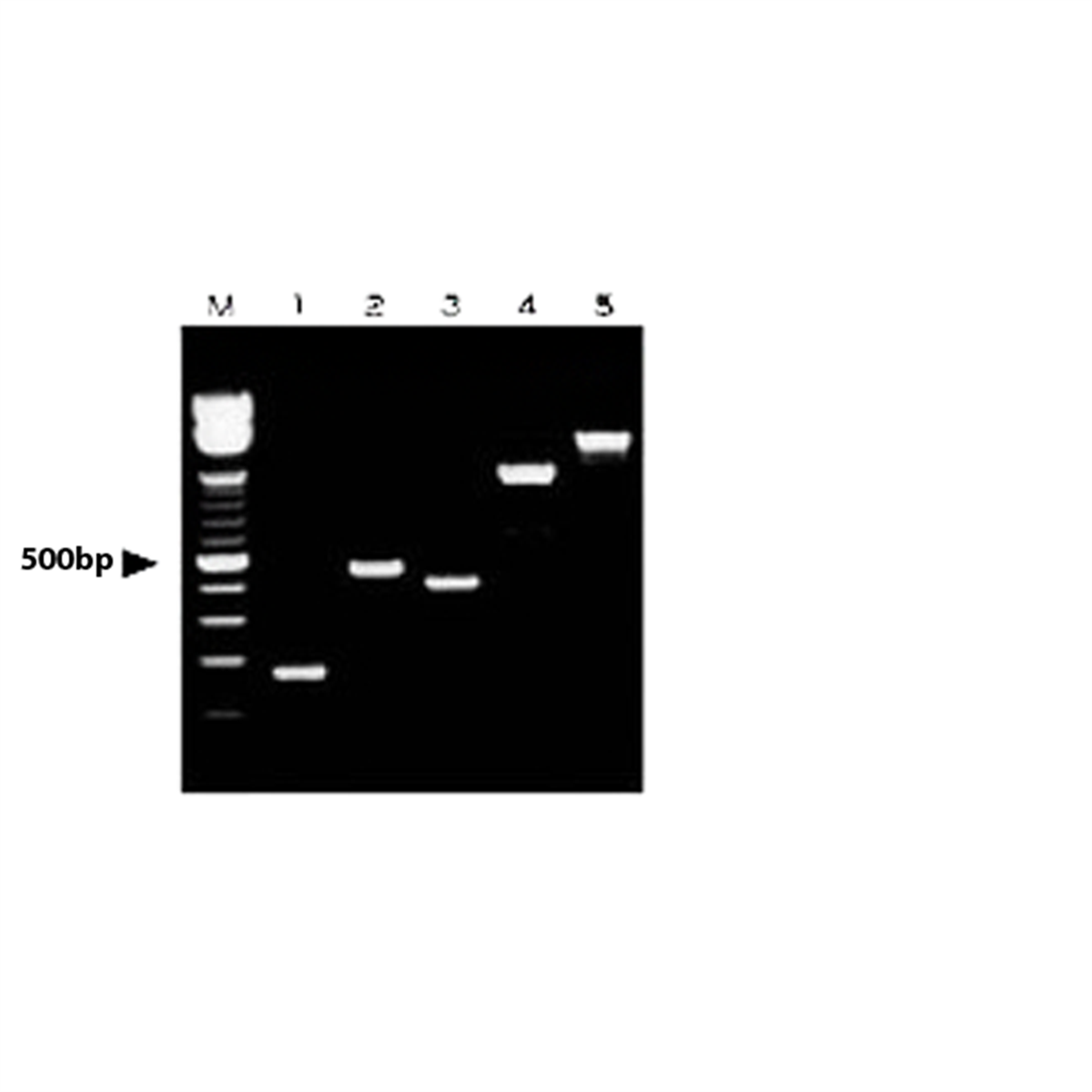
Distinct and specific amplified bands from 180 bp to 1.3 kb were observed with rTaq DNA polymerase by 1% agarose gel electrophoresis.
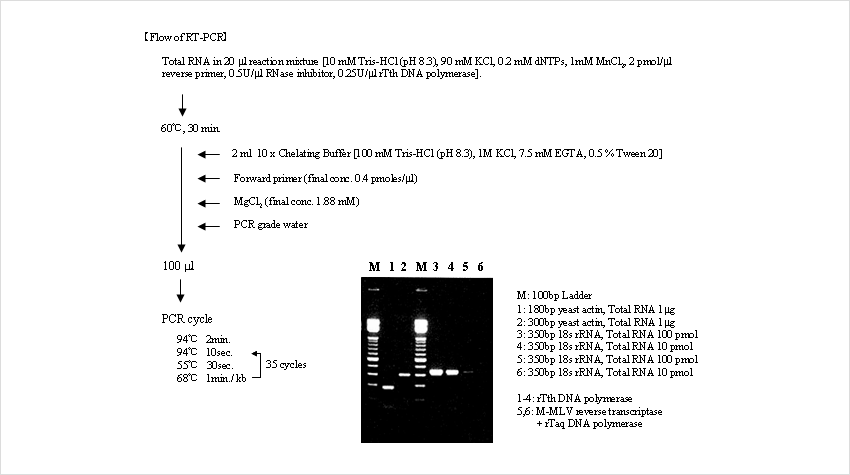
Example 2. Amplification of the yeast actin and human 18s rRNA by RT-PCR
The single-enzyme RT-PCR with rTth DNA polymerase gave distinct amplification bands, whereas RT-PCR with M-MLV reverse transcriptase and rTaq DNA polymerase gave very faint bands.
References
- F.C. Lawyer, S. Stoffel, R.K. Saiki, K. Myambo, R. Drummond, D.H. Gelfand., J. Biol. Chem., 264: 6427-6437 (1989)
- T. Nagahama, K. Sugiura, S. Lee, H. Morita, Y. Adachi, A.H. Kwon, Y. Kamiyama, S. Ikehara, Stem cells, 19: 425-435 (2001)