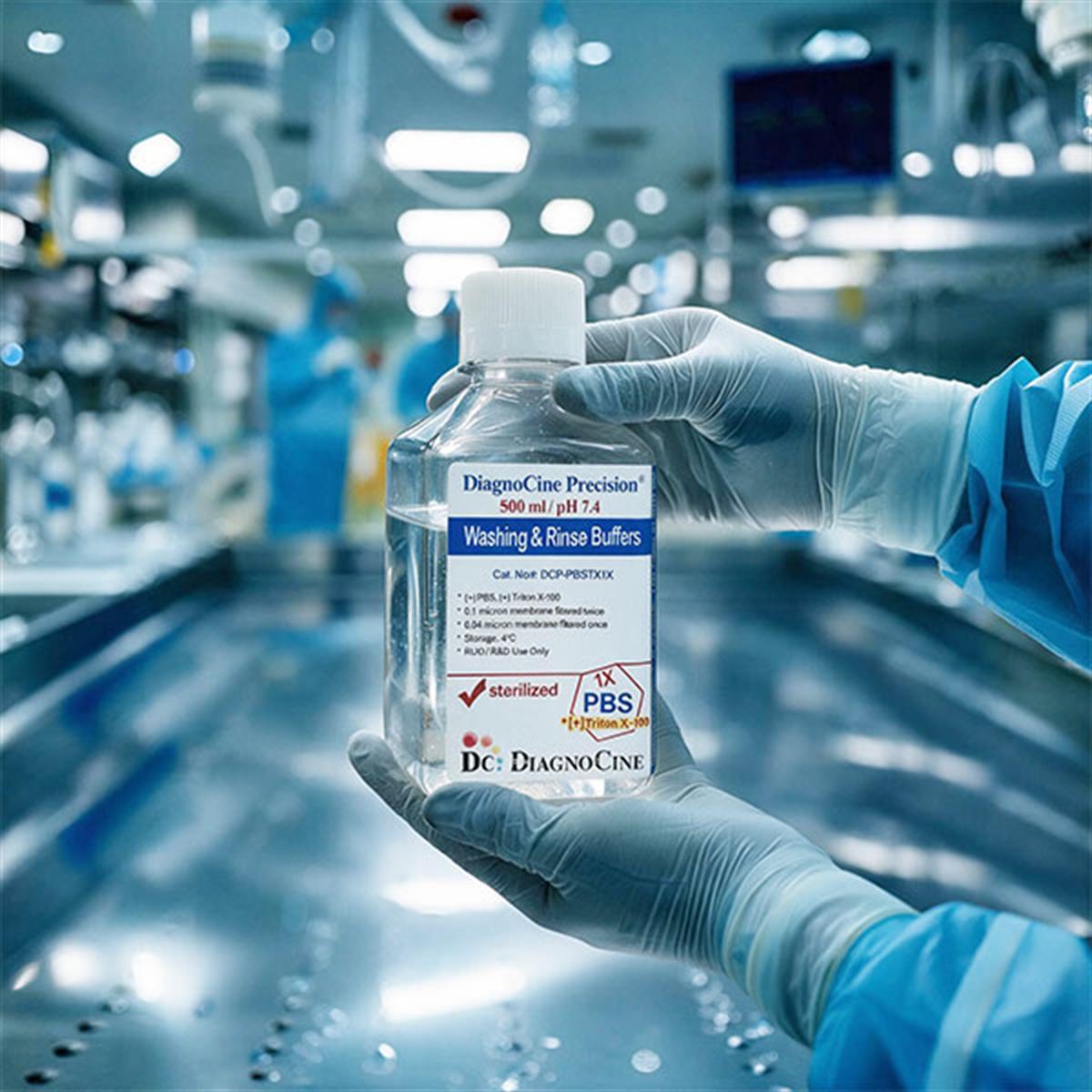
Washing & Rinse Buffers
Three wash chemistries, one page. Match the buffer to your detection chemistry and go straight to its product page — the rationale, history, applications, and selection guidance follow below.
| Product | Core Basis | Primary Application | Product Page |
|---|---|---|---|
| Phosphate-Based Washing Buffer (PBST) | PBS + Tween-20 | Universal ELISA/immunoassay standard | Viewarrow_forward |
| Tris-Based Washing Buffer (TBST) | TBS + surfactant | Phospho-protein assays & Westerns | Viewarrow_forward |
| CATAROSEV™ Buffer Set (100 mL × 3) | Multi-component | Exosome/EV workflows | Viewarrow_forward |
Not sure which buffer? Compare what each design requirement delivers · See applications by workflow · Read the FAQ
Specificity is decided at the wash step
In solid-phase assays — Western blotting, ELISA, immunohistochemistry — success comes down to specificity. After a sample is incubated with antibodies or detection probes, some of those molecules inevitably stick weakly and non-specifically where they don't belong. Washing and rinse buffers remove these unbound, loosely bound reagents, so that only true high-affinity binding remains to be detected.
The specifications that decide whether a wash buffer fits a protocol — and the one that decides it more than any other.
- Three configurations stocked: a phosphate-based wash (PBST), a Tris-based wash (TBST), and the CATAROSEV™ Buffer Set for extracellular-vesicle work.
- Background reduction — continuously rinsing away unbound primary and secondary antibodies, lowering background and preventing false positives.
- Surface-tension reduction — a mild non-ionic detergent allows the buffer to wet hydrophobic surfaces evenly, reaching corners and membrane pores.
- Chemical stability — maintaining pH and salt balance so target proteins stay bound and folded rather than peeling off or denaturing.
- The PBST/TBST decision — use TBST whenever the readout involves phosphoproteins or an alkaline-phosphatase conjugate; PBST is fine, and cheaper and simpler, for most HRP-based and general immunoassays.
- Standard surfactant level — the standard Tween-20 concentration for washes is 0.05–0.1%.
- Built for engineered solid supports — nitrocellulose, PVDF, and polystyrene are designed to bind biomolecules tightly, including the ones you don't want.
- A documented lineage — ELISA named in 1971, Western blotting defined in 1979, and Tween-20 formalized for blot detection in 1982.
- Configurations in this category3
- Standard Tween-20 concentration for washes0.05–0.1%
- Phosphate-based wash (PBST) basisPBS + Tween-20
- Tris-based wash (TBST) basisTBS + non-ionic surfactant
- Phosphate content, TBSTphosphate-free
- CATAROSEV™ Buffer Set format100 mL × 3
- Solid supports servednitrocellulose, PVDF, polystyrene
- Detection chemistries addressedHRP, alkaline phosphatase (AP)
- ELISA introduced and named1971
- Tween-20 formalized for blot detection1982
The support binds everything — the wash decides what stays
Solid supports (nitrocellulose, PVDF, polystyrene) are engineered to bind biomolecules tightly — including the ones you don't want. Each mechanism below answers a specific way that a plain rinse fails.
Background reduction
Continuously rinsing away unbound primary and secondary antibodies, lowering background and preventing false positives.
Surface-tension reduction
A mild non-ionic detergent allows the buffer to wet hydrophobic surfaces evenly, reaching corners and membrane pores.
Chemical stability
Maintaining pH and salt balance so target proteins stay bound and folded rather than peeling off or denaturing.
Why plain saline was not enough
Early immunoassays rinsed tubes and wells with plain saline or distilled water. That removed bulk liquid but was inefficient at disrupting the weak hydrophobic interactions that cause background noise and false positives.
Phosphate interference
TBST is phosphate-free, so free phosphate can't interfere with phospho-specific antibodies or alkaline-phosphatase (AP) detection — which is why the Tris-based wash gives very clean backgrounds on those readouts.
Surfactant level is a spec, not a detail
Lowering surface tension allows the wash to gently displace nonspecific protein without stripping tightly bound target complexes. The standard Tween-20 concentration for washes is 0.05–0.1%.
A wash buffer is a discrimination step, not a rinse
The difference between a clean blot and a false positive is not usually the antibody — it is whether the wash could disrupt weak, non-specific hydrophobic binding while leaving true high-affinity complexes intact. That is exactly the job a plain saline rinse could not do, and exactly what a low concentration of non-ionic surfactant in a balanced salt buffer was introduced to solve.
From a saline rinse to a formulated wash
Two developments explain why a modern wash buffer looks the way it does — and why the surfactant is on the label.
-
1
Mid-20th century Plain saline and distilled water
Early immunoassays rinsed tubes and wells with plain saline or distilled water. Significance: removed bulk liquid but was inefficient at disrupting the weak hydrophobic interactions that cause background noise and false positives.
-
2
1970s–1980s Non-ionic surfactants enter the buffer
As multi-layer assays (sandwich ELISAs, Western blots) demanded cleaner backgrounds, researchers added low concentrations of nonionic surfactants — most notably Tween-20 — to balanced salt buffers such as PBS or TBS. Significance: lowering surface tension allows the wash to gently displace nonspecific protein without stripping tightly bound target complexes. Batteiger et al. (1982) formalized Tween-20's role in blot detection.
What each design requirement actually delivers
The three requirement classes that define a washing and rinse buffer, the component that satisfies each, and what it buys you at the bench.
| Design requirement | Component involved | What it provides |
|---|---|---|
| Background reduction | The wash step itself, repeated between incubations | Continuously rinses away unbound primary and secondary antibodies, lowering background and preventing false positives |
| Surface-tension reduction | A mild non-ionic detergent (Tween-20, 0.05–0.1%) | Lets the buffer wet hydrophobic surfaces evenly, reaching corners and membrane pores |
| Chemical stability | A balanced salt base — PBS or TBS | Maintains pH and salt balance so target proteins stay bound and folded rather than peeling off or denaturing |
Which workflow, which buffer
Select a workflow to see what the category is intended to support there.
- Rinsing membranes between block, primary, and secondary antibody steps
- TBST — phospho-protein assays & Westerns; phosphate-free, so free phosphate can't interfere with phospho-specific antibodies or alkaline-phosphatase (AP) detection; very clean backgrounds
- PBST — isotonic, physiological background for standard (non-phospho) blots
- Multi-layer assays such as sandwich ELISAs and Western blots are what drove the addition of nonionic surfactants to balanced salt buffers in the first place
- Rinsing wells after each incubation for reproducible, quantitative optical readings
- PBST — universal ELISA/immunoassay standard; isotonic, physiological background for routine microplate washes
- PBST is fine — and cheaper and simpler — for most HRP-based and general immunoassays
- Switch to TBST if the readout uses an alkaline-phosphatase conjugate, since phosphate competes and interferes
- Cleaning tissue sections between steps for sharp, localized staining
- A mild non-ionic detergent lets the buffer wet hydrophobic surfaces evenly, reaching corners and membrane pores
- Maintaining pH and salt balance keeps target proteins bound and folded rather than peeling off or denaturing
- Removing unbound primary and secondary antibodies is what prevents background and false positives
- Removing unbound reagents between capture and detection
- PBST — isotonic, physiological background for multiplex bead assays
- Lowering surface tension displaces nonspecific protein gently, without stripping tightly bound target complexes
- Application-specific washing, rinsing, and conditioning steps for extracellular-vesicle purification and analysis
- Limits sample aggregation
- Supplied as a multi-component specialized suite, 100 mL × 3
How the three wash chemistries compare
Core basis and the workflow each product is intended for.
| Product | Core Basis | Best Use |
|---|---|---|
| Phosphate-Based Washing Buffer (PBST) | PBS + non-ionic surfactant (Tween-20) | Universal ELISA/immunoassay standard — isotonic, physiological background for routine microplate washes, multiplex bead assays, and standard (non-phospho) blots |
| Tris-Based Washing Buffer (TBST) | TBS + non-ionic surfactant | Phospho-protein assays & Westerns — phosphate-free, so free phosphate can't interfere with phospho-specific antibodies or alkaline-phosphatase (AP) detection; very clean backgrounds |
| CATAROSEV™ Buffer Set (100 mL × 3) | Multi-component specialized suite | Exosome/EV workflows — application-specific washing, rinsing, and conditioning steps for extracellular-vesicle purification and analysis, limiting sample aggregation |
Frequently asked questions
The questions that come up most often when a purchasing spec meets a bench protocol.
The primary literature behind these buffers
The three papers that define the solid-phase assay formats these wash buffers serve.
- Batteiger, B., Newhall, W. J., & Jones, R. B. (1982). The use of Tween 20 as a blocking agent in the immunological detection of proteins transferred to nitrocellulose membranes. Journal of Immunological Methods, 55(3), 297–307. — The foundational comparative study establishing non-ionic detergent (Tween-20) for blocking and washing in blot detection.
- Engvall, E., & Perlmann, P. (1971). Enzyme-linked immunosorbent assay (ELISA). Quantitative assay of immunoglobulin G. Immunochemistry, 8(9), 871–874. — The paper that introduced (and named) ELISA — the solid-phase assay format built around iterative wash steps.
- Towbin, H., Staehelin, T., & Gordon, J. (1979). Electrophoretic transfer of proteins from polyacrylamide gels to nitrocellulose sheets: procedure and some applications. Proceedings of the National Academy of Sciences, 76(9), 4350–4354. — The origin of Western blotting, defining the membrane-based detection workflow that wash buffers serve.