


Tris Based Washing Buffers
Select See the table below
- See the table below
Tris Based Washing Buffers - Category Selection Guide
This is a category page, not a product page — pick the wash format your protocol needs and click View to open its product page, where sizes, documentation and ordering live.
1Tris Based Washing Buffers
Five wash buffers, ten catalog numbers. They differ by detergent, by detergent percentage, and by concentration factor.
| Cat. No. | Size |
|---|---|
| DCP-TNP1X_500 ml | 500 ml |
| DCP-TNP1X_1000 ml | 1000 ml |
| DCP-TBST0.1X_500ml | 500 ml |
| DCP-TBST0.1X_1000ml | 1000 ml |
| DCP-TBST1X_100 ml | 100 ml |
| DCP-TBST1X_500 ml | 500 ml |
| DCP-TBST20X_500 ml | 500 ml |
| DCP-TBST20X_1000 ml | 1000 ml |
| DCP-TTXB1X_100 ml | 100 ml |
| DCP-TTXB1X_500 ml | 500 ml |
2Protease Inhibitor Cocktail with Tris Based Washing Buffers
Three ready-to-use combinations, three catalog numbers. Each pairs a seven-component protease inhibitor cocktail with one of the washing buffers above.
| Cat. No. | Size |
|---|---|
| DCP-PICTNP1X | 10 x 10 mL |
| DCP-PICTTX1X | 10 x 10 mL |
| DCP-PICTT201X | 10 x 10 mL |
Not sure which format? Browse the washing-buffer formats · See the cocktail components · Read the FAQ
What a Tris based washing buffer is for
Tris-based washing buffers are essential solutions used in various biochemical and molecular biology applications. They help remove unbound materials and reduce background noise, improving assay sensitivity and specificity. These buffers are primarily composed of Tris (tris(hydroxymethyl)aminomethane), which is a widely used biological buffer due to its effective pH buffering capacity in the range of 7.0 to 8.0.
Five product pages, ten catalog numbers. What separates them is the detergent, the detergent percentage, and the concentration factor. The three protease-inhibited combinations are a separate family and are described in Part 2.
- Five products, ten catalog numbers: Tris NP-40 Buffer, TBST (0.1% Tween 20) [1X], Tris-Buffered Saline (TBS) with (0.05%) Tween-20 [1X], TBST (0.05% Tween 20) [20X], and Tris Triton-X Buffer.
- One base chemistry: every product in this group is built on Tris (tris(hydroxymethyl)aminomethane), stated by the source as buffering effectively across pH 7.0 to 8.0.
- Three detergent formats: NP-40, Tween 20, and Triton-X, as published in the product names.
- Two Tween 20 percentages: 0.1% and 0.05% — the source lists both as separate products, not as a single configurable item.
- Ready-to-use and concentrate: four products at 1X plus one 20X concentrate (TBST, 0.05% Tween 20).
- Fill sizes: 100 ml, 500 ml, and 1000 ml.
- Sterile filtration: filtered through a 0.1 micron membrane twice and a 0.04 micron membrane twice, in a sterile environment; stored at 4 °C and shipped at room temperature.
- Customization: other concentrations, added chemicals, compounds, proteins or supplements, different pH, and other modifications are available on inquiry.
- Base bufferTris
- Stated buffering rangepH 7.0 to 8.0
- Products in this group5
- Catalog numbers10
- Detergent formatsNP-40 / Tween 20 / Triton-X
- Tween 20 percentages0.1% and 0.05%
- Concentrations offered1X and 20X
- Fill sizes100 / 500 / 1000 ml
- Sterile filtration0.1 µm ×2 + 0.04 µm ×2
- Storage / shipping4 °C / room temperature
A wash step is where signal is won or lost
Every product on this page does the same job — carry unbound material away without disturbing what is meant to stay bound. The differences below are the ones the source itself draws, and they are the ones that decide which bottle belongs on your bench.
Removing unbound material
The stated purpose of the family: help remove unbound materials so that only specifically bound species remain to be detected. Everything else about a wash buffer is in service of that one job.
Reducing background noise
The source names background reduction as the second function, with the direct consequence that assay sensitivity and specificity improve. A dirty background costs you the low end of your dynamic range.
Tris as the base
All eight product pages share one buffering chemistry: Tris, tris(hydroxymethyl)aminomethane, described by the source as a widely used biological buffer effective across pH 7.0 to 8.0.
Detergent and percentage
The family is published as NP-40, Tween 20, and Triton-X formats, with Tween 20 offered at two percentages — 0.1% and 0.05%. The source lists these as distinct products; match the one your protocol names.
Preserving protein integrity
The protease inhibitor cocktail formats of Part 2 are described as a ready-to-use combination that removes unbound material and reduces background noise while preserving protein integrity — the reason to reach for them rather than a plain wash buffer.
When the catalog does not fit
Other concentrations, additions of chemicals, compounds, proteins or supplements, a different pH, and other modifications are available on inquiry. Ask before you compromise on a formulation.
Three questions decide which of the eight pages you want
Which detergent does your protocol name — NP-40, Tween 20, or Triton-X? If Tween 20, at what percentage — 0.1% or 0.05%? And do you need the protease inhibitor cocktail already in the bottle, which moves you from Part 1 to Part 2? Answer those three and the catalog above narrows to one group.
Four membrane passes before the bottle is filled
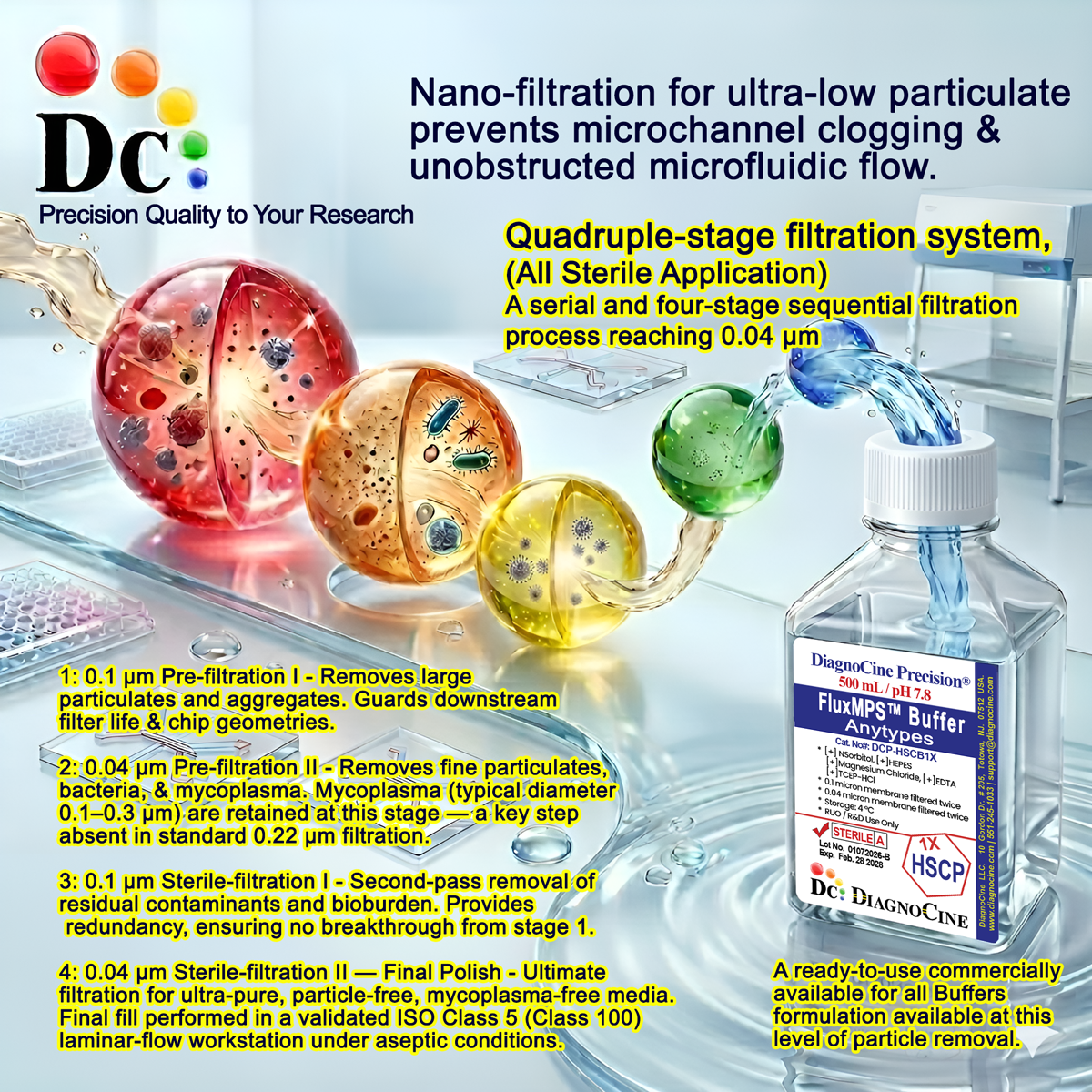
The source states one sterility process for the Tris Based Washing Buffers: filtration through a 0.1 micron membrane twice and a 0.04 micron membrane twice, carried out in a sterile environment. The four stages below are that process, in order.
-
1
0.1 µm Pre-filtration I
The first 0.1 micron pass takes out the bulk particulate load before any finer membrane sees the fluid, so the downstream stages are not asked to do coarse work.
-
2
0.04 µm Pre-filtration II
A 0.04 micron pass follows, reaching well below the 0.1 micron cut and removing sub-micron material that a coarser membrane leaves in solution.
-
3
0.1 µm Sterile-filtration I
The second 0.1 micron pass is the sterile-filtration stage, performed in the sterile environment the source specifies for the fill.
-
4
0.04 µm Sterile-filtration II — Final Polish
The final 0.04 micron pass is the polishing stage: the last thing the buffer passes through before it reaches the bottle you open at the bench.
Why a wash buffer is worth filtering this hard
A wash buffer touches the assay surface more times than any other reagent in the workflow, and it touches it last. Particulate carried in by the wash is particulate deposited on the membrane, the well, or the channel — which is exactly the background the buffer is there to remove.
Protease Inhibitor Cocktail with Tris Based Washing Buffers
These Ready-to-use combination of a protease inhibitor cocktail with various washing buffers provides a powerful tool for removing unbound materials and reducing background noise while preserving protein integrity. The cocktail contains AEBSF.HCl, a serine protease inhibitor; Aprotinin, which targets serine proteases and has anti-inflammatory properties; Bestatin, an aminopeptidase inhibitor; E-64, a cysteine protease inhibitor; EDTA, a metalloproteinase inhibitor; Leupeptin, which inhibits both serine and cysteine proteases; and Pepstatin A, an aspartic protease inhibitor.
- Protease Inhibitor Cocktail with NP-40 Buffer — DCP-PICTNP1X · 10 x 10 mL
- Protease Inhibitor Cocktail with Tris Triton-X Buffer — DCP-PICTTX1X · 10 x 10 mL
- Protease Inhibitor Cocktail with Tris Tween 20 Buffer — DCP-PICTT201X · 10 x 10 mL
- All three are supplied ready to use; the washing buffer and the seven-component cocktail arrive combined in one bottle.
The seven cocktail components
| Component | Role, as published by the source |
|---|---|
| AEBSF.HCl | A serine protease inhibitor |
| Aprotinin | Targets serine proteases and has anti-inflammatory properties |
| Bestatin | An aminopeptidase inhibitor[6] |
| E-64 | A cysteine protease inhibitor[5] |
| EDTA | A metalloproteinase inhibitor |
| Leupeptin | Inhibits both serine and cysteine proteases |
| Pepstatin A | An aspartic protease inhibitor[7] |
The washing buffers, grouped by detergent
Select a detergent to see the products the source lists under it. The source describes one shared function for the whole group; what changes between tabs is the detergent, the percentage, and the concentration factor.
- TBST (Tris-buffered saline, 0.1% Tween 20) [1X] — 500 ml and 1000 ml
- Tris-Buffered Saline (TBS) with (0.05%) Tween-20 [1X] — 100 ml and 500 ml
- TBST (Tris-buffered saline, 0.05% Tween 20) [20X] — 500 ml and 1000 ml
- Shared function: help remove unbound materials and reduce background noise, improving assay sensitivity and specificity
- The 20X entry is the only concentrate in this group; the other two are supplied at 1X
- Tris NP-40 Buffer — 500 ml and 1000 ml
- Tris Triton-X Buffer — 100 ml and 500 ml
- Shared function: help remove unbound materials and reduce background noise, improving assay sensitivity and specificity
- Both are built on the same Tris base as the Tween 20 formats, with a different detergent
What every product on this page has in common
Values reproduced from the source. Where a specification is published for only one of the two families, the row is badged Part 1 (Tris Based Washing Buffers) or Part 2 (Protease Inhibitor Cocktail formats).
| Specification | As published |
|---|---|
| Base buffer | Tris (tris(hydroxymethyl)aminomethane) |
| Stated buffering range | pH 7.0 to 8.0 |
| Storage Part 1 | 4 °C |
| Shipping Part 1 | Room temperature |
| Sterility Part 1 | Filtered 0.1 micron twice and 0.04 micron twice, in a sterile environment |
| Detergents offered | NP-40, Tween 20 (0.1% and 0.05%), Triton-X |
| Concentrations offered | 1X and 20X |
| Fill sizes | 100 ml, 500 ml, 1000 ml (Part 1); 10 x 10 mL (Part 2) |
| Cocktail composition Part 2 | AEBSF.HCl, Aprotinin, Bestatin, E-64, EDTA, Leupeptin, Pepstatin A |
| Customization | Other concentrations, added chemicals / compounds / proteins / supplements, different pH, and other modifications on inquiry |
Frequently asked questions
The questions that come up most often when a protocol calls for a Tris based wash and eight product pages are on the screen.
Supporting literature
The source description carries no citation list, so the curated primary papers below are supplied as supporting literature and were each checked against the primary record before being written. They cover buffer chemistry and the Tris comparison (1); protein blotting to nitrocellulose (2); the use of Tween 20 as a blocking agent on nitrocellulose (3); the original ELISA (4); and the first characterizations of E-64, bestatin and pepstatin (5–8). They describe the methods, not these products.
- Good NE, Winget GD, Winter W, Connolly TN, Izawa S, Singh RMM (1966). Hydrogen ion buffers for biological research. Biochemistry 5(2):467–477. doi:10.1021/bi00866a011
- Towbin H, Staehelin T, Gordon J (1979). Electrophoretic transfer of proteins from polyacrylamide gels to nitrocellulose sheets: procedure and some applications. Proc Natl Acad Sci USA 76(9):4350–4354. doi:10.1073/pnas.76.9.4350
- Batteiger B, Newhall WJ, Jones RB (1982). The use of Tween 20 as a blocking agent in the immunological detection of proteins transferred to nitrocellulose membranes. J Immunol Methods 55(3):297–307. doi:10.1016/0022-1759(82)90089-8
- Engvall E, Perlmann P (1971). Enzyme-linked immunosorbent assay (ELISA). Quantitative assay of immunoglobulin G. Immunochemistry 8(9):871–874. doi:10.1016/0019-2791(71)90454-X
- Barrett AJ, Kembhavi AA, Brown MA, Kirschke H, Knight CG, Tamai M, Hanada K (1982). L-trans-Epoxysuccinyl-leucylamido(4-guanidino)butane (E-64) and its analogues as inhibitors of cysteine proteinases including cathepsins B, H and L. Biochem J 201(1):189–198. doi:10.1042/bj2010189
- Umezawa H, Aoyagi T, Suda H, Hamada M, Takeuchi T (1976). Bestatin, an inhibitor of aminopeptidase B, produced by actinomycetes. J Antibiot (Tokyo) 29(1):97–99. doi:10.7164/antibiotics.29.97
- Umezawa H, Aoyagi T, Morishima H, Matsuzaki M, Hamada M (1970). Pepstatin, a new pepsin inhibitor produced by Actinomycetes. J Antibiot (Tokyo) 23(5):259–262. doi:10.7164/antibiotics.23.259
- Suda H, Aoyagi T, Takeuchi T, Umezawa H (1976). Inhibition of aminopeptidase B and leucine aminopeptidase by bestatin and its stereoisomer. Arch Biochem Biophys 177(1):196–200. doi:10.1016/0003-9861(76)90429-X