


Tris Based Transfer Buffers
Select See the table below
- See the table below
FluxMPS™ Tris Based Transfer Buffers
This is a family overview, not an orderable page. Pick the transfer chemistry and concentration your blot needs, then click View to reach its own product page.
| Name | Cat. No. | Size | Product Page |
|---|---|---|---|
| FluxMPS™ Tris CAPS buffer 10Xscience10X Concentrate | DCP-TCAPS10X_500 ml | 500 ml | Viewarrow_forward |
| FluxMPS™ Tris CAPS buffer 10Xscience10X Concentrate | DCP-TCAPS10X_1000 ml | 1000 ml | Viewarrow_forward |
| FluxMPS™ Tris-Glycine Non-Denaturing Bufferinventory_21X Ready-to-Use | DCP-TGNDB1X_500 ml | 500 ml | Viewarrow_forward |
| FluxMPS™ Tris-Glycine Non-Denaturing Bufferinventory_21X Ready-to-Use | DCP-TGNDB1X_1000 ml | 1000 ml | Viewarrow_forward |
| FluxMPS™ Tris-Glycine Non-Denaturing Buffer [10X]science10X Concentrate | DCP-TGNDRB10X_500 ml | 500 ml | Viewarrow_forward |
| FluxMPS™ Tris-Glycine Non-Denaturing Buffer [10X]science10X Concentrate | DCP-TGNDRB10X_1000 ml | 1000 ml | Viewarrow_forward |
| FluxMPS™ Bis-Tris Transfer Bufferinventory_21X Ready-to-Use | DCP-BTTB1X_500 ml | 500 ml | Viewarrow_forward |
| FluxMPS™ Bis-Tris Transfer Bufferinventory_21X Ready-to-Use | DCP-BTTB1X_1000 ml | 1000 ml | Viewarrow_forward |
Not sure which one? Compare by chemistry · Read the transfer optimization levers · See the shared specifications · Read the FAQ
The step between the gel and the membrane
Tris-based transfer buffers are integral to the Western blotting process, facilitating the efficient transfer of proteins from gels to membranes while maintaining protein integrity. The choice of buffer composition may need to be optimized based on specific proteins of interest and experimental requirements. For challenging transfers, modifications such as adjusting methanol concentration or adding SDS may be necessary to improve transfer efficiency.
- Four products, eight catalog entries. Each product is listed in 500 ml and 1000 ml.
- Three transfer chemistries: Tris-CAPS, Tris-Glycine (non-denaturing), and Bis-Tris.
- Two working formats. Two products ship as 1X ready-to-use; two ship as 10X concentrates that are diluted before use.
- The Tris-Glycine non-denaturing formulation is offered in both formats — as a 1X buffer and as a separate [10X] concentrate with its own catalog number.
- Supplied as a clear, colorless liquid and stored at 4 °C.
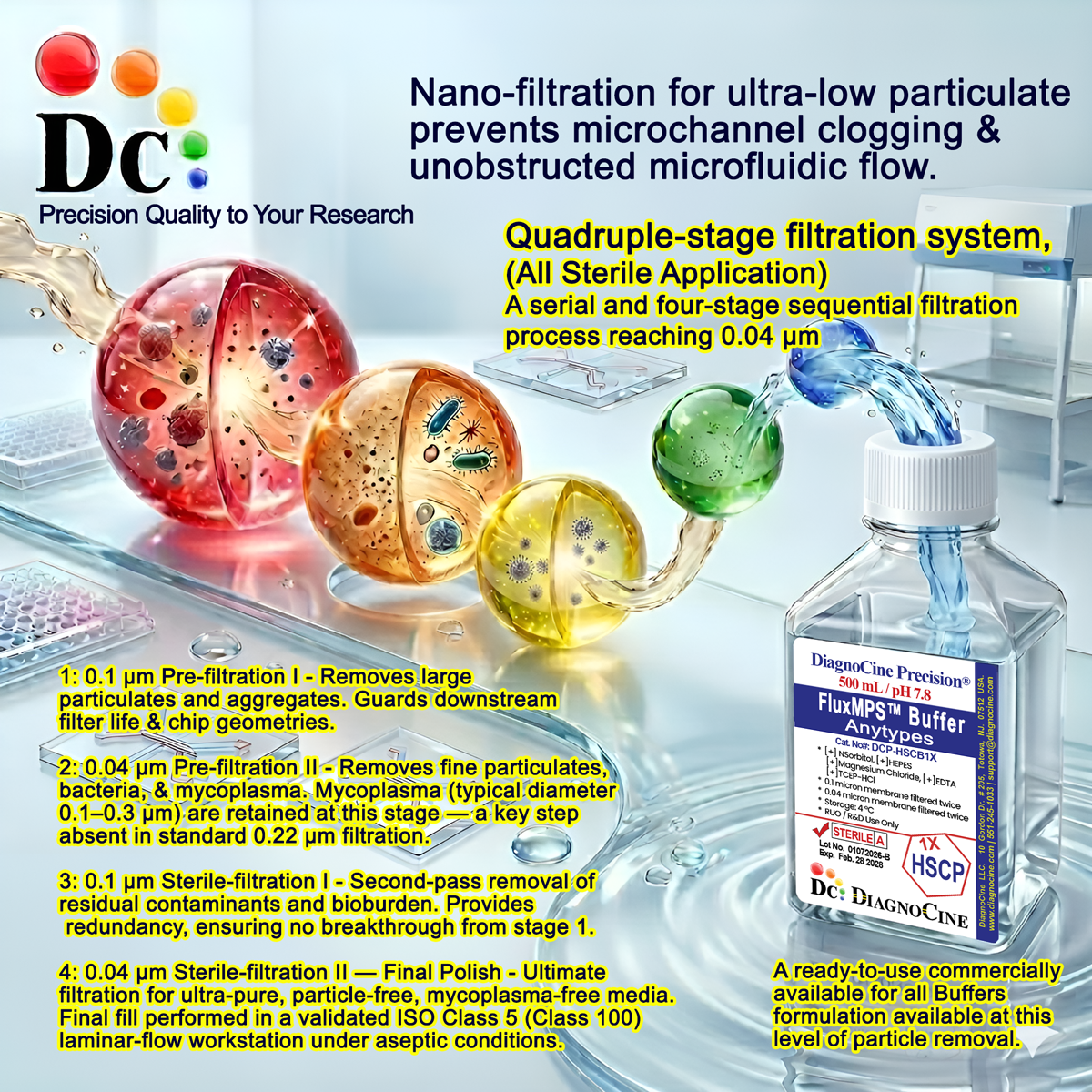
- Quadruple-stage filtration: filtered 0.1 micron twice and 0.04 micron twice, in a sterile environment.
- Optimization is expected. Buffer composition may need to be tuned to the specific protein of interest, and for challenging transfers the methanol concentration can be adjusted or SDS added.
- Products on this page4
- Catalog entries8
- Transfer chemistries3
- 1X ready-to-use products2
- 10X concentrate products2
- Sizes500 ml · 1000 ml
- AppearanceClear, Colorless Liquid
- Filtration0.1 µm ×2 + 0.04 µm ×2
- Fill environmentsterile environment
- Storage4 °C
Six things the source says this step has to do
Transfer is the point where a good gel becomes a good blot — or does not. Each card below is one property the source attributes to Tris-based transfer buffers.
Integral to Western blotting
The source's own framing. The transfer buffer is not a consumable detail — it is the medium the entire blot depends on, sitting between electrophoresis and detection.
Efficient transfer, gel to membrane
The buffer facilitates the efficient transfer of proteins from gels to membranes. Efficiency here is recovery: protein left behind in the gel never reaches the antibody.
Protein integrity maintained
Transfer has to move the protein without damaging it. The source names maintaining protein integrity as a defining requirement of the step, alongside efficiency.
Composition follows the target
The choice of buffer composition may need to be optimized based on the specific proteins of interest and the experimental requirements — which is why this family carries three chemistries rather than one.
Methanol is a lever
For challenging transfers, adjusting the methanol concentration is one of the two modifications the source names as a way to improve transfer efficiency.
SDS is the other lever
Adding SDS is the second named modification for challenging transfers. Both levers are expected adjustments, not signs that something has gone wrong.
Pick the chemistry first, then the format
Two decisions, in order. The chemistry — Tris-CAPS, Tris-Glycine non-denaturing, or Bis-Tris — is a protocol decision driven by the protein of interest. The format — 1X ready-to-use or 10X concentrate — is a throughput and storage decision, and the Tris-Glycine non-denaturing formulation is available either way.
Quadruple-stage filtration, in a sterile environment
The published sterility statement for this family is a four-pass membrane process: 0.1 micron twice, then 0.04 micron twice. A transfer buffer floods the gel, the membrane, and the stack, so anything it carries ends up on the blot surface you are about to image.
-
1
0.1 µm Pre-filtration I
First pass through a 0.1-micron membrane.
-
2
0.04 µm Pre-filtration II
First pass through a 0.04-micron membrane.
-
3
0.1 µm Sterile-filtration I
Second pass through a 0.1-micron membrane, performed in a sterile environment.
-
4
0.04 µm Sterile-filtration II — Final Polish
Final 0.04-micron polishing pass in a sterile environment. The buffer is delivered as a clear, colorless liquid.
Why the polish matters on a blot
Particulate that settles on a membrane during transfer does not wash off cleanly and shows up later as speckle in the imaged lane. An ultra-filtered, ultra-low-particulate buffer keeps that background off the membrane before blocking and detection ever begin.
The three levers the source names
Transfer buffers are expected to be tuned rather than used blind. These are the adjustments the source identifies, reproduced as published.
| Lever | When it applies | What the source says |
|---|---|---|
| Buffer composition | Any transfer | The choice of buffer composition may need to be optimized based on specific proteins of interest and experimental requirements. |
| Methanol concentration | Challenging transfers | Adjusting methanol concentration may be necessary to improve transfer efficiency. |
| SDS | Challenging transfers | Adding SDS may be necessary to improve transfer efficiency. |
Which products share which buffer system
The same four products, regrouped by buffer chemistry rather than catalog order. Every entry is reproduced from the catalog above.
- FluxMPS™ Tris CAPS buffer 10X — DCP-TCAPS10X · 500 ml, 1000 ml
- FluxMPS™ Tris-Glycine Non-Denaturing Buffer — DCP-TGNDB1X · 500 ml, 1000 ml · 1X ready-to-use
- FluxMPS™ Tris-Glycine Non-Denaturing Buffer [10X] — DCP-TGNDRB10X · 500 ml, 1000 ml · 10X concentrate
- FluxMPS™ Bis-Tris Transfer Buffer — DCP-BTTB1X · 500 ml, 1000 ml
What every product in this family has in common
The published specification block for the Tris Based Transfer Buffers family, reproduced value for value.
| Storage | 4 °C |
|---|---|
| Appearance | Clear, Colorless Liquid |
| Sterility | Filtered 0.1 micron twice and 0.04 micron twice, in a sterile environment |
Frequently asked questions
The questions that come up most often when choosing a transfer buffer.
Primary sources behind the method
The source description carries no reference list. The entries below are the primary reports for electrophoretic transfer and for the buffer systems this family is built on.
- Towbin, H., Staehelin, T., & Gordon, J. (1979). Electrophoretic transfer of proteins from polyacrylamide gels to nitrocellulose sheets: procedure and some applications. Proceedings of the National Academy of Sciences USA, 76(9), 4350–4354. — The paper that established electrophoretic protein transfer from gel to membrane, and with it the Tris-glycine transfer buffer that the Western blotting workflow was built on.doi:10.1073/pnas.76.9.4350
- Matsudaira, P. (1987). Sequence from picomole quantities of proteins electroblotted onto polyvinylidene difluoride membranes. Journal of Biological Chemistry, 262(21), 10035–10038. — Introduced CAPS-based transfer for electroblotting onto PVDF, the reason CAPS buffers exist alongside Tris-glycine in a transfer-buffer catalog.
- Laemmli, U. K. (1970). Cleavage of structural proteins during the assembly of the head of bacteriophage T4. Nature, 227(5259), 680–685. — The discontinuous Tris-glycine SDS system that the gel upstream of the transfer step is almost always run in, and the origin of the glycine and SDS the transfer buffer has to work with.