


Tris Based Running Buffers
Select See the table below
- See the table below
Tris Based Running Buffers - Category Selection Guide
This is a category page, not a product page. Pick the buffer your gel calls for and click View to open its product page — the shared specification, the filtration architecture, and the application guidance follow below.
| Cat. No. | pH | Size |
|---|---|---|
| DCP-TTSDSRB1X | 8.3 | 500 ml |
| DCP-TTSDSRB1X | 8.3 | 1000 ml |
| DCP-TGSB1X | 8.3 | 500 ml |
| DCP-TGSB1X | 8.3 | 1000 ml |
| DCP-TGNDB1X | 8.3 | 500 ml |
| DCP-TGNDB1X | 8.3 | 1000 ml |
| DCP-MESSDSRB1X | 7.3 | 500 ml |
| DCP-MESSDSRB1X | 7.3 | 1000 ml |
| DCP-MOPSSDSRB1X | 7.7 | 500 ml |
| DCP-MOPSSDSRB1X | 7.7 | 1000 ml |
| DCP-TAE1X | 8.0 | 500 ml |
| DCP-TAE1X | 8.0 | 1000 ml |
| DCP-TBERB1X | 8.3 | 500 ml |
| DCP-TBERB1X | 8.3 | 1000 ml |
Not sure which buffer? See the shared specification · See the buffers by group · Read the FAQ
What the tank buffer is actually doing
Tris based buffers play a crucial role in maintaining consistent pH, providing ions for conductivity, and ensuring efficient and reproducible protein separation in gel electrophoresis experiments. Tris provides effective buffering in the alkaline range.
The specification every buffer in this family shares, and the one value that separates them.
- Seven buffers stocked: Tris-Tricine SDS Running Buffer, Tris-Glycine SDS Buffer, Tris-Glycine Non-Denaturing Buffer, MES SDS Running Buffer, MOPS SDS Running Buffer, Tris Acetate EDTA Buffer, and Tris Borate EDTA Running Buffer.
- Three jobs, one solution: consistent pH, ions for conductivity, and efficient, reproducible protein separation.
- pH is the differentiator: the family runs from 7.3 to 8.3 — MES at 7.3, MOPS at 7.7, Tris Acetate EDTA at 8.0, and the remaining four at 8.3.
- Alkaline-range buffering: Tris provides effective buffering in the alkaline range.
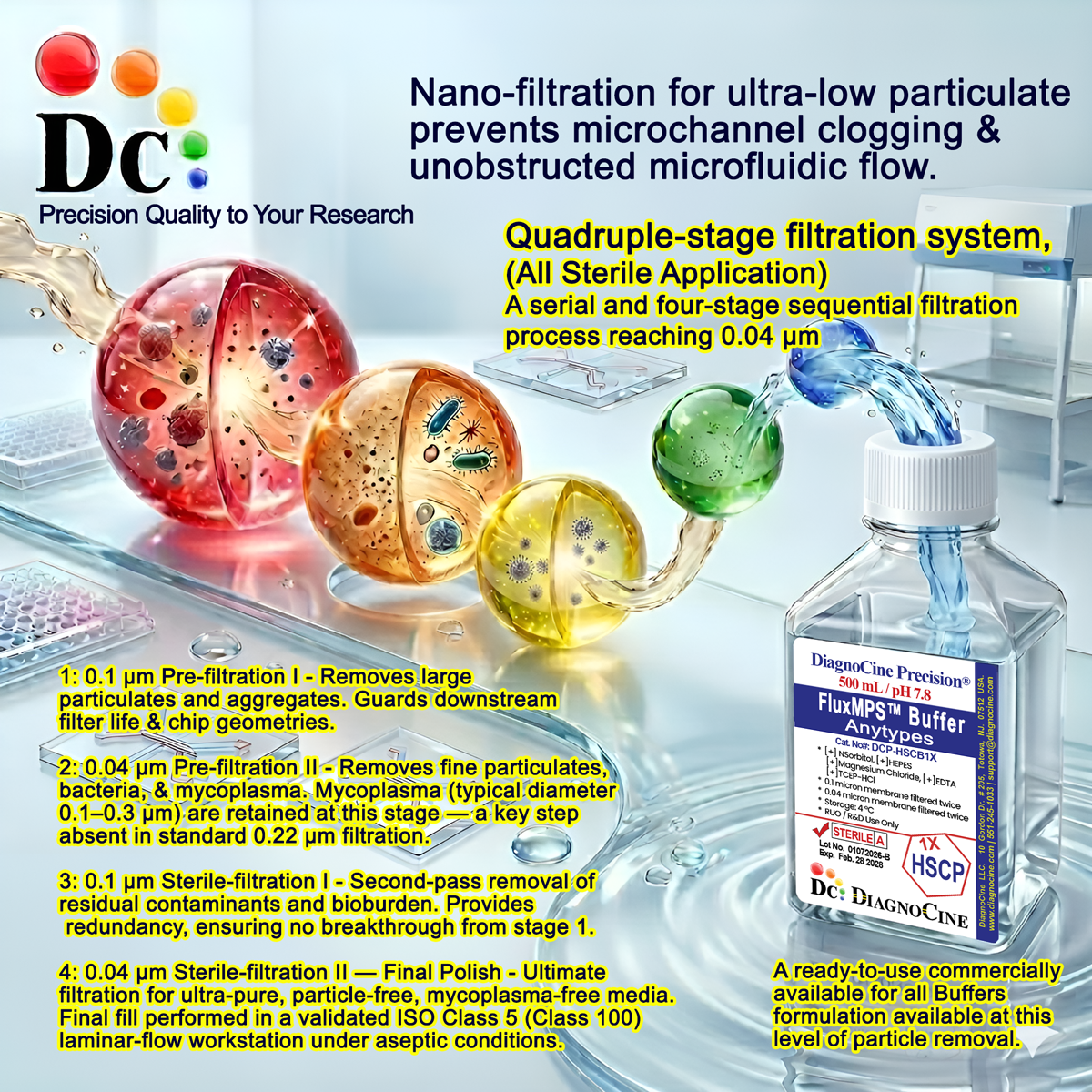
- Quadruple-stage filtration: filtered 0.1 micron twice and 0.04 micron twice, in a sterile environment — sub-0.1 µm polishing on every fill.
- Appearance: clear, colorless liquid — a one-second incoming check before a bottle goes on the bench.
- Two fill volumes: every product is offered in 500 ml and 1000 ml under one catalog number.
- Products in this category7
- Catalog rows (product × fill size)14
- Fill volumes500 ml · 1000 ml
- Stated pH values7.3 · 7.7 · 8.0 · 8.3
- Lowest stated pH7.3 (MES SDS Running Buffer)
- Highest stated pH8.3 (four products)
- Filtration architecture0.1 µm ×2 + 0.04 µm ×2
- Fill environmentsterile environment
- Appearanceclear, colorless liquid
- Tris buffering rangealkaline
Three jobs the tank buffer has to do at once
A running buffer is not just the liquid the gel sits in. Each panel below is one of the roles the source assigns to it, plus the two specifications that decide whether a given lot can play them.
Consistent pH
Tris based buffers play a crucial role in maintaining consistent pH through the run. Every product in this family carries its own stated pH, from 7.3 to 8.3.
Ions for conductivity
The buffer provides the ions that carry current through the gel. Without a defined ionic supply there is no reproducible field, and without that there is no reproducible migration.
Efficient, reproducible separation
The point of the first two jobs is the third: ensuring efficient and reproducible protein separation in gel electrophoresis experiments.
Buffering in the alkaline range
Tris provides effective buffering in the alkaline range, which is where four of the seven products in this family sit, at pH 8.3.
Ultra-low particulate by architecture
Filtered 0.1 micron twice and 0.04 micron twice in a sterile environment. Sub-0.1 µm polishing is what makes these buffers microchannel-safe for automated and microfluidic handling.
Clear, colorless liquid
Appearance is a specification, not a description. A clear, colorless liquid is the expected state on receipt, and any deviation is worth raising before the bottle is poured into a tank.
Read the pH, then read the name
Every product in this family shares the same filtration architecture, the same sterile-environment fill, the same appearance specification, and the same two fill volumes. The one specification the source varies across the catalog is pH — 7.3, 7.7, 8.0, or 8.3 — so that is the value to match against the protocol before anything else.
Quadruple-stage: 0.1 µm twice, 0.04 µm twice
The source states one sterility specification for the whole family: filtered 0.1 micron twice and 0.04 micron twice, in a sterile environment. Four membrane passes, in this order.
-
1
0.1 µm Pre-filtration I
The first 0.1 micron pass takes out the bulk particulate load before any polishing membrane sees the solution.
-
2
0.04 µm Pre-filtration II
The first 0.04 micron pass drops the retained size well below what a conventional sterilizing filter reaches.
-
3
0.1 µm Sterile-filtration I
The second 0.1 micron pass is run inside the sterile environment in which the product is filled.
-
4
0.04 µm Sterile-filtration II — Final Polish
The final 0.04 micron pass is the last thing the solution passes through before it reaches the bottle.
Why the last pass is the one that matters
A 0.04 micron final polish is the specification that lets these buffers be described as ultra-low particulate and microchannel-safe. It is the architecture, not an adjective, that supports the claim — and it is stated identically for every product in this family.
What every buffer in this family has in common
Four of the five specifications below are identical across all seven products. Only pH varies — which is why the catalog above sorts on it.
| Parameter | Stated specification | Scope |
|---|---|---|
| Sterility | Filtered 0.1 micron twice and 0.04 micron twice, in a sterile environment | All 7 products |
| Appearance | Clear, colorless liquid | All 7 products |
| Fill volumes | 500 ml and 1000 ml | All 7 products |
| Buffering range (Tris) | Effective buffering in the alkaline range | Stated for the category |
| pH | 7.3, 7.7, 8.0, or 8.3 depending on the product | Varies — see the catalog |
How the seven buffers group by name
Select a group to see which products carry that token in their source name, and what the source states about the family's function.
- Tris-Tricine SDS Running Buffer — pH 8.3
- Tris-Glycine SDS Buffer — pH 8.3
- MES SDS Running Buffer — pH 7.3
- MOPS SDS Running Buffer — pH 7.7
- All four maintain consistent pH, provide ions for conductivity, and support efficient and reproducible protein separation in gel electrophoresis experiments.
- Tris-Glycine Non-Denaturing Buffer — pH 8.3
- The only product in the family whose source name states a non-denaturing format.
- It carries the same sterility, appearance, and fill-volume specification as every other member.
- Tris Acetate EDTA Buffer — pH 8.0
- Tris Borate EDTA Running Buffer — pH 8.3
- Both carry the EDTA token in their source name and the family's shared sterility, appearance, and fill-volume specification. The source states no application for either individually — see the product page.
Frequently asked questions
The questions that come up most often when a gel protocol meets a purchasing spec.
The buffer systems behind these products
The source carries no citations of its own. The papers below are the primary literature defining the discontinuous and Tricine buffer systems this family is named for, each verified against the publisher record.
- Ornstein, L. (1964). Disc electrophoresis — I: Background and theory. Annals of the New York Academy of Sciences, 121(2), 321–349. — The theory of the discontinuous (stacking / resolving) buffer system on which Tris-based gel electrophoresis rests. doi:10.1111/j.1749-6632.1964.tb14207.x
- Davis, B. J. (1964). Disc electrophoresis — II: Method and application to human serum proteins. Annals of the New York Academy of Sciences, 121(2), 404–427. — The companion method paper that put the discontinuous system into practice.
- Laemmli, U. K. (1970). Cleavage of structural proteins during the assembly of the head of bacteriophage T4. Nature, 227(5259), 680–685. — The paper that introduced the Tris-glycine SDS discontinuous system still used for routine SDS-PAGE. doi:10.1038/227680a0
- Good, N. E., Winget, G. D., Winter, W., Connolly, T. N., Izawa, S., & Singh, R. M. M. (1966). Hydrogen ion buffers for biological research. Biochemistry, 5(2), 467–477. — The paper that established the design criteria for near-neutral biological buffers, MES among them. doi:10.1021/bi00866a011
- Schägger, H., & von Jagow, G. (1987). Tricine-sodium dodecyl sulfate-polyacrylamide gel electrophoresis for the separation of proteins in the range from 1 to 100 kDa. Analytical Biochemistry, 166(2), 368–379. — The original Tricine-SDS system, using Tricine as the trailing ion to resolve small proteins at lower acrylamide concentrations than glycine-SDS systems. doi:10.1016/0003-2697(87)90587-2
- Schägger, H. (2006). Tricine–SDS-PAGE. Nature Protocols, 1(1), 16–22. — The modern step-by-step protocol for the Tricine system, including staining and electroblotting. doi:10.1038/nprot.2006.4