


Tris Based Lysis/Extraction Buffers
Select See the table below
- See the table below
FluxMPS™ Tris Based Lysis/Extraction Buffers
This is a family overview, not an orderable page. Pick the formulation — or the pre-blended protease-inhibitor version — and click View to reach its own product page.
| Name | Special | Cat. No. | Size | Product Page |
|---|---|---|---|---|
|
water_dropTris Based Lysis/Extraction Buffers · 5 products · 10 sizes
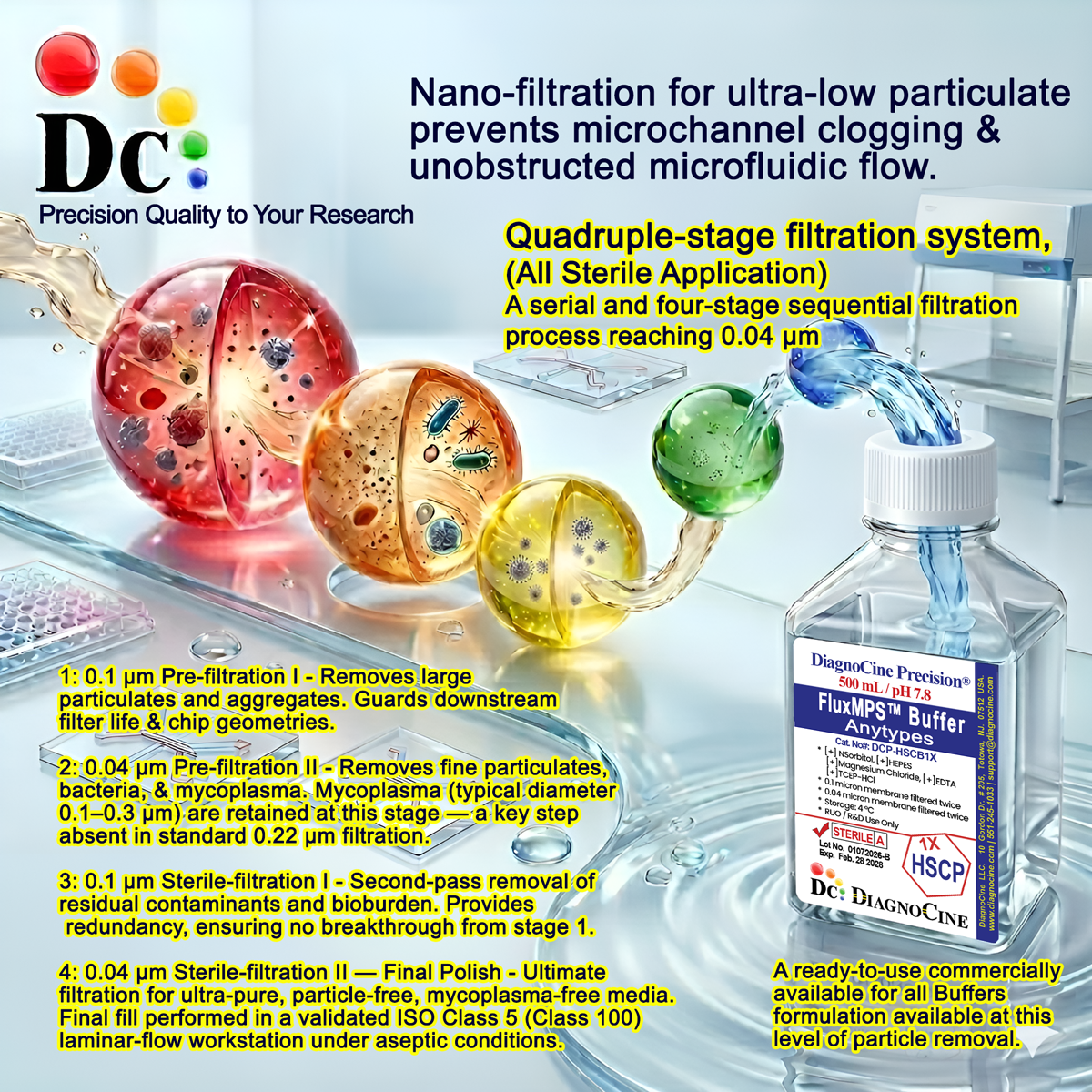
Base detergent buffers. Clear, colorless liquid · filtered 0.1 µm twice, then 0.04 µm twice, in a sterile environment · stored at 4 °C. See the filtration architecture.
|
||||
| Nonidet-P40 (NP-40) Buffer | Contains Glycerol | DCP-NP401X_100 ml | 100 ml | Viewarrow_forward |
| Nonidet-P40 (NP-40) Buffer | Contains Glycerol | DCP-NP401X_500 ml | 500 ml | Viewarrow_forward |
| Tris NP-40 Buffer | DCP-TNP1X_500 ml | 500 ml | Viewarrow_forward | |
| Tris NP-40 Buffer | DCP-TNP1X_1000 ml | 1000 ml | Viewarrow_forward | |
| RIPA Buffer | DCP-RIPA1X_100 ml | 100 ml | Viewarrow_forward | |
| RIPA Buffer | DCP-RIPA1X_500 ml | 500 ml | Viewarrow_forward | |
| Cytoskeleton Extraction Buffer | DCP-CEB1X_100 ml | 100 ml | Viewarrow_forward | |
| Cytoskeleton Extraction Buffer | DCP-CEB1X_500 ml | 500 ml | Viewarrow_forward | |
| Tris Triton-X Buffer | DCP-TTXB1X_100 ml | 100 ml | Viewarrow_forward | |
| Tris Triton-X Buffer | DCP-TTXB1X_500 ml | 500 ml | Viewarrow_forward | |
|
inventory_2Protease Inhibitor Cocktail Pre-Blends · 4 products
Ready-to-use combinations of the seven-component protease inhibitor cocktail with a Tris-based buffer. See the cocktail components.
|
||||
| Protease Inhibitor Cocktail with NP-40 Buffer | DCP-PICTNP1X | 10 x 10 mL | Viewarrow_forward | |
| Protease Inhibitor Cocktail with RIPA Buffer | DCP-PICTRIPA1X | 10 x 10 mL | Viewarrow_forward | |
| Protease Inhibitor Cocktail with Tris Triton-X Buffer | DCP-PICTTX1X | 10 x 10 mL | Viewarrow_forward | |
| Protease Inhibitor Cocktail with Tris Tween 20 Buffer | DCP-PICTT201X | 10 x 10 mL | Viewarrow_forward | |
Not sure which one? Compare by formulation · See the cocktail components · Read the shared specifications · Read the FAQ
Five formulations on one Tris platform
Tris-based buffers provide an effective and versatile option for protein extraction and lysis, with the specific formulation depending on the experimental needs and protein characteristics. Their ability to maintain physiological pH and compatibility with various additives make them a popular choice in molecular biology and biochemistry research.
- Nine products, fourteen catalog entries. Five base lysis/extraction buffers across ten sizes, plus four ready-to-use protease inhibitor cocktail pre-blends.
- Five distinct formulations: Nonidet-P40 (NP-40) Buffer, Tris NP-40 Buffer, RIPA Buffer, Cytoskeleton Extraction Buffer, and Tris Triton-X Buffer.
- One product carries a stated special attribute: Nonidet-P40 (NP-40) Buffer contains glycerol.
- Supplied as a clear, colorless liquid and stored at 4 °C.
- Quadruple-stage filtration: filtered 0.1 micron twice and 0.04 micron twice, in a sterile environment.
- Inhibitors are expected, not assumed. For protein extraction, protease inhibitors are often added to prevent proteolysis; enzyme inhibitors like phosphatase inhibitors may also be included for specific studies.
- Seven inhibitor components in the pre-blends: AEBSF·HCl, Aprotinin, Bestatin, E-64, EDTA, Leupeptin, and Pepstatin A.
- Products on this page9
- Base lysis/extraction buffers5
- Protease inhibitor pre-blends4
- AppearanceClear, Colorless Liquid
- Filtration0.1 µm ×2 + 0.04 µm ×2
- Fill environmentsterile environment
- Storage4 °C
- Base buffer sizes100 ml · 500 ml · 1000 ml
- Pre-blend size10 x 10 mL
- Cocktail components7
Six reasons this family is the versatile default
Each card below is one property the source attributes to Tris-based lysis and extraction buffers.
Effective and versatile
The source's own framing: Tris-based buffers are an effective and versatile option for protein extraction and lysis — which is why this family carries five formulations rather than one.
The formulation follows the target
The specific formulation depends on the experimental needs and the protein characteristics. That is a selection decision, not a default — NP-40, Triton-X, RIPA, and cytoskeleton extraction are different answers to different targets.
Physiological pH
The ability to maintain physiological pH is one of the two properties the source names as making these buffers a popular choice in molecular biology and biochemistry research.
Compatibility with additives
The second named property. It is what makes the pre-blended protease inhibitor versions in the second catalog band possible, and what lets you add your own inhibitors to the base buffers.
Detergents open the cell
The method utilizes detergents to disrupt cell membranes and solubilize proteins. Across this family that means NP-40, Triton-X, the multi-detergent RIPA formulation, or the cytoskeleton extraction formulation.
Inhibitors are part of the plan
For protein extraction, protease inhibitors are often added to prevent proteolysis, and enzyme inhibitors like phosphatase inhibitors may also be included for specific studies. The pre-blends ship that step already done.
Pick the formulation first, then decide who adds the inhibitors
The two catalog bands answer two different questions. The base band is where you choose the chemistry that matches your target. The pre-blend band is where you decide whether the seven-component cocktail arrives already combined with that buffer, or whether you add inhibitors yourself at the bench.
Quadruple-stage filtration, in a sterile environment
The published sterility statement for this family is a four-pass membrane process: 0.1 micron twice, then 0.04 micron twice. A lysis buffer is added directly to the sample and travels with it downstream, so whatever the buffer carries becomes part of the lysate.
-
1
0.1 µm Pre-filtration I
First pass through a 0.1-micron membrane.
-
2
0.04 µm Pre-filtration II
First pass through a 0.04-micron membrane.
-
3
0.1 µm Sterile-filtration I
Second pass through a 0.1-micron membrane, performed in a sterile environment.
-
4
0.04 µm Sterile-filtration II — Final Polish
Final 0.04-micron polishing pass in a sterile environment. The buffer is delivered as a clear, colorless liquid.
Why the polish matters in a lysate
An ultra-filtered, ultra-low-particulate buffer keeps background out of colorimetric assays, gel electrophoresis, and quantitative immunodetection, and keeps it out of microfluidic and organ-on-a-chip (OoC) sample handling — where a particulate that would be invisible in a cuvette can block a channel.
The seven components and what each one stops
These ready-to-use combinations of a protease inhibitor cocktail with various lysis buffers provide a powerful tool for efficient protein extraction while preserving protein integrity. This method utilizes detergents to disrupt cell membranes and solubilize proteins, while the carefully formulated protease inhibitor cocktail prevents protein degradation during the lysis process.
| Component | What it inhibits |
|---|---|
| AEBSF·HCl | A serine protease inhibitor |
| Aprotinin | Targets serine proteases and has anti-inflammatory properties |
| Bestatin | An aminopeptidase inhibitor[4] |
| E-64 | A cysteine protease inhibitor[2] |
| EDTA | A metalloproteinase inhibitor |
| Leupeptin | Inhibits both serine and cysteine proteases[5] |
| Pepstatin A | An aspartic protease inhibitor[3] |
Which products share which chemistry
The same nine products, regrouped by formulation rather than by catalog band. Every entry is reproduced from the catalog above.
- Nonidet-P40 (NP-40) Buffer — DCP-NP401X · 100 ml, 500 ml · Contains Glycerol
- Tris NP-40 Buffer — DCP-TNP1X · 500 ml, 1000 ml
- Protease Inhibitor Cocktail with NP-40 Buffer — DCP-PICTNP1X · 10 x 10 mL
- Tris Triton-X Buffer — DCP-TTXB1X · 100 ml, 500 ml
- Protease Inhibitor Cocktail with Tris Triton-X Buffer — DCP-PICTTX1X · 10 x 10 mL
- RIPA Buffer — DCP-RIPA1X · 100 ml, 500 ml
- Protease Inhibitor Cocktail with RIPA Buffer — DCP-PICTRIPA1X · 10 x 10 mL
- Cytoskeleton Extraction Buffer — DCP-CEB1X · 100 ml, 500 ml
- Protease Inhibitor Cocktail with Tris Tween 20 Buffer — DCP-PICTT201X · 10 x 10 mL
What every product in this family has in common
The published specification block for the Tris Based Lysis/Extraction Buffers family, reproduced value for value.
| Storage | 4 °C |
|---|---|
| Appearance | Clear, Colorless Liquid |
| Sterility | Filtered 0.1 micron twice and 0.04 micron twice, in a sterile environment |
Frequently asked questions
The questions that come up most often when choosing within this family.
Primary sources behind the chemistry
The source description carries no reference list. The entries below are the primary reports for the detergent mechanism, for the RIPA workflow this family is partly named after, and for the cocktail components whose original literature could be verified.
- Helenius, A., & Simons, K. (1975). Solubilization of membranes by detergents. Biochimica et Biophysica Acta (BBA) – Reviews on Biomembranes, 415(1), 29–79. — How detergent class, concentration, and critical micelle concentration govern membrane solubilization; the basis for every detergent-based lysis buffer, including NP-40 and Triton-X formulations.doi:10.1016/0304-4157(75)90016-7
- Hanada, K., Tamai, M., Yamagishi, M., Ohmura, S., Sawada, J., & Tanaka, I. (1978). Isolation and characterization of E-64, a new thiol protease inhibitor. Agricultural and Biological Chemistry, 42(3), 523–528. — The original isolation of E-64 from Aspergillus japonicus, reported as a specific, irreversible inhibitor of thiol (cysteine) proteases.doi:10.1271/bbb1961.42.523
- Umezawa, H., Aoyagi, T., Morishima, H., Matsuzaki, M., & Hamada, M. (1970). Pepstatin, a new pepsin inhibitor produced by Actinomycetes. The Journal of Antibiotics, 23(5), 259–262. — The original report of pepstatin, the reference inhibitor of aspartic proteases.
- Umezawa, H., Aoyagi, T., Suda, H., Hamada, M., & Takeuchi, T. (1976). Bestatin, an inhibitor of aminopeptidase B, produced by actinomycetes. The Journal of Antibiotics, 29(1), 97–99. — The original report of bestatin as an aminopeptidase inhibitor.
- Aoyagi, T., Takeuchi, T., Matsuzaki, A., Kawamura, K., Kondo, S., Hamada, M., Maeda, K., & Umezawa, H. (1969). Leupeptins, new protease inhibitors from actinomycetes. The Journal of Antibiotics, 22(6), 283–286. — The original report of the leupeptins, which inhibit both serine and cysteine proteases.
- Kessler, S. W. (1975). Rapid isolation of antigens from cells with a staphylococcal protein A–antibody adsorbent: parameters of the interaction of antibody-antigen complexes with protein A. Journal of Immunology, 115(6), 1617–1624. — Established the protein A–based immunoprecipitation method underlying the radioimmunoprecipitation (RIPA) workflow that the RIPA Buffer in this family is named for.doi:10.4049/jimmunol.115.6.1617