


Tris Based Blocking Buffers
Select See the table below
- See the table below
Tris Based Blocking Buffers - Category Selection Guide
Five phosphate-free blocking formulations on two Tris-buffered bases, ten catalog numbers in 500 ml and 1000 ml. This page is a category reference — pick the formulation your detection chemistry needs and click View for its product page; specifications, filtration architecture and selection guidance follow below.
| Cat. No. | Base | Size |
|---|---|---|
| DCP-BSATBS3X_500 ml | TBS | 500 ml |
| DCP-BSATBS3X_1000 ml | TBS | 1000 ml |
| DCP-BSATBST3X_500 ml | TBST | 500 ml |
| DCP-BSATBST3X_1000 ml | TBST | 1000 ml |
| DCP-CTBS1X_500 ml | TBS | 500 ml |
| DCP-CTBS1X_1000 ml | TBS | 1000 ml |
| DCP-GTBS1X_500 ml | TBS | 500 ml |
| DCP-GTBS1X_1000 ml | TBS | 1000 ml |
| DCP-PVPTBS1X_500 ml | TBS | 500 ml |
| DCP-PVPTBS1X_1000 ml | TBS | 1000 ml |
Not sure which formulation? Compare the blocking agents · See applications by formulation · Read the FAQ
What the five formulations share, and where they part company
Tris-based blocking buffers provide an effective and versatile option for reducing non-specific binding in various protein detection techniques. Their phosphate-free nature makes them particularly suitable for phosphoprotein detection and alkaline phosphatase-based systems. The choice between different formulations depends on the specific requirements of the assay and the proteins being studied.
- Five formulations: Bovine Serum Albumin (3%) with TBS, Bovine Serum Albumin (3%) with TBST, Casein (1%) with TBS, Gelatin (1%) in TBS, and PVP in TBS.
- Two Tris-buffered bases: TBS and TBST, as published in the product names.
- Phosphate-free: the source identifies the phosphate-free nature of these buffers as what makes them particularly suitable for phosphoprotein detection and alkaline phosphatase-based systems.
- Appearance: Clear, Colorless Liquid.
- Sterility: filtered 0.1 micron twice and 0.04 micron twice, in a sterile environment.
- Fill sizes: every formulation is stocked in 500 ml and 1000 ml — ten catalog numbers in total.
- Selection basis: the source states that the choice between formulations depends on the specific requirements of the assay and the proteins being studied.
- CategoryTris Based Blocking Buffers
- Buffer bases stockedTBS, TBST
- Formulations5
- Catalog numbers10
- Fill sizes500 ml, 1000 ml
- AppearanceClear, Colorless Liquid
- Filtration0.1 µm twice, 0.04 µm twice
- Fill environmentsterile environment
- Blocking agentsBSA 3%, Casein 1%, Gelatin 1%, PVP
- Phosphate contentphosphate-free
Same base, different blocker, different blot
All five formulations sit on a Tris base, so the variable a buyer is actually choosing is the blocking agent. The published immunoassay literature is consistent on one point: that choice is not cosmetic. Each card below is cited to the reference list at the foot of the page.
Non-specific binding is the target
The source describes these buffers as an effective and versatile option for reducing non-specific binding in various protein detection techniques. Blocking occupies the sites on the solid phase that the probe would otherwise adsorb to.
The Tris base is phosphate-free
The source attributes the fit of this family to that phosphate-free nature, which it says makes these buffers particularly suitable for phosphoprotein detection and alkaline phosphatase-based systems.
The blocker changes what you detect
A direct comparison of serum albumin, non-fat dry milk and Tween 20 on nitrocellulose found quantitative and qualitative differences in the antigens detected, and recommended comparing several blocking and washing methods rather than assuming one.[2]
Blocking efficiency differs by agent
Across a million-fold concentration range on polystyrene plates, casein and instantized milk suppressed non-specific binding by over 90 % at far lower concentrations than most of eight other proteins; enzymatically hydrolysed porcine-skin gelatin was the least effective protein tested.[3]
Casein is itself a phosphoprotein
Casein is the primary blocking protein of non-fat dry milk and is a phosphoprotein, which is why casein-based blocking is reported as unsuitable for phospho-specific antibodies such as anti-phosphoserine and anti-phosphothreonine.[7]
A protein-free route exists
Polyvinylpyrrolidone was described as a blocking agent for immunochemical work precisely because it is not a protein[4]; it is also the long-standing blocking component of Denhardt’s hybridisation solution.[5]
The one decision this page exists to support
The source says the choice between formulations depends on the specific requirements of the assay and the proteins being studied — and the literature says where that bites hardest: a casein blocker and a phospho-specific antibody are a documented mismatch[7], while a purified single protein such as BSA carries its own caveat that preparations differ and need a blocking control.[6]
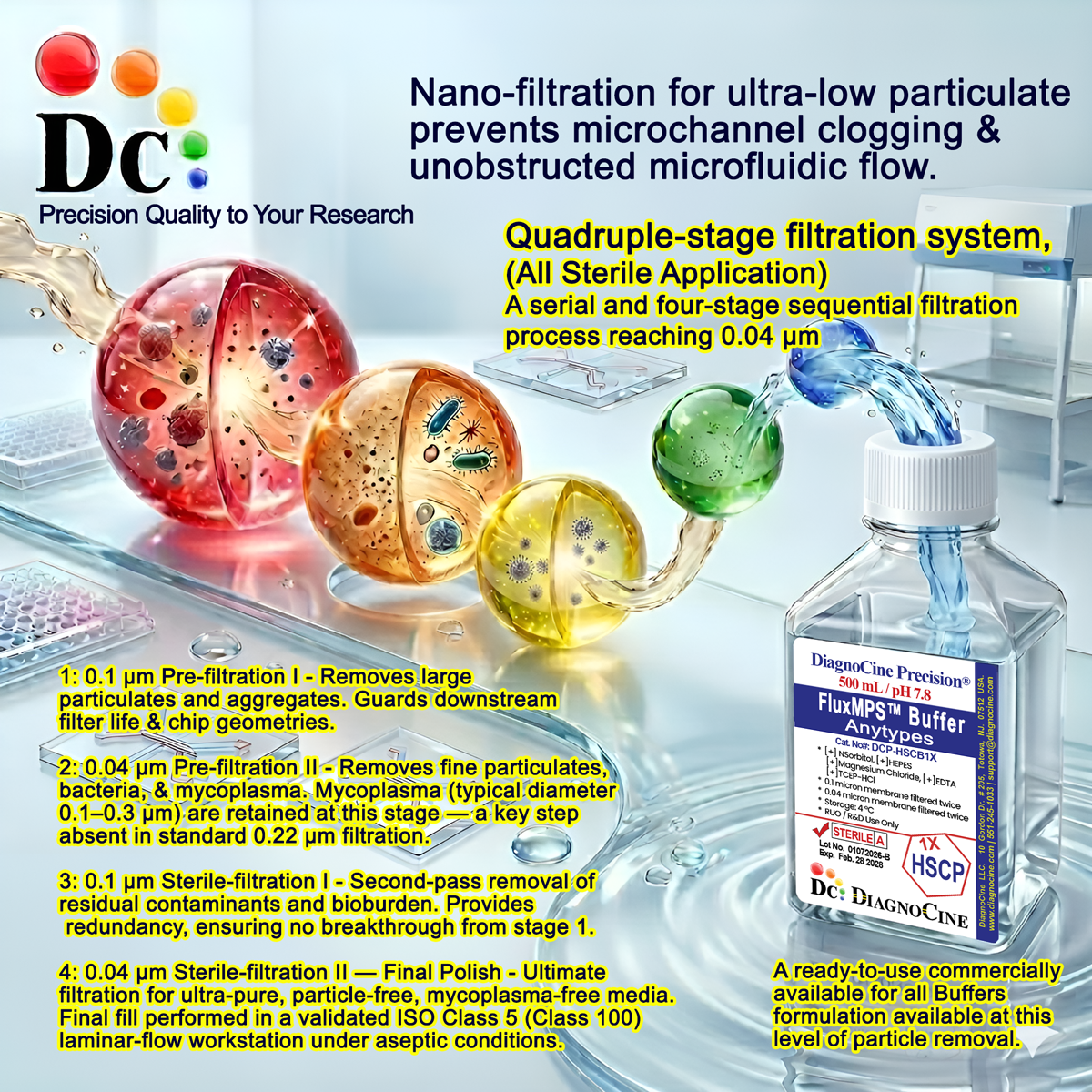
Four membrane passes, ending at 0.04 micron
The source states one sterility line for the whole family: filtered 0.1 micron twice and 0.04 micron in a sterile environment. Under the canonical house wording that is a four-stage architecture, and it is the same for every catalog number on this page.
-
1
0.1 µm Pre-filtration I
First pass through a 0.1 micron membrane, removing the bulk particulate and microbial load before the finer stages.
-
2
0.04 µm Pre-filtration II
Sub-0.1 micron pass, taking out the fine fraction that a 0.1 micron membrane passes.
-
3
0.1 µm Sterile-filtration I
Second 0.1 micron pass, performed in the sterile environment the source specifies for the fill.
-
4
0.04 µm Sterile-filtration II — Final Polish
Final 0.04 micron polish before fill. The delivered solution is a Clear, Colorless Liquid.
The five stocked agents, and what the literature records about each
The source does not publish a comparison table for this family, so the table below pairs each stocked formulation with the published characterisation of its blocking agent. Every entry is cited; nothing in the “Formulation” column has been altered from the catalog.
| Formulation (as stocked) | Agent class | What the published literature records | Watch-out |
|---|---|---|---|
| Bovine Serum Albumin (3%) with TBS Blocking Buffer | Single purified protein | Serum albumin is one of the standard blockers benchmarked against milk, casein and gelatin on plates and on nitrocellulose.[2,3] | BSA preparations are not interchangeable: non-specific binding to BSA has been traced to the preparation itself, so a blocking-agent control is advised.[6] |
| Bovine Serum Albumin (3%) with TBST Blocking Buffer | Single purified protein on a Tween-containing base | The non-ionic detergent Tween 20 was itself introduced as a means of blocking unoccupied protein-binding sites on nitrocellulose, in place of a protein.[1] | Tween 20 used alone as the blocking agent has been reported to give artefactual results, so it is generally used alongside a protein blocker rather than instead of one.[9] |
| Casein (1%) with TBS Blocking Buffer | Milk phosphoprotein | Casein and instantized milk were the most effective proteins tested for suppressing non-specific binding of a peroxidase conjugate, blocking by over 90 % at far lower concentrations than most alternatives.[3] | Casein is a phosphoprotein; casein-based blocking is reported as unsuitable for phospho-specific antibodies.[7] |
| Gelatin (1%) in TBS Blocking Buffer | Denatured collagen | Blocking performance depends strongly on the gelatin source: fish-skin gelatin blocked far better than enzymatically hydrolysed porcine-skin gelatin, which was the weakest protein in the series and was almost useless as a pre-treatment agent.[3] | The source does not state the gelatin origin for this catalog item. Confirm the source before assuming a performance figure from the literature applies. |
| PVP in TBS Blocking Buffer | Synthetic polymer, protein-free | Polyvinylpyrrolidone was characterised as a blocking agent for immunochemical studies[4], and is the classic blocking polymer of Denhardt’s membrane-hybridisation solution.[5] | The source does not state a PVP concentration for this catalog item, while the other four formulations carry one. |
Which formulation for which detection chemistry
The source assigns applications to the category as a whole, not to individual formulations. Each tab therefore states the source’s own category-level use first, then the published characterisation of that specific blocking agent, cited. Select a formulation to see both.
- Reducing non-specific binding in various protein detection techniques (source).
- Phosphoprotein detection and alkaline phosphatase-based systems, which the source attributes to the phosphate-free Tris base.
- Workflows where a single purified protein is preferred over a milk-derived blocker — casein-based blocking is reported as unsuitable for phospho-specific antibodies.[7]
- Run a blocking-agent control: non-specific binding has been traced to the BSA preparation itself rather than to the assay.[6]
- Reducing non-specific binding in various protein detection techniques (source).
- Protocols that keep a non-ionic detergent in the blocking step; Tween 20 was introduced as a way of blocking unoccupied protein-binding sites on nitrocellulose in place of a protein.[1]
- Phosphoprotein detection and alkaline phosphatase-based systems, on the same phosphate-free Tris base as the TBS version (source).
- Note that Tween 20 used alone as the blocking agent has been reported to produce artefactual results.[9]
- Reducing non-specific binding in various protein detection techniques (source).
- General protein detection where blocking strength is the priority: casein blocked non-specific binding by over 90 % at far lower concentrations than most of eight other proteins tested.[3]
- Not the formulation to reach for with phospho-specific antibodies — casein is itself a phosphoprotein.[7]
- Reducing non-specific binding in various protein detection techniques (source).
- An alternative when albumin- or milk-derived blockers cross-react with the probe; gelatin sits in the same benchmarked series as albumin, casein and milk.[3]
- Published performance is source-dependent: fish-skin gelatin blocked far better than enzymatically hydrolysed porcine-skin gelatin.[3] The Diagnocine source does not state which gelatin this item uses — confirm before transferring a literature figure to it.
- Reducing non-specific binding in various protein detection techniques (source).
- Workflows in which every protein blocker is a potential cross-reactant: polyvinylpyrrolidone was characterised as a blocking agent for immunochemical studies precisely because it is not a protein.[4]
- Membrane-hybridisation lineage: PVP is the classic blocking polymer of Denhardt’s solution.[5]
- Phosphoprotein detection and alkaline phosphatase-based systems, on the phosphate-free Tris base (source).
The five formulations side by side
Every value in this table is reproduced from the catalog exactly as published.
| Product | Blocking agent | Base | Catalog numbers | Sizes |
|---|---|---|---|---|
| Bovine Serum Albumin (3%) with TBS Blocking Buffer | Bovine Serum Albumin (3%) | TBS | DCP-BSATBS3X_500 ml DCP-BSATBS3X_1000 ml |
500 ml, 1000 ml |
| Bovine Serum Albumin (3%) with TBST Blocking Buffer | Bovine Serum Albumin (3%) | TBST | DCP-BSATBST3X_500 ml DCP-BSATBST3X_1000 ml |
500 ml, 1000 ml |
| Casein (1%) with TBS Blocking Buffer | Casein (1%) | TBS | DCP-CTBS1X_500 ml DCP-CTBS1X_1000 ml |
500 ml, 1000 ml |
| Gelatin (1%) in TBS Blocking Buffer | Gelatin (1%) | TBS | DCP-GTBS1X_500 ml DCP-GTBS1X_1000 ml |
500 ml, 1000 ml |
| PVP in TBS Blocking Buffer | PVP (concentration not stated in source) | TBS | DCP-PVPTBS1X_500 ml DCP-PVPTBS1X_1000 ml |
500 ml, 1000 ml |
Frequently asked questions
The questions that come up when a purchasing decision meets a detection chemistry.
Supporting literature on blocking agents
The Diagnocine source description carries no citation list of its own. The peer-reviewed sources below are the ones cited in the sections above; each was checked against its published record before it was listed.
- Batteiger B, Newhall WJ 5th, Jones RB (1982). The use of Tween 20 as a blocking agent in the immunological detection of proteins transferred to nitrocellulose membranes. J Immunol Methods 55(3):297–307. doi:10.1016/0022-1759(82)90089-8
- Spinola SM, Cannon JG (1985). Different blocking agents cause variation in the immunologic detection of proteins transferred to nitrocellulose membranes. J Immunol Methods 81(1):161–165. doi:10.1016/0022-1759(85)90132-2
- Vogt RF Jr, Phillips DL, Henderson LO, Whitfield W, Spierto FW (1987). Quantitative differences among various proteins as blocking agents for ELISA microtiter plates. J Immunol Methods 101(1):43–50. doi:10.1016/0022-1759(87)90214-6
- Haycock JW (1993). Polyvinylpyrrolidone as a blocking agent in immunochemical studies. Anal Biochem 208(2):397–399. doi:10.1006/abio.1993.1068
- Denhardt DT (1966). A membrane-filter technique for the detection of complementary DNA. Biochem Biophys Res Commun 23(5):641–646. doi:10.1016/0006-291X(66)90447-5
- Xiao Y, Isaacs SN (2012). Enzyme-linked immunosorbent assay (ELISA) and blocking with bovine serum albumin (BSA) — not all BSAs are alike. J Immunol Methods 384(1–2):148–151. doi:10.1016/j.jim.2012.06.009
- Galva C, Gatto C, Milanick M (2012). Soymilk: an effective and inexpensive blocking agent for immunoblotting. Anal Biochem 426(1):22–23. doi:10.1016/j.ab.2012.03.028 — source for the statement that casein is the primary blocking protein of non-fat dry milk and is a phosphoprotein, making it unsuitable for phospho-specific antibodies.
- Good NE, Winget GD, Winter W, Connolly TN, Izawa S, Singh RMM (1966). Hydrogen ion buffers for biological research. Biochemistry 5(2):467–477. doi:10.1021/bi00866a011
- Bird CR, Gearing AJH, Thorpe R (1988). The use of Tween 20 alone as a blocking agent for immunoblotting can cause artefactual results. J Immunol Methods 106(2):175–179.