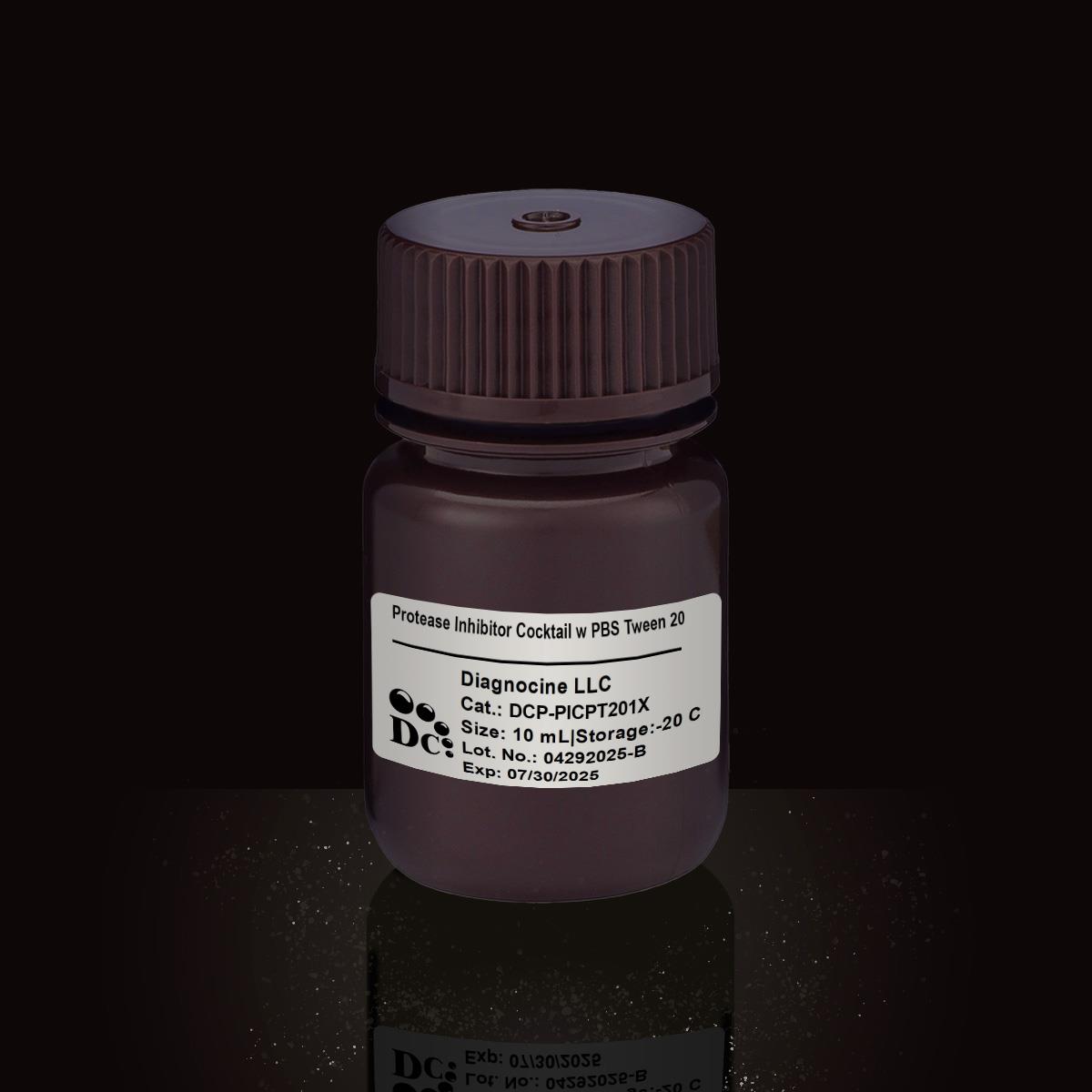
Protease Inhibitor Cocktail with PBS Tween 20 Buffer
FluxMPS™ Protease Inhibitor Cocktail with PBS Tween 20 Buffer
A ready-to-use, MPS-grade combination of a broad-spectrum protease inhibitor cocktail with PBS Tween 20 buffer, formulated for efficient cell lysis and protein extraction while preserving native protein integrity. The physiological ionic strength of PBS, the mild solubilizing action of Tween 20, and quadruple-stage ultra-filtration make this buffer microchannel-safe for sensitive protein-extraction workflows, including microfluidic and organ-on-a-chip (OoC) sample preparation.
- Quadruple-stage filtration: 0.1 µm membrane (applied twice) and 0.04 µm membrane (applied twice)
- Broad-spectrum protease inhibitor cocktail: AEBSF.HCl, Aprotinin, Bestatin, E-64, EDTA, Leupeptin, Pepstatin A
- Physiological PBS formulation with Tween 20 for efficient cell lysis and protein solubilization
- DNase- and RNase-activity tested (18 hr, room temperature)
- Sterile, ultrapure, ready-to-use format — 10 x 10 mL
- Microchannel-safe for organ-on-a-chip (OoC) and microfluidic protein-extraction workflows
- Manufactured under ISO 13485-certified, CE-approved facilities
- Customization available: alternate concentrations, tracking dyes, different pH, and other modifications
- Format10 x 10 mL
- AppearanceClear solution
- pHPhysiological (PBS-based)
- FormulationPBS with Tween 20 and protease inhibitor cocktail
- Filtration0.1 µm membrane (x2) + 0.04 µm membrane (x2)
- SterilitySterile, ultrapure
- DNase ActivityNone detected (18 hr, RT)
- RNase ActivityNone detected (18 hr, RT)
- Storage-80°C
- Shelf Life3 months
Engineered where standard lysis buffers fail
Conventional 0.22 µm-filtered lysis buffers carry subvisible particulates, inconsistent ionic strength, and no defined protease-inhibition strategy — conditions that accelerate proteolytic degradation and clog microfluidic channels. This buffer is built to remove those failure points at the source.
Microchannel-safe purity
Quadruple-stage 0.1 µm / 0.04 µm filtration removes particulates that would otherwise accumulate in microfluidic channels and biosensor surfaces during protein extraction.
Physiological, stable formulation
The PBS base delivers a defined, physiological ionic environment while Tween 20 aids controlled cell lysis and protein solubilization without harsh denaturation.
Ultrapure-grade water
Prepared with Ultrapure Type 1 water (18.2 MΩ·cm), consistent with USP <85> quality expectations for sensitive protein work.
Low background for downstream assays
Formulated to support clean results in Western blotting, immunoprecipitation, and enzymatic assays where background interference confounds interpretation.
Defined, traceable composition
Each protease inhibitor and buffer salt is added at a specified concentration, giving researchers a fully documented, reproducible formulation.
Customization on demand
Alternate concentrations, tracking dyes, different pH, and other formulation modifications are available — contact support@diagnocine.com.
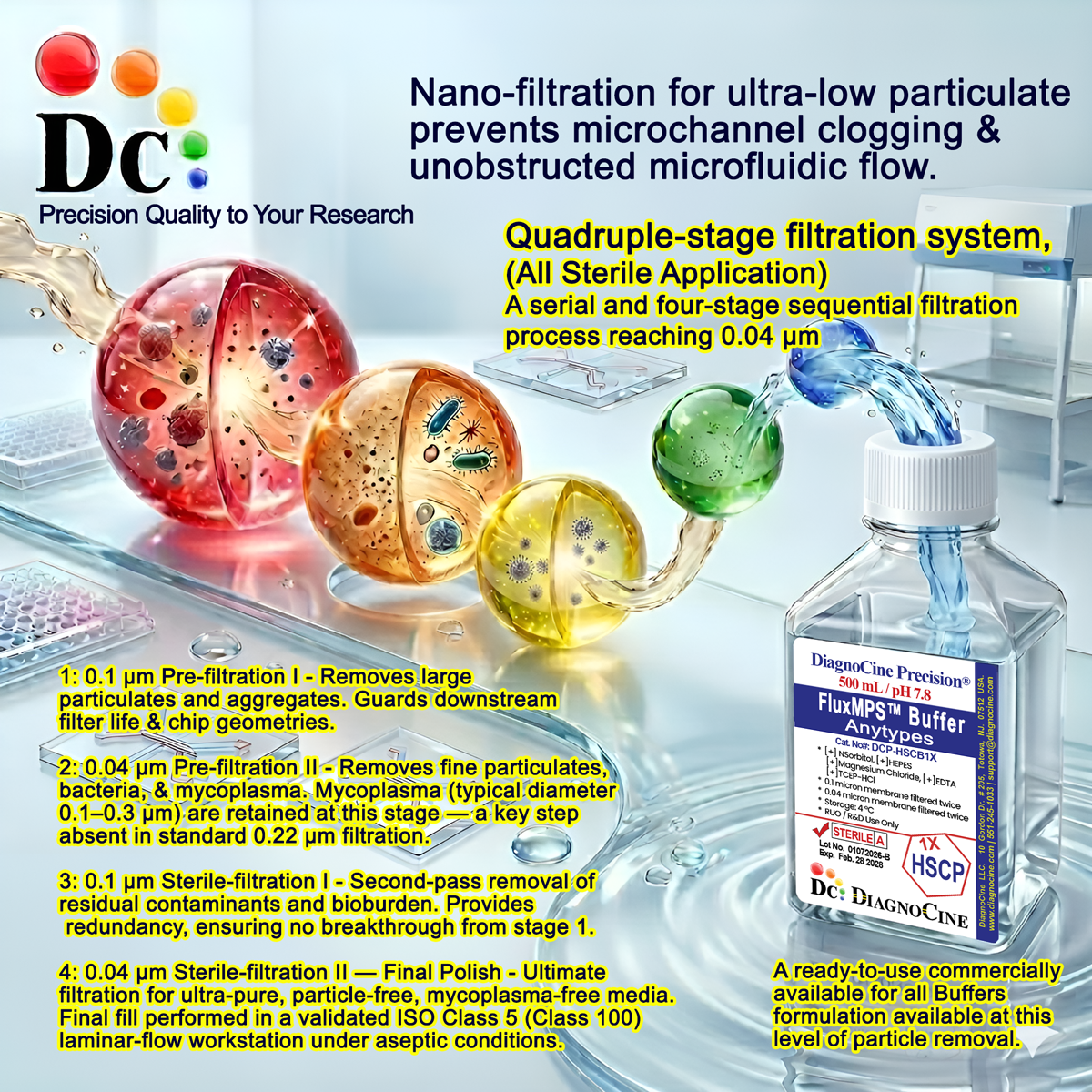
Quadruple-stage filtration system
Every lot is sequentially filtered through a 0.1 µm membrane twice and a 0.04 µm membrane twice, layering four discrete purification passes to protect sensitive protein samples and downstream microfluidic hardware.
-
1
0.1 µm Pre-filtration I
Removes large particulates and aggregates, extending the working life of the downstream filters.
-
2
0.04 µm Pre-filtration II
Retains fine particulates and bioburden ahead of the sterile-filtration passes.
-
3
0.1 µm Sterile-filtration I
Second-pass redundancy through the 0.1 µm membrane in a sterile environment.
-
4
0.04 µm Sterile-filtration II — Final Polish
Final 0.04 µm polish performed in a sterile environment to reduce the risk of mycoplasma contamination; the smallest known mycoplasma type is about 0.2 microns.
Performance vs. conventional buffer
Sequential 0.1 µm (applied twice) and 0.04 µm (applied twice) filtration removes finer particulates than a single 0.22 µm pass used in conventional lysis buffers, supporting cleaner downstream protein analysis and reduced microchannel fouling.
© Diagnocine® — DCP-PICPT201X
Where this buffer performs
The combination of a physiological PBS Tween 20 base with a multi-target protease inhibitor cocktail supports accurate, degradation-free analysis across a range of protein-focused workflows.
Automated Bioreactors & Robotics
An optional 0.01 µm (10 nm) ultra-filtered variant is available for automated bioreactor and robotic liquid-handling platforms where valve and sensor protection is critical.
- Total Particulate Exclusion for closed-loop automated systems
- Valve & Sensor Protection against fine particulate fouling
- Extended Perfusion Stability for long-duration protein-extraction runs
Inquiry Required: the 0.01 µm ultra-filtered grade is available upon request — contact support@diagnocine.com.
Micro Physiological System (MPS) & Chip
Microchannel-safe formulation for protein extraction within microfluidic and organ-on-a-chip platforms.
Wash, Dilution & Reconstitution
PBS Tween 20 base supports cell lysis, rinse, and reconstitution steps ahead of protein analysis.
iPSC-Derived Model Handling
Preserves native protein structure during lysis of sensitive iPSC-derived cell models.
Endothelial & Primary Cell Perfusion
Supports protein extraction from primary and endothelial cell cultures without proteolytic loss.
Western Blotting, Immunoprecipitation & Enzymatic Assays
Protease inhibition preserves protein samples for accurate downstream analysis and target enzyme activity studies.
Protein Target Studies
Supports research into protein targets and therapeutic development where proteolytic degradation must be minimized.
Specifications at a glance
Every parameter below is measured or declared for DCP-PICPT201X as manufactured.
| Parameter | Specification |
|---|---|
| Formulation / Composition | PBS with Tween 20 and protease inhibitor cocktail |
| Appearance | Clear solution |
| pH | Physiological (PBS formulation) |
| Sodium Chloride Concentration | 137 mM |
| Potassium Chloride Concentration | 2.7 mM |
| Sodium Phosphate Dibasic Concentration | 10 mM |
| Potassium Phosphate Monobasic Concentration | 1.8 mM |
| Tween 20 Concentration | 0.1% |
| Parameter | Specification |
|---|---|
| Sterility USP <71> | Filtered 0.1 µm membrane (x2) and 0.04 µm membrane (x2) in a sterile environment |
| DNase Activity | None detected (18 hr, room temperature, plasmid DNA) |
| RNase Activity | None detected (18 hr, room temperature, ribosomal RNA) |
| Water Purity | Ultrapure Type 1 water (18.2 MΩ·cm) |
| Filtration System | Quadruple-stage (0.1 µm x2, 0.04 µm x2) |
| Manufacturing Standard ISO 13485 | ISO 13485-certified, CE-approved facility |
| Parameter | Specification |
|---|---|
| Format | 10 x 10 mL |
| Storage Temperature | -80°C |
| Shelf Life | 3 months |
| Parameter | Specification |
|---|---|
| Manufacturing Facility | ISO 13485-certified, CE-approved (DiagnoCine Precision) |
| Quality Assurance & Testing | DiagnoCine R&D and Quality Testing Center |
| Customization & Assembly Location | Totowa, New Jersey, USA |
| Regulatory Alignment | ISO 13485-certified, CE-approved |
| Intended Use | Research Use Only (RUO) |
Full composition
Every protease inhibitor and buffer salt is added at a defined, controlled concentration.
| Component | CAS Number | Concentration |
|---|---|---|
| AEBSF.HCl | 30827-99-7 | 100 uM |
| Aprotinin | 9087-70-1 | 0.8 uM |
| Bestatin | 58970-76-6 | 0.05 mM |
| E-64 | 66701-25-5 | 1 uM |
| EDTA | 60-00-4 | 5 mM |
| Leupeptin | 103476-89-7 | 0.01 mM |
| Pepstatin A | 26305-03-3 | 1 uM |
| Tween 20 | 9005-64-5 | 0.1% |
| Potassium Chloride | 7447-40-7 | 2.7 mM |
| Sodium Chloride | 7647-14-5 | 137 mM |
| Sodium Phosphate Dibasic | 7558-79-4 | 10 mM |
| Potassium Phosphate Monobasic | 7778-77-0 | 1.8 mM |
Manufacturing & compliance
DCP-PICPT201X is manufactured, tested, and packaged under a controlled quality system.
ISO 13485:2016 QMS
Manufactured under ISO 13485-certified and CE-approved facilities, with final packaging, QA, and testing at the DiagnoCine R&D and Quality Testing Center.
Ultrapure Type 1 Water
Formulated with Ultrapure Type 1 water (18.2 MΩ·cm) consistent with USP <85> expectations.
Sterile-Filtered Fill
Quadruple-stage 0.1 µm / 0.04 µm filtration performed in a sterile environment to reduce mycoplasma contamination risk.
Micro-Batch Precision
Specific customization requests and assembly are accomplished at DiagnoCine Precision in Totowa, New Jersey, USA.
Endotoxin Testing USP <85> BET
Endotoxin testing follows the USP <85> Bacterial Endotoxins Test protocol as part of the quality release program.
Particulate Evaluation USP <788> Method 2
Particulate matter is evaluated in accordance with USP <788> Method 2 during quality release.
Nuclease Testing
DNase and RNase activity testing confirmed no detectable activity after 18 hours of incubation at room temperature.
Documentation / CoA
A Certificate of Analysis is available upon request — contact support@diagnocine.com.
How DCP-PICPT201X compares
A side-by-side view against conventional lysis buffer formulations.
| Parameter | DCP-PICPT201X (FluxMPS™) | Conventional Buffer | Standard Alternative |
|---|---|---|---|
| Filtration architecture | Quadruple-stage (0.1 µm x2 + 0.04 µm x2) | Single-stage 0.22 µm | Single-stage 0.22 µm |
| Broad-spectrum protease inhibition | check_circle | cancel | cancel |
| PBS Tween 20 lysis buffer base | check_circle | check_circle | cancel |
| Sterile, ultrapure formulation | check_circle | cancel | cancel |
| DNase / RNase tested | check_circle | cancel | cancel |
| Microfluidic / OoC channel compatibility | check_circle | cancel | cancel |
| Custom formulation available | check_circle | cancel | cancel |
| ISO 13485 manufacturing | check_circle | cancel | cancel |
Frequently asked questions
Answers to common questions about DCP-PICPT201X.
Supporting literature
Curated references relevant to protease inhibition, PBS-based lysis buffers, and microfluidic sample preparation.
- Ingham, K.C. Protease inhibitors in protein purification and analysis. doi:10.1016/0003-2697(84)90803-8
- North, M.J. Prevention of unwanted proteolysis. doi:10.1016/0968-0004(89)90054-3
- Mahmood, T.; Yang, P.C. Western blot: technique, theory, and trouble shooting. doi:10.4103/1947-2714.100998
- Bond, J.S.; Butler, P.E. Intracellular proteases. doi:10.1146/annurev.bi.56.070187.001445
- Bhatia, S.N.; Ingber, D.E. Microfluidic organs-on-chips. doi:10.1038/nbt.2989
- Rando, R.R. Chemistry and enzymology of E-64 family cysteine protease inhibitors. doi:10.1021/bi00369a001
- Umezawa, H. Small molecule protease inhibitors of microbial origin. doi:10.1146/annurev.mi.36.100182.002135
- Huang, Y. et al. Endotoxin and particulate control in cell-based perfusion systems. doi:10.1002/bit.26904