

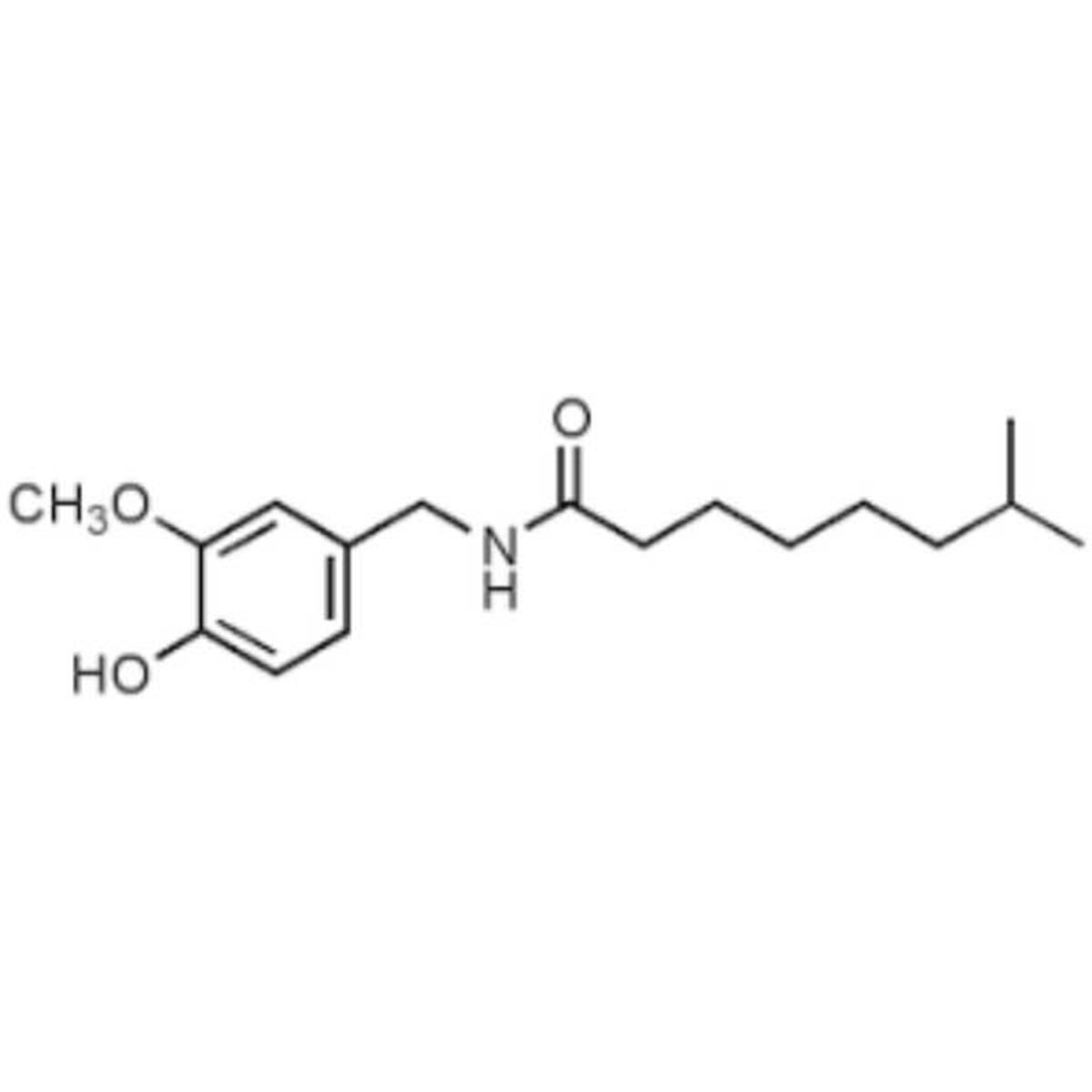
Nordihydrocapsaicin
Cat. No. FNK-NH100301
Features:
Size: 1 mg
CAS #: 28789-35-7
Molecular Formula: C17H27NO3
Molecular weight: 293.40
Purity: >99% (HPLC)
Origin: Red pepper
Storage: 4°C, Dark Storage
Product Description
Nordihydrocapsaicin is likely a capsaicinoid compound found in chili peppers. It is probably studied for its potential biological activities and contribution to the pungency of peppers.
Property
- Chemical Formula: C17H27NO3
- Molecular Weight: Approximately 293.40 g/mol
- Appearance: Likely a white to off-white crystalline powder
- Solubility: Probably poorly soluble in water, soluble in organic solvents
- Research: Used in studies investigating the pungency and biological effects of capsaicinoids
- Food Industry: May be used as a flavoring agent or in the production of spicy foods
- Pharmaceutical Development: Potentially investigated for pain relief applications
- Storage: Store in a cool, dry place, protected from light
- Handling: Use appropriate personal protective equipment, including gloves and eye protection
- Safety Measures: Avoid skin and eye contact; may cause irritation
- Cardiovascular Health
- Capsaicinoids, including nordihydrocapsaicin, may have beneficial effects on cardiovascular health:
- They can potentially reduce the risk of heart disease by improving cholesterol levels.
- These compounds may promote vascular health by increasing the expression and activation of endothelial nitric oxide synthase (eNOS), which enhances endothelium-dependent vasodilation.
- In animal studies, dietary capsaicin has been shown to slow atherogenesis in atherosclerosis-prone mice.
- Capsaicinoids, including nordihydrocapsaicin, may have beneficial effects on cardiovascular health:
- Metabolic Disorders
- Capsaicinoids have demonstrated potential in addressing metabolic disorders:
- They may help with body weight loss and increased metabolism.
- Some studies suggest that capsaicinoids could have a positive impact on diabetes management.
- Capsaicinoids have demonstrated potential in addressing metabolic disorders:
- Pain Management
- One of the most well-established uses of capsaicinoids is in pain management:
- Capsaicin, and potentially nordihydrocapsaicin, have been used to treat various pain conditions, including neuropathic pain.
- High-concentration capsaicin patches have shown efficacy in treating post-herpetic neuralgia (PHN) and other neuropathic pain conditions.
- One of the most well-established uses of capsaicinoids is in pain management:
- Cancer
- While more research is needed, capsaicinoids have shown potential anti-cancer properties:
- Capsaicin has been found to induce apoptosis in various cancer cell types, including prostate, colon, skin, breast, lung, and bladder cancer cells.
- It may act through multiple pathways, including the activation of TRPV1 receptors and modulation of various signaling pathways involved in cell proliferation and apoptosis.
- While more research is needed, capsaicinoids have shown potential anti-cancer properties:
- Gastrointestinal Disorders
- Capsaicinoids may have effects on gastrointestinal function:
- - They can potentially modulate ion transport in the intestine, which could have implications for conditions like diarrhea.
- - Some studies suggest that capsaicin may have protective effects against gastric ulcers, although more research is needed to confirm this.
- Capsaicinoids may have effects on gastrointestinal function:
- Inflammatory Conditions
- Capsaicinoids have shown anti-inflammatory properties:
- They may help in managing inflammatory conditions such as arthritis.
- The anti-inflammatory effects are thought to be mediated through the desensitization of sensory neurons and modulation of inflammatory mediators.
- Capsaicinoids have shown anti-inflammatory properties:
Cell Signaling Pathways Affected
- TRPV1 Activation
- Nordihydrocapsaicin, as a capsaicinoid, primarily acts by activating the TRPV1 (transient receptor potential vanilloid 1) receptor. This activation leads to:
- - Influx of Ca2+ and Na+ ions into cells
- - Membrane depolarization
- - Activation of calcium-dependent signaling cascades
- Nordihydrocapsaicin, as a capsaicinoid, primarily acts by activating the TRPV1 (transient receptor potential vanilloid 1) receptor. This activation leads to:
- Downstream Signaling Pathways
- Activation of TRPV1 by nordihydrocapsaicin triggers several downstream signaling pathways:
- **Protein Kinase Activation:**
- - Protein Kinase A (PKA)
- - Protein Kinase C (PKC)
- - CaMKII (Ca2+/calmodulin-dependent protein kinase II)
- These kinases phosphorylate TRPV1 at multiple sites, leading to sensitization of the channel.
- Activation of TRPV1 by nordihydrocapsaicin triggers several downstream signaling pathways:
- MAPK Pathway:
- - Increased phosphorylation of p38 MAPK
- - Activation of ERK1/2
- PI3K/Akt Pathway:
- - Activation of PI3K/Akt signaling
- Other Affected Pathways
- NF-κB Pathway:
- Capsaicinoids like nordihydrocapsaicin may inhibit the NF-κB pathway by:
- - Inhibiting phosphorylation of IκBα
- - Reducing NF-κB activation
- Calcium Signaling:
- - Increased intracellular Ca2+ levels
- - Activation of calmodulin (CaM) and calcineurin (PPP3C)
- Mitochondrial Effects:
- - Alteration of NAD+/NADH ratio
- - Potential effects on oxidative stress and SIRT1 activity
- Estrogenic Signaling:
- While lacking cell proliferation activity, nordihydrocapsaicin may affect estrogen-responsive gene expression similarly to other capsaicinoids[6].
- NF-κB Pathway: