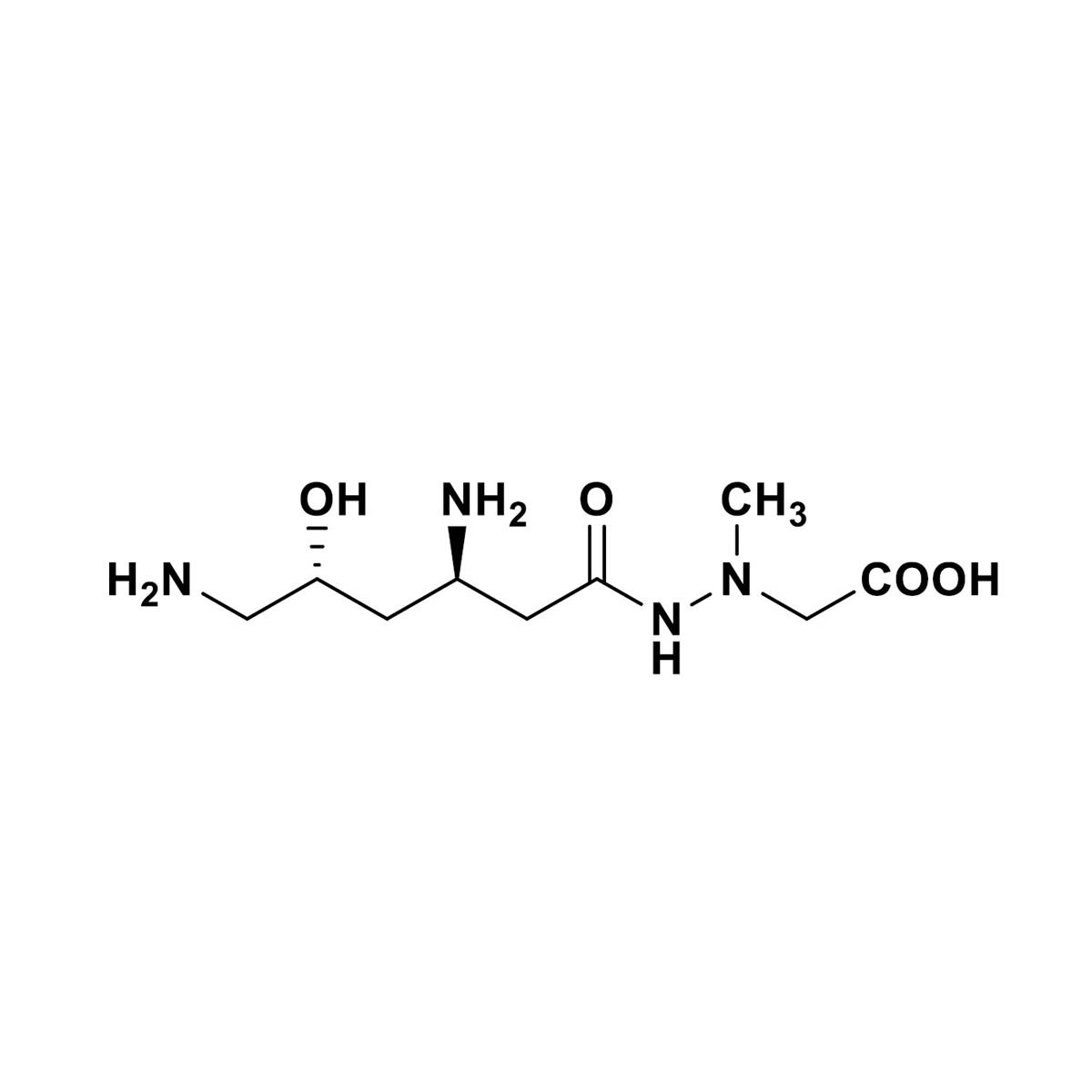
Negamycin (Antibacterial (Gram-Positive & Negative)) (Bacterial Protein Synthesis Inhibitor)
Product#: FNK-14662
$598.00
Availability:
Ships in 1-2 Weeks
Negamycin <Antibacterial (Gram-Positive & Negative)> <Bacterial Protein Synthesis Inhibitor>
Cat No.: FNK-14662
Size: 5 mg
Specifications
Code No. : 14662
CAS# : 33404-78-3 (free form)
Molecular Formula : C9H20N4O4?HCl (mono HCl salt)
Molecular Weight : 284.741 (mono HCl salt)
Source : Streptomyces sp. M890-C2
Supplied as : Powder, mono HCl salt Purity : >80 % (qNMR)
Long Term Storage : at -20 oC under Argon atmosphere
Solubility : Soluble in MeOH, DMSO, H2O Insoluble in Hexane
CAS# : 33404-78-3 (free form)
Molecular Formula : C9H20N4O4?HCl (mono HCl salt)
Molecular Weight : 284.741 (mono HCl salt)
Source : Streptomyces sp. M890-C2
Supplied as : Powder, mono HCl salt Purity : >80 % (qNMR)
Long Term Storage : at -20 oC under Argon atmosphere
Solubility : Soluble in MeOH, DMSO, H2O Insoluble in Hexane
Application Notes
Negamycin is obtained from culture filtrate of Streptomyces sp. M890-C2. 1) It inhibits the growth of Grampositive and Gram-negative bacteria including drug-resistant Pseudomonas and causes inhibition of protein synthesis by interacting with the h34 element of 16S rRNA within the head domain of small ribosomal subunit. 1-4) Negamycin shows excellent therapeutic efficacy against in vivo mouse models of bacterial infection: Pseudomonas aeruginosa (ED50: 4.4 mg/kg/sc), Klebsiella pneumoniae (ED50: 5.0 mg/kg/sc) and Salmonella Typhi (ED50: 2.5 mg/kg/sc). 1) The LD50 value of negamycin to mice by intravenous injection is 400-500 mg/kg. 1) Negamycin restores dystrophin expression in skeletal and cardiac muscles of the mdx mouse, an animal model of Duchenne muscular dystrophy (DMD). 5) Negamycin crosses the bacterial cytoplasmic membrane by multiple routes. 6) The structure-activity relationships of negamycin analogs have been studied. 7-9)
Clinical Significance
Duchenne Muscular Dystrophy (DMD):
Negamycin has been studied for its ability to restore dystrophin expression in the skeletal muscles of mice models with Duchenne muscular dystrophy. Dystrophin is a crucial protein for muscle function, and its absence due to nonsense mutations leads to the progression of DMD.
Nonsense Mutation-Associated Disorders:
Negamycin and its derivatives, such as TCP-1109, have demonstrated significant readthrough activity against various nonsense mutations. This activity suggests that negamycin could potentially be used to treat a range of genetic disorders caused by different types of PTCs, including TGA, TAG, and TAA mutations.
Cell Signaling Pathway
Negamycin's mechanism involves a unique binding mode to the bacterial ribosome, which disrupts normal protein synthesis. This disruption is achieved through inducing miscoding and inhibiting ribosome translocation, crucial processes in protein synthesis. The antibiotic's ability to cross bacterial membranes is facilitated by multiple uptake routes, including peptide transporters like the dipeptide permease Dpp, and is influenced by environmental conditions such as pH and the presence of calcium.
References
1) A new antibiotic, negamycin. Hamada M, et al. J Antibiot. 1970 23(3) 170-171.
2) Mechanism of action of negamycin in Escherichia coli K12. I. Inhibition of initiation of protein synthesis. Mizuno S, et al. J Antibiot. 1970 23(12) 581-588.
3) Mechanism of action of negamycin in Escherichia coli K12. II. Miscoding activity in polypeptide synthesis directed by synthetic polynucleotide. Mizuno S, et al. J Antibiot. 1970 23(12) 589-594.
4) Negamycin induces translational stalling and miscoding by binding to the small subunit head domain of the Escherichia coli ribosome. Olivier NB, et al. Proc Natl Acad Sci USA. 2014 111(46) 16274-16279.
5) Negamycin restores dystrophin expression in skeletal and cardiac muscles of mdx mice. Arakawa M, et al. J Biochem. 2003 134(5) 751-758.
6) The antibiotic negamycin crosses the bacterial cytoplasmic membrane by multiple routes. Hörömpöli D, et al. Antimicrob Agents Chemother. 2021 65(4) e00986.
7) Syntheses and properties of negamycin analogs modified the δ-hydroxy-β-lysine moiety. Kondo S, et al. J Antibiot. 1976 29(2) 208-211.
8) Structure-activity relationships among negamycin analogs. Uehara Y, et al. J Antibiot. 1976 29(9) 937-943.
9) Structural insights lead to a negamycin analogue with improved antimicrobial activity against Gram-negative pathogens. McKinney DC, et al. ACS Med Chem Lett. 2015 6(8) 930-935.
Related Products

2) Mechanism of action of negamycin in Escherichia coli K12. I. Inhibition of initiation of protein synthesis. Mizuno S, et al. J Antibiot. 1970 23(12) 581-588.
3) Mechanism of action of negamycin in Escherichia coli K12. II. Miscoding activity in polypeptide synthesis directed by synthetic polynucleotide. Mizuno S, et al. J Antibiot. 1970 23(12) 589-594.
4) Negamycin induces translational stalling and miscoding by binding to the small subunit head domain of the Escherichia coli ribosome. Olivier NB, et al. Proc Natl Acad Sci USA. 2014 111(46) 16274-16279.
5) Negamycin restores dystrophin expression in skeletal and cardiac muscles of mdx mice. Arakawa M, et al. J Biochem. 2003 134(5) 751-758.
6) The antibiotic negamycin crosses the bacterial cytoplasmic membrane by multiple routes. Hörömpöli D, et al. Antimicrob Agents Chemother. 2021 65(4) e00986.
7) Syntheses and properties of negamycin analogs modified the δ-hydroxy-β-lysine moiety. Kondo S, et al. J Antibiot. 1976 29(2) 208-211.
8) Structure-activity relationships among negamycin analogs. Uehara Y, et al. J Antibiot. 1976 29(9) 937-943.
9) Structural insights lead to a negamycin analogue with improved antimicrobial activity against Gram-negative pathogens. McKinney DC, et al. ACS Med Chem Lett. 2015 6(8) 930-935.
Related Products
| Infection Related | Name | Product Code | Link |
|---|---|---|---|
| Anti-HIV-Ⅰ | Benanomicin A | FNK-02966 |  |
| Benanomicin B | FNK-02968 | |
|
| Anti-MRSA, Anti-VRE | Bottromycin A2 | FNK-00592 | |
| Anti-Gram Positive / Negative Bacteria |
Althiomycin | FNK-14660 | |
| Cyclamidomycin | FNK-01541 | |
|
| Negamycin (HCl) | FNK-14662 | Current Link | |
| Anti-Gram Positive Bacteria | Bottromycin A2 | FNK-00592 | |
| Anti-Respiratory Infectious Bacteria | Forphenicinol | FNK-09637 | |
| Acid-Fast Bacillus Growth Suppression | Minosaminomycin | FNK-02872 | |
| Antifungal | Benanomicin A | FNK-02966 | |
| Benanomicin B | FNK-02968 | |
|
| Bacterial Protein Synthesis Inhibitor | Althiomycin | FNK-14660 | |
| Minosaminomycin | FNK-02872 | |
|
| Negamycin (HCl) | FNK-14662 | Current Link | |
| Pneumocystis pneumonia suppression |
Benanomicin A | FNK-02966 | |