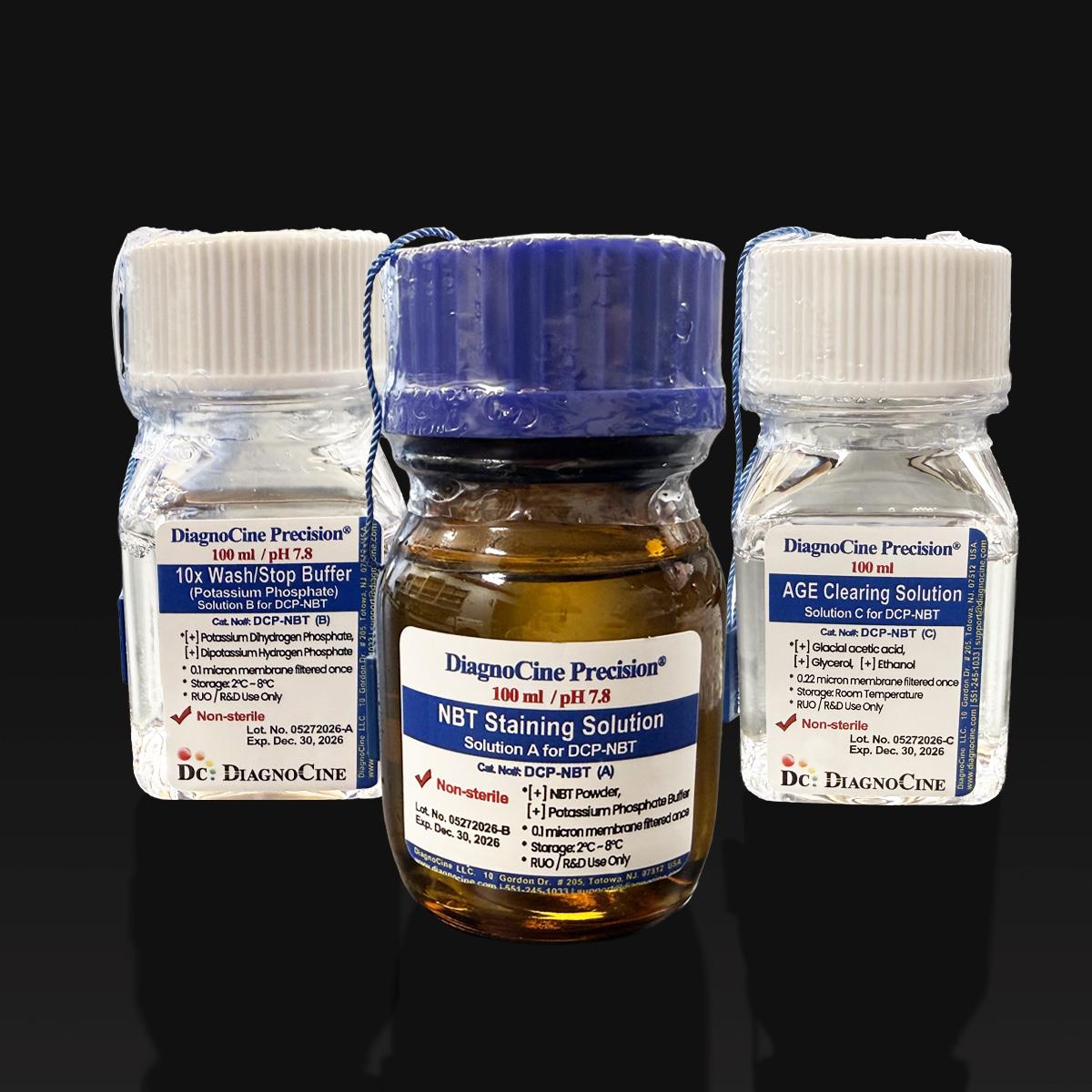
NBT Plant Tissue ROS Detection Kit
NBT Plant Tissue ROS Detection Kit
A ready-to-use staining kit for rapid histochemical detection of superoxide (O₂•¯) accumulation in plant tissues. Includes NBT staining solution, potassium phosphate wash/stop buffer, and AGE chlorophyll-clearing solution.
- Ready-to-use NBT staining solution (no weighing or pH-adjusting needed)
- Potassium phosphate-based system optimized for plant tissues (pH 7.8)
- Included clearing solution (AGE: acetic acid:glycerol:ethanol, 1:1:3) for efficient chlorophyll removal
- Suitable for Arabidopsis, crop leaves, roots, and other small plant tissues
- Ideal for stress assays, teaching labs, and routine ROS screening
- Ultrapure Type 1 water (18.2 MΩ·cm
- Customizable formulation available upon request
- pH7.8 for solution A and B
- AppearanceSolution A is yellow. Scoution B and C are clear
- Filtration0.1µm for solution A and B, 0.22µm for solution C
- Shelf Life6 months
NBT Staining Solution
- Storage2-8 °C
- Shelf Life6 months
- NBT Powder0.05%
- Potassium Phosphate Buffer10 mM
10x Wash/Stop Buffer (Potassium Phosphate)
- Storage2-8 °C
- Shelf Life6 months
- Potassium Dihydrogen Phosphate0.021M
- Dipotassium Hydrogen Phosphate0.079M
AGE Clearing Solution (Acetic Acid : Glycerol : Ethanol = 1 : 1 : 3, v/v/v)
- StorageRoom Temperature
- Shelf Life6 months
- Glacial acetic acid20%
- Glycerol 20%
- Ethanol 60%
Standard laboratory reagents filtered at 0.22 µm leave sub-micron particulates, mycoplasma, and aggregates that interfere with sensitive downstream applications. NBT Plant Tissue ROS Detection Kit is manufactured under ISO 13485 quality systems with multi-stage ultra-filtration to eliminate these failure modes.
Superoxide-specific detection
0.05% NBT in potassium phosphate buffer (pH 7.8) forms blue formazan deposits at sites of superoxide accumulation.
High-contrast clearing
AGE clearing solution (acetic acid:glycerol:ethanol, 1:1:3) efficiently removes chlorophyll for clear visualization of blue staining.
10X wash buffer included
Potassium phosphate wash/stop buffer for efficient removal of unreacted NBT and clean background.
Teaching & research ready
Suitable for Arabidopsis, crop leaves, roots, and other small tissues in stress assays and routine ROS screening.
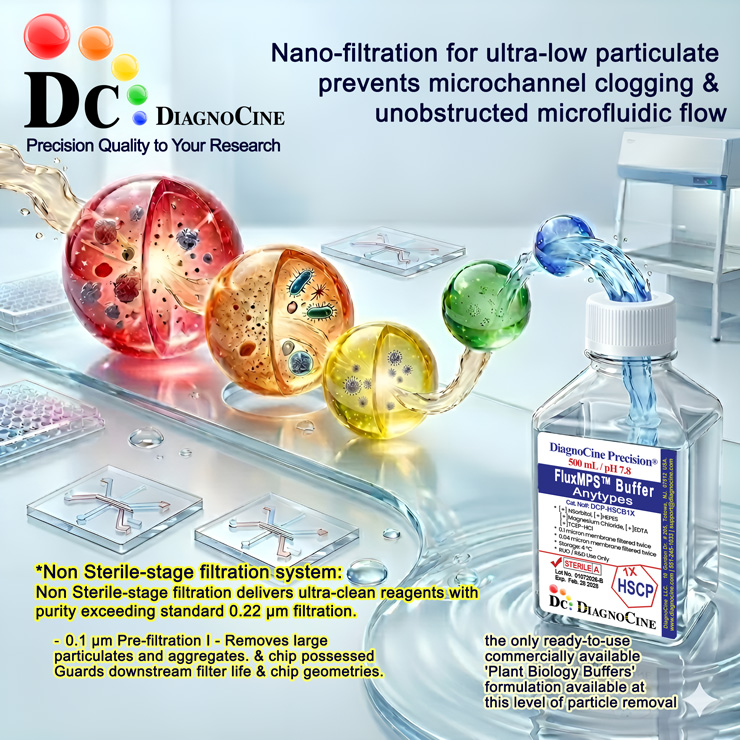
Sequential filtration system
A sequential filtration process reaching 0.1 µm for clean reagent purity exceeding standard 0.22 µm filtration.
-
1
0.1 µm filtration
Removes large particulates, aggregates, and bacteria. Primary guard providing baseline purity exceeding standard 0.22 µm filtration.
Performance vs. conventional reagents
Standard 0.22 µm single-pass filtration leaves particles in the 0.12–0.22 µm range. FluxMPS™ removes these contaminants for cleaner results and higher reproducibility.
Validated applications
- Monitoring oxidative stress responses in leaves and roots
- Comparing ROS levels under different treatments (light, drought, salt, chemicals, pathogens)
- Ag/biotech R&D screens for stress tolerance or treatment effects
- Approx. 100 qualitative leaf/seedling staining reactions per kit (assuming ~2-3 mL per reaction and batching multiple small tissues per well)
- Preparation Equilibrate NBT Staining Solution to room temperature in the dark.
Protocol & usage instructions
- Preparation:
- Equilibrate NBT Staining Solution to room temperature in the dark.
- Prepare 1x Wash/Stop Buffer by diluting 10x stock 1:10 with distilled water. - Staining:
- Place plant tissues (e.g., excised leaves or roots) in tubes, vials, or multi-well plates.
- Add enough NBT Staining Solution to fully immerse the samples (e.g., 2-3 mL per well).
- Optionally apply gentle vacuum to improve infiltration.
- Incubate in the dark at room temperature until blue formazan deposits are clearly visible (typically from tens of minutes to a few hours, depending on tissue and treatment). - Washing / stopping:
- Remove NBT solution.
- Wash tissues 3-4 times in 1× Wash/Stop Buffer, gently swirling or rocking to remove unreacted NBT. - Clearing:
- Transfer tissues to AGE Clearing Solution.
- Incubate at room temperature (or gently warmed if desired) until chlorophyll is sufficiently removed and contrast between blue formazan and background is optimal.
- Samples can be imaged directly in AGE solution or transferred to another mounting medium if preferred. - Imaging and analysis:
- Visualize blue formazan staining by bright-field microscopy or by flatbed/scanner imaging.
- Qualitatively compare intensity and distribution between treatments, genotypes, or conditions.
- Nitro blue tetrazolium chloride: Handle with gloves, avoid inhalation, ingestion, and contact with skin or eyes. May cause irritation.
- AGE Clearing Solution: Flammable and corrosive due to ethanol and acetic acid. Use in a well-ventilated area or fume hood. Keep away from open flames and heat sources.
- Always wear appropriate laboratory PPE (lab coat, gloves, eye protection) and follow institutional chemical safety guidelines.
- For research and teaching use only. Not for use in diagnostic procedures.
Quality assurance & logistics
ISO 13485:2016 Certified
Manufactured under certified QMS with full traceability and lot documentation.
Made in USA
All manufacturing, QA testing, and final assembly at DiagnoCine Precision, Totowa, NJ.
Supporting literature
- Jabs T, Dietrich RA, Dang JL. Initiation of runaway cell death in an Arabidopsis mutant by extracellular superoxide. Science. 1996;273(5283):1853-1856.
- Fryer MJ, Oxborough K, Mullineaux PM, Baker NR. Imaging of photo-oxidative stress responses in leaves. J Exp Bot. 2002;53(372):1249-1254.
- Kumar D, Yusuf MA, Singh P, et al. Histochemical detection of superoxide and H₂O₂ accumulation in Brassica juncea seedlings. Bio-protocol. 2014;4(8):e1108.