
Mouse Anti-feline CD3ε Monoclonal Antibody
Product#: FNK-ABS-070002
$330.28
Availability:
Ships in 1-2 Weeks
Mouse Anti-feline CD3ε Monoclonal Antibody
General information
| Cat. No. | :FNK-ABS-070002 |
| Size | :0.1mg |
| Antigen Species | :Canine |
| Host Animal | :Mouse |
| Label | :Unlabeled |
| Clone | :5G-6-7-3 |
| CD number | :CD3 |
| Isotype | :Mouse IgG1 |
| Product Form | :Purified IgG – liquid |
| Reconstitution Buffer | :Reconstitute with sterile PBS containing 0.09% sodium azide |
| Specificity | :This antibody was selected for its ability to detect canine CD3ε molecule in western blots. |
| Cross Reactivity | :Canine |
| Immunogen | :Synthetic protein sequence derived from canine CD3ε |
| Preparation | :Purified IgG prepared by affinity chromatography on Protein G from culture supernatant |
| Storage | :Store at 4℃ or at –20℃ if preferred |
| Shipping Condition | :Dry Ice |
 |
Application
|
|
Yes |
No |
Not Determined |
Suggested Working Dilution |
|
Western Blotting |
O |
|
|
1/200-1/1000 |
|
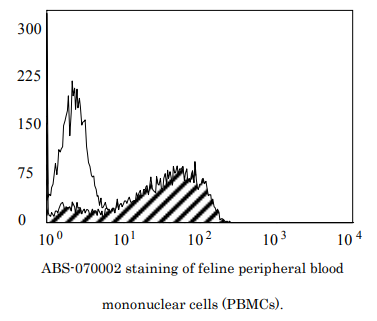
Flow Cytometry |
O |
|
|
|
|
Immunohistology |
|
O |
|
|
|
ELISA |
O |
|
|
|
Optimal dilutions should be determined by each laboratory for each application.
Human Diseases
- T-cell Immunodeficiency: Defects in the CD3ε gene can lead to severe combined immunodeficiency (SCID) characterized by a lack of functional T cells.
- Autoimmune Diseases: Altered CD3ε signaling has been implicated in the development of autoimmune conditions like type 1 diabetes.
Cellular Signaling Pathways
- T-cell Receptor (TCR) Signaling: CD3ε is a critical component of the TCR complex, which also includes the TCRα/β chains and the CD3γ, CD3δ, and CD3ζ chains. CD3ε plays a key role in coupling antigen recognition to intracellular signaling pathways that activate T cells.
- Src Family Kinase Activation: Upon TCR engagement, the immunoreceptor tyrosine-based activation motifs (ITAMs) within the cytoplasmic tail of CD3ε become phosphorylated by Src family kinases like Lck. This leads to the recruitment and activation of downstream signaling molecules like ZAP-70.
- Calcium Signaling: CD3ε-mediated signaling triggers an increase in intracellular calcium levels, which is essential for the activation of transcription factors like NFAT that regulate T-cell activation genes.
- MAPK Pathways: CD3ε signaling activates the Ras/MAPK pathway, leading to the phosphorylation of transcription factors like AP-1 that control T-cell proliferation and differentiation."
Aliases for CD3E Gene
- CD3e Molecule 2 3 5
- CD3e Antigen, Epsilon Polypeptide (TiT3 Complex) 2 3
- T-Cell Surface Glycoprotein CD3 Epsilon Chain 3 4
- T-Cell Surface Antigen T3/Leu-4 Epsilon Chain 3 4
- CD3e Molecule, Epsilon (CD3-TCR Complex) 2 3
- T3E 3 4
- T-Cell Antigen Receptor Complex, Epsilon Subunit Of T3 3
- CD3e Antigen 4
- CD3-Epsilon 3
- IMD18 3
- TCRE 3
- CD3E 5
References
- 65060-1-IG.” CD3ε Antibody (65060-1-Ig) | Proteintech, 31 Aug. 2024, www.ptglab.com/products/CD3-Antibody-65060-1-Ig.htm.
- Seitzer, U, et al. “Reduced T-Cell Receptor CD3zeta-Chain Protein and Sustained Cd3epsilon Expression at the Site of Mycobacterial Infection.” Immunology, U.S. National Library of Medicine, Nov. 2001, www.ncbi.nlm.nih.gov/pmc/articles/PMC1783312/.
- Tailor, Pankaj, et al. “The Proline-Rich Sequence of CD3epsilon as an Amplifier of Low-Avidity TCR Signaling.” Journal of Immunology (Baltimore, Md.?: 1950), U.S. National Library of Medicine, 1 July 2008, www.ncbi.nlm.nih.gov/pmc/articles/PMC2665931/.
- Mouse Anti-Porcine CD3ε-Biot (PPT3).” SouthernBiotech, www.southernbiotech.com/mouse-anti-porcine-cd3e-biot-ppt3-4510-08.
- Cell Signaling Technology. “CD3ε (CD3-12) Rat Mab.” Cell Signaling Technology, www.cellsignal.com/products/primary-antibodies/cd3e-cd3-12-rat-mab/4443.