Three grades, one page. Pick the grade your protocol needs and go straight to its product page — the full specification, standards, and application guidance follow below.
Laboratory Water — Catalog · 3 Grades
Select the grade that matches your workflow — click View for the product page.
Water is the most-used reagent in any life-science lab and the most underestimated. It is never just “H2O.” Depending on how it is purified, water carries dissolved ions, organic carbon, dissolved gases, particulates, microbes, endotoxins, and nucleases — any of which can quietly wreck an experiment. Laboratory water grades are defined precisely so researchers can match purity to the task: rinsing glassware needs one grade; qPCR and LC–MS need another entirely.
The specifications that decide whether a grade fits a protocol — and the ones a single resistivity number will not tell you.
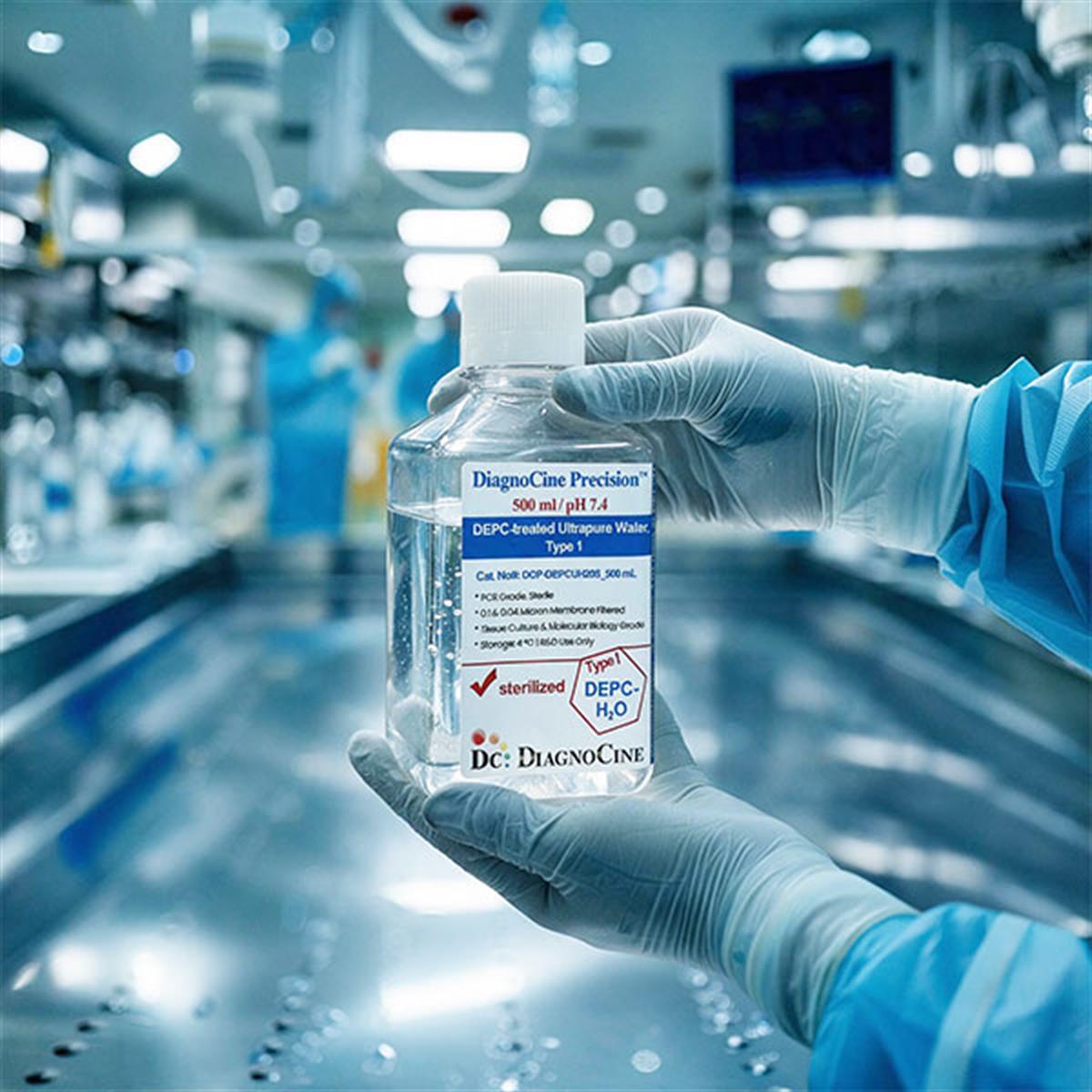
Three grades stocked: Ultrapure Water (Type I), Deionized (DI) Water (Type II / Pure Water), and Nuclease-Free Water (Non-DEPC Treated).
Ionic purity is measured as electrical resistivity; the theoretical maximum is 18.2 MΩ·cm at 25 °C.
Total Organic Carbon (TOC) is where clinical water (<500 ppb) and research water (<10 ppb) differ most — roughly a 50-fold gap.
Nucleases (DNase/RNase) are controlled only in nuclease-free molecular-biology water; resistivity says nothing about them.
Endotoxins (pyrogens) matter for cell culture and any injectable / in vivo work.
Bacteria and particulates clog microfluidic channels and assay needles and are controlled by terminal 0.2 µm filtration.
Standards, not adjectives: ASTM D1193 defines reagent-water Types I–IV; CLSI defines Clinical Laboratory Reagent Water (CLRW).
ASTM D1193CLSI GP40 (formerly C3)RUO
CATEGORY REFERENCE · LABORATORY WATER
Grade selection at a glance — resistivity, TOC, and what each grade is actually for
Type I (ultrapure) resistivity≥18 MΩ·cm (commonly 18.2)
Type I typical TOCoften <50 ppb; research-grade <10 ppb
Type II resistivity≥1 MΩ·cm
Type III resistivity≥4 MΩ·cm
Type IV resistivity≥0.2 MΩ·cm
CLSI CLRW (clinical)≥10 MΩ·cm, TOC <500 ppb
CLRW bacteria limit<10 CFU/mL
Terminal filtration (Type I)0.2 µm
Nuclease (DNase/RNase) controlnuclease-free grade only
Theoretical purity ceiling18.2 MΩ·cm @ 25 °C
Why Water Grade Matters
Different applications fail from different contaminants
That is why one grade does not fit all. Each contaminant class breaks a different kind of experiment, and each is measured — or ignored — by a different specification.
bolt
Ions (measured by resistivity)
Dissolved salts skew electrochemistry, buffer pH, and trace-metal analysis (AAS, ICP–MS). Higher resistivity means fewer ions; the theoretical maximum is 18.2 MΩ·cm at 25 °C.
science
Total Organic Carbon (TOC)
Organic residues interfere with HPLC / LC–MS baselines and can inhibit sensitive enzymatic reactions. This is the parameter on which clinical water (TOC <500 ppb) and research water (TOC <10 ppb) differ most — a ~50-fold gap.
biotech
Nucleases (DNase / RNase)
Degrade DNA and RNA; catastrophic for PCR, cloning, and RNA work. Removed and verified only in “nuclease-free” molecular-biology water — resistivity says nothing about them.
vaccines
Endotoxins (pyrogens)
Bacterial cell-wall fragments that trigger immune responses; critical to control for cell culture and any injectable or in vivo work.
filter_alt
Bacteria & particulates
Clog microfluidic channels and assay needles, seed biofilms, and add background signal. Controlled by terminal 0.2 µm filtration.
rule
Match the spec to the task
Resistivity is necessary but not sufficient. Molecular biology cares about organics and nucleases, not just ions — so the full specification, not a single number, decides whether a grade fits.
The most common procurement mistake
Carrying a clinical water spec (CLRW; ≥10 MΩ·cm, TOC <500 ppb) into a molecular-biology workflow. CLRW is well-suited to automated clinical analyzers but categorically unsuitable for qPCR or LC–MS, where the 50-fold higher TOC — and the lack of nuclease control — can cause silent failures such as Ct drift.
~50×
TOC gap between CLRW (<500 ppb) and research-grade ultrapure water (<10 ppb)
18.2
MΩ·cm — theoretically ion-free water at 25 °C
History & Standardization
How “pure water” became a measurable specification
Lab water moved from a process description (“distilled”) to an auditable specification tied to the application. Each step in that history explains a number you still see on a Certificate of Analysis today.
1
Early–mid 20th c. Distillation
Labs relied on simple distillation (“distilled water”) to remove non-volatile salts and many contaminants. This set the first practical purity baseline, but distillation is energy-intensive and leaves volatile organics and dissolved CO2 behind.
2
Mid–late 20th c. Ion exchange & reverse osmosis
Ion exchange (deionization) and, later, reverse osmosis (RO) were adopted, enabling much higher ionic purity measured as electrical resistivity. This made 18.2 MΩ·cm — theoretically ion-free water at 25 °C — an achievable, monitorable target.
3
1960s–present Formal grades
Standards bodies formalized grades. ASTM D1193 defines reagent-water Types I–IV; the Clinical and Laboratory Standards Institute (CLSI) defines Clinical Laboratory Reagent Water (CLRW) for diagnostics. This replaced vague terms like “distilled” or “pure” with measurable, auditable specifications tied to application.
4
Modern era Polishing beyond resistivity
As qPCR, NGS, and LC–MS pushed detection limits lower, ultrapure water with polishing for TOC, endotoxin, and nuclease / protease removal became essential — well beyond what ionic resistivity alone can capture.
Grade Reference (Standards)
ASTM D1193 Types I–IV and CLSI CLRW side by side
Published grade definitions, with the production route typically associated with each. Use this table to translate a purchasing spec into an actual application fit.
Grade
Typical resistivity (25 °C)
Typical TOC
Notes / typical production
ASTM Type I (ultrapure)
≥18 MΩ·cm (commonly 18.2)
often <50 ppb (research-grade held <10 ppb)
Distillation / RO / EDI + mixed-bed ion exchange + 0.2 µm filter
ASTM Type II
≥1 MΩ·cm
<50 ppb
The minimum a good distillation process should produce
ASTM Type III
≥4 MΩ·cm
<200 ppb
Distillation / IX / EDI / RO + 0.45 µm filter; glassware rinsing, feed water
ASTM Type IV
≥0.2 MΩ·cm
not specified
Least stringent; general / rough use
CLSI CLRW (clinical)
≥10 MΩ·cm
<500 ppb
Bacteria <10 CFU/mL, 0.2 µm filtration; for clinical analyzers
Read the whole row, not just the resistivity. ASTM sets Type III’s minimum resistivity (4 MΩ·cm) higher than Type II’s (1 MΩ·cm). That looks backward until the rest of the row is read: the types were built around different production methods and different jobs — Type II is held to tighter organic and trace-ion limits — not a single linear purity ranking. Always match the full specification to the application, and consult the current published ASTM D1193 and CLSI GP40 tables for the controlling limits.
Applications by Grade
Which grade for which bench workflow
Select a grade to see the workflows it is intended to support.
Type I · 18.2 MΩ·cm · low TOC · nuclease-free
PCR / qPCR, NGS, sequencing, cloning, DNA / RNA work
LC–MS / GC–MS mobile phases
ICP–MS / AAS trace analysis
Cell and tissue culture media
Buffer and standard preparation
CLRW · ≥10 MΩ·cm · TOC <500 ppb
Feed water and reagent water for automated clinical chemistry analyzers
Immunoassay analyzers
Electrolyte and enzyme analyzers
Cuvette washing
Type II · ≥1 MΩ·cm
General buffer and reagent preparation
Microbiological media
Histology and staining solutions
Feed water for Type I polishers
Type III / IV · general use
Glassware rinsing
Autoclave and water-bath filling
Humidifiers
Product Comparison
How the water products compare
Attributes and the workflow each product is intended for.
Product
Grade / attributes
Best use
Nuclease-Free Water (DEPC-free)
Ultrapure, DNase / RNase-free, 0.2 µm filtered
PCR, RT-qPCR, cloning, and RNA work where nuclease contamination must be zero; DEPC-free avoids DEPC’s interference with some downstream reactions
Molecular Biology Grade Water
Ultrapure, low-TOC, nuclease-free
General molecular-biology reagent, sample, and master-mix dilution
Cell Culture Grade Water (endotoxin-tested)
Ultrapure, low-endotoxin, sterile-filtered
Preparing / diluting cell-culture media and buffers where endotoxin control is critical
Ultrapure / Type I Water
≥18 MΩ·cm, low TOC
Trace analysis (LC–MS, ICP–MS), buffer and standard preparation
FAQ
Frequently asked questions
The questions that come up most often when a purchasing spec meets a bench protocol.
No — this is the most common procurement mistake. CLRW (≥10 MΩ·cm, TOC <500 ppb, bacteria <10 CFU/mL, 0.2 µm filtration) is well-suited to automated clinical analyzers, but it is categorically unsuitable for qPCR or LC–MS. The roughly 50-fold higher TOC, together with the lack of nuclease control, can cause silent failures such as Ct drift.
No. Resistivity measures dissolved ions only. Nucleases (DNase / RNase) degrade DNA and RNA and are removed and verified only in nuclease-free molecular-biology water — resistivity says nothing about them. Resistivity is necessary but not sufficient: molecular biology cares about organics and nucleases, not just ions.
Because the ASTM types are not a single linear purity ranking. Type III is specified at ≥4 MΩ·cm and Type II at ≥1 MΩ·cm, but Type II is held to tighter organic-carbon and trace-ion limits (TOC <50 ppb versus <200 ppb) and is tied to a distillation route, while Type III is a general-purpose grade polished through a 0.45 µm filter. Grade the water on the full specification, never on resistivity alone.
Ultrapure (Type I) water is the grade listed for cell and tissue culture media as well as buffer and standard preparation. Where endotoxin control is critical, use cell-culture-grade water that is ultrapure, low-endotoxin, and sterile-filtered — endotoxins are bacterial cell-wall fragments that trigger immune responses and matter for cell culture and any injectable or in vivo work. For general buffer and reagent preparation, microbiological media, and histology or staining solutions, Type II (pure) water is the listed grade.
Nuclease-Free Water (DEPC-free) is ultrapure, DNase / RNase-free, and 0.2 µm filtered. Being DEPC-free avoids DEPC’s interference with some downstream reactions, which is why it is specified for PCR, RT-qPCR, cloning, and RNA work where nuclease contamination must be zero.
Ultrapure Type I water (≥18 MΩ·cm, low TOC). Organic residues interfere with HPLC / LC–MS baselines, and dissolved salts skew trace-metal analysis by AAS and ICP–MS, so both the ionic and the organic specification have to be met. Type I water is the listed grade for LC–MS / GC–MS mobile phases and ICP–MS / AAS trace analysis.
It depends entirely on the task. Type II (pure) water covers general buffer and reagent preparation, microbiological media, histology and staining solutions, and feed water for Type I polishers. Glassware rinsing, autoclave and water-bath filling, and humidifiers are Type III / IV duties. Anything touching PCR, NGS, LC–MS, trace analysis, or cell culture should move up to ultrapure Type I.
Key References
Standards and supporting literature
The controlling standards and technical sources behind the grade definitions above.
ASTM D1193-06(2018). Standard Specification for Reagent Water. ASTM International, West Conshohocken, PA. — Defines reagent-water Types I–IV and the microbiological A/B/C grades used across analytical labs.
Clinical and Laboratory Standards Institute (CLSI). Preparation and Testing of Reagent Water in the Clinical Laboratory (GP40, formerly C3). CLSI, Wayne, PA. — Defines Clinical Laboratory Reagent Water (CLRW): ≥10 MΩ·cm, TOC <500 ppb, bacteria <10 CFU/mL, 0.2 µm filtration.
Sigma-Aldrich / Merck Millipore. Understanding Water Quality Grades for Laboratory Applications (technical article). — Practical mapping of ASTM / CLSI grades to specific applications (chromatography, PCR, cell culture, trace analysis).
U.S. NIH Office of Research Facilities (2013). Laboratory Water: Its Importance and Application (DTR white paper). — Cross-comparison of ASTM, CLSI / NCCLS, and USP water frameworks and their differing terminology.