
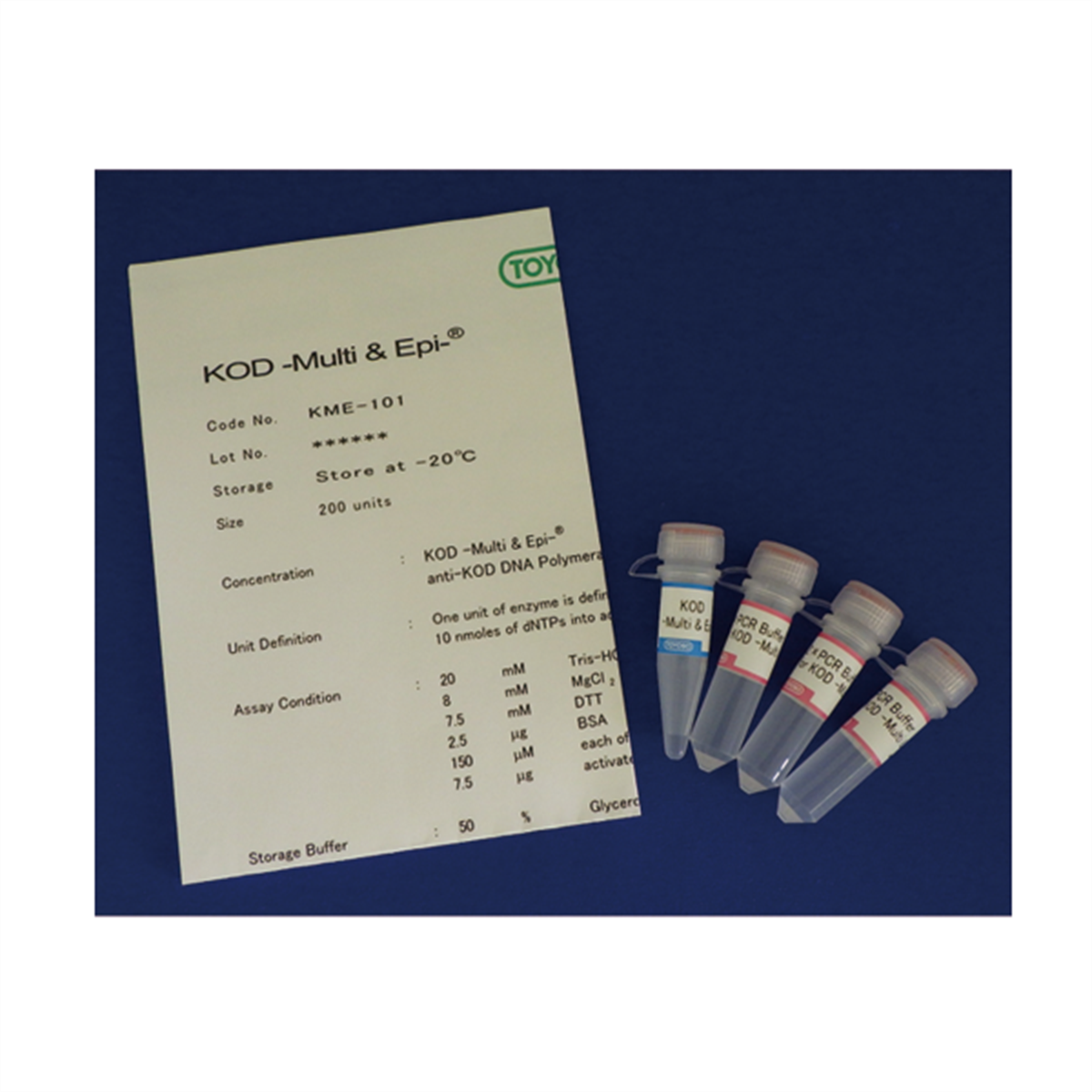
KOD -Multi & Epi-, 1 pack
KOD -Multi & Epi-, 1 pack
DESCRIPTIONKOD -Multi & Epi- is a high-fidelity PCR enzyme based on genetically modified KOD DNA polymerase(UKOD). This modified enzyme enables amplification from templates containing uracils (U) or using primers containing inosines (I)…
Shipping & ordering notice: This product has ICE or DRY ICE shipping requirements, DO NOT select Ground Shipping. $1.00 is only for sample (please inquire)
Product Overview
KOD -Multi & Epi-
| Product Name | Cat. No. | Size | Storage | Order |
|---|---|---|---|---|
| KOD -Multi & Epi-, Trial | TYB-KME-101S | 1 vial | Store at -20°C ( 4°C for a month ) | Order |
| KOD -Multi & Epi-, 1 pack | TYB-KME-101 | 200 µl X 1 | Store at -20°C ( 4°C for a month ) | Current page |
| KOD -Multi & Epi-, 5 pack | TYB-KME-101-5PK | 200 µl X 5 | Store at -20°C ( 4°C for a month ) | Order |
| KOD -Multi & Epi-, 10 pack | TYB-KME-101-10PK | 200 µl X 10 | Store at -20°C ( 4°C for a month ) | Order |
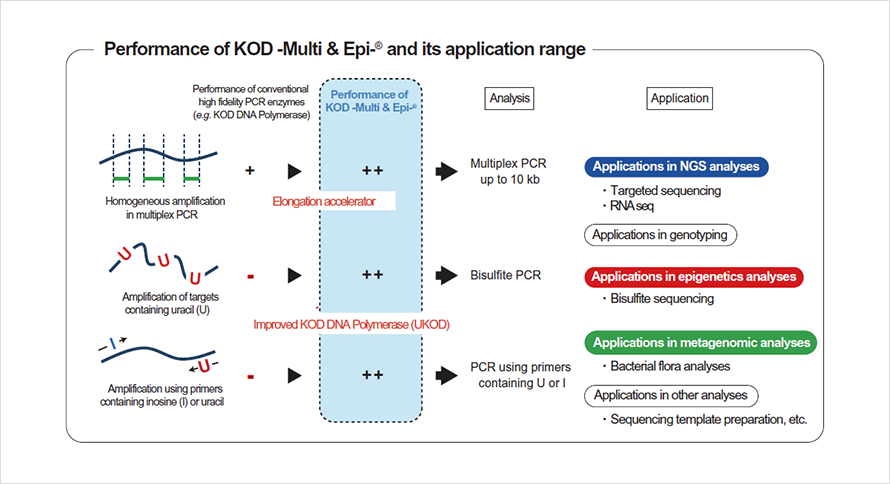
KOD -Multi & Epi- is a high-fidelity PCR enzyme based on genetically modified KOD DNA polymerase(UKOD). This modified enzyme enables amplification from templates containing uracils (U) or using primers containing inosines (I) and uracils (U). Furthermore, addition of the Elongation Accelerator significantly reduces amplification bias during PCR. KOD -Multi & Epi- can be applied to various purposes such as a) multiplex PCR, b) bisulfite PCR in epigenetics research, and c) metagenomics research.
This enzyme is also applicable for the preparation of DNA fragments for next-generation sequencing and capillary sequencing via cloning because the enzyme exhibits about 11-fold higher PCR fidelity.
KOD -Multi & Epi- contains two types of anti-KOD DNA polymerase antibodies that inhibit the polymerase and its 3'→5' exonuclease activity, thus allowing for Hot Start PCR. Furthermore, KOD -Multi & Epi- generates blunt-end PCR products because of its 3'→5' exonuclease (proof-reading) activity.
FEATURES
- Homogeneous amplification (Low bias)
- Effective amplification from templates containing uracils (U) and primers containing uracil (U) or Inosine (I) can be used
- High fidelity
- Applicable for amplification from crude samples
- Highly efficiency
APPLICATIONS
SOURCE
E. colistrain carrying the cloned KOD DNA polymerase gene
COMPONENTS
KOD -Multi & Epi-® (1.0 U/uL)* 200 uL × 1
2× PCR Buffer for KOD -Multi & Epi-** 1.7 ml × 3
*The enzyme solution contains anti-KOD DNA polymerase antibodies that neutralize the polymerase and inhibit its 3'→5' exonuclease activities.
**The 2× PCR Buffer for KOD -Multi & Epi- contains dNTPs (dATP, dGTP, dCTP and dTTP), and Mg2+ at 4.0 mM (final concentration: 2.0 mM).
APPLICATION DATA
Example 1.PCR performance in Multiplex PCR
The small targets from 200 to 1,000 bp and the large target from 1 to 10 kb were amplified by single-plex or multiplex PCR. Each target was successfully amplified by both single-plex and multiplex PCR.
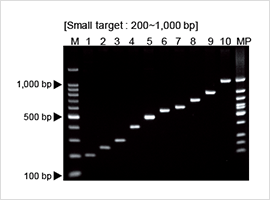 |
M:100 bp DNA ladder 1:DDB2 200 bp 2:FANCG 250 bp 3:HBg 300 bp 4:CDH1 400 bp 5:chrome9 500 bp |
6:ERCC4 550 bp 7:HRAS 600 bp 8:PRF1 700 bp 9:BRCA1 800 bp 10:CDK4 1000 bp MP:Multiplex PCR 1~10 |
Sample Human genomic DNA 50ng Primer concentration 0.3mM each Multiplex PCR cycle 94 C, 2 min / 98 C, 10 sec 68 C, 30 sec (25 cycles) |
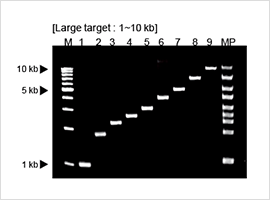 |
M:1 kb DNA ladder 1:chromo9 1 kb 2:MSH6 1.8 kb 3:BRCA2 2.3 kb 4:WT-1 2.5 kb 5:FNCE 3 kb |
6:RAD51D 4 kb 7:KRAS 5 kb 8:BRCA1 7 kb 9:DDB2 10 kb MP: Multiplex PCR 1~9 |
Example 2.Amplification from bisulfite-treated DNA
The target DNAs (917–1,583 bp) were amplified using bisulfite-treated CpG-methylated Jurkat genomic DNA. All targets were successfully amplified using KOD -Multi & Epi-®.
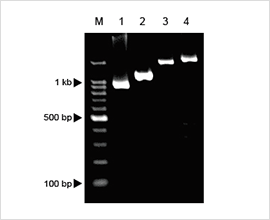 |
M: 100 bp DNA ladder 1:TGFb 917 bp 2:BRCA2 1134 bp 3:APOE 1487 bp 4:TGFb 1583 bp |
REFERENCES
- Takagi M, Nishioka M, Kakihara H, Kitabayashi M, Inoue H, Kawakami B, Oka M, and Imanaka T., Appl. Environ. Microbiol., 63: 4504–10 (1997)
- Hashimoto H, Nishioka M, Fujiwara S, Takagi M, Imanaka T, Inoue T and Kai Y, J. Mol. Biol., 306: 469–77 (2001)
- Mizuguchi H, Nakatsuji M, Fujiwara S, Takagi M and Imanaka T, J Biochem., 126:762-8 (1999)
- Suzuki, Tomohiro, et al. "Crucial role of iron in epigenetic rewriting during adipocyte differentiation mediated by JMJD1A and TET2 activity." Nucleic Acids Research, vol. 51, no. 12, 2023, pp. 6120–6142. https://doi.org/10.1093/nar/gkad342.
- Li, Zhuxuan, et al. "Alveolar differentiation drives resistance to KRAS inhibition in lung adenocarcinoma." Cancer Discovery, vol. 14, no. 2, 2024, pp. 308–325. https://doi.org/10.1158/2159-8290.CD-23-0289.
- Ai, Kang, et al. "DNA methyltransferase Dnmt3ba-mediated epigenetic modulation of Integrin signaling is essential for hematopoietic stem and progenitor cell development." Communications Biology, vol. 8, 2025, p. 1612. https://doi.org/10.1038/s42003-025-09003-w.
- Yao, Weijian, et al. "CD38hi macrophages promote fibrotic transition following acute kidney injury by modulating NAD+ metabolism." Molecular Therapy, vol. 33, no. 7, 2025, pp. 3434–3452. https://doi.org/10.1016/j.ymthe.2025.04.039.
- Nakaya, Masataka, et al. "Non-viral generation of transgenic non-human primates via the piggyBac transposon system." Nature Communications, vol. 16, no. 1, 2025, p. 2179. https://doi.org/10.1038/s41467-025-57365-w.
- Cha, Ju Hyuen, et al. "Discovery of novel disease-causing mutation in SSBP1 and its correction using adenine base editor to improve mitochondrial function." Molecular Therapy - Nucleic Acids, vol. 35, no. 3, 2024, p. 102257. https://doi.org/10.1016/j.omtn.2024.102257
- Yoshimoto, Daisuke, et al. "Downregulation of HLA Class I Expression through HLA-A DNA Methylation Is Associated with Reduced CD8+ T-cell Infiltration in Cervical Cancer." Cancer Immunology Research, vol. 14, no. 1, 2025, pp. 77–89. https://doi.org/10.1158/2326-6066.CIR-25-0594.
- Sung, Keewon, et al. "A rational engineering strategy for structural dynamics modulation enables target specificity enhancement of the Cas9 nuclease." Nucleic Acids Research, vol. 53, no. 12, 2025, p. gkaf535. https://doi.org/10.1093/nar/gkaf535.
- Singhal, Anupriya, et al. "A classical epithelial state drives acute resistance to KRAS inhibition in pancreas cancer." Cancer Discovery, vol. 14, no. 11, 2024, pp. 2122–2134. https://doi.org/10.1158/2159-8290.CD-24-0740.
- Nam, Hye Jin, et al. "Autophagy induction enhances homologous recombination-associated CRISPR–Cas9 gene editing." Nucleic Acids Research, vol. 53, no. 7, 2025, p. gkaf258. https://doi.org/10.1093/nar/gkaf258.
- Kano, Mayuko, et al. "Functional calcium-responsive parathyroid glands generated using single-step blastocyst complementation." Proceedings of the National Academy of Sciences, vol. 120, no. 28, 2023, p. e2216564120. https://doi.org/10.1073/pnas.2216564120.
- Hong, Sung-Ah, et al. "Therapeutic base editing and prime editing of COL7A1 mutations in recessive dystrophic epidermolysis bullosa." Molecular Therapy, vol. 30, no. 8, 2022, pp. 2664–2679. https://doi.org/10.1016/j.ymthe.2022.06.005.
- Jo, Min Ju, and Hye Jin Nam. "Protocol to screen chemicals to enhance homology-directed repair in CRISPR-Cas9 gene editing." STAR Protocols, vol. 6, no. 3, 2025, p. 103896. https://doi.org/10.1016/j.xpro.2025.103896
- Habib, Omer, et al. "Comprehensive analysis of prime editing outcomes in human embryonic stem cells." Nucleic Acids Research, vol. 50, no. 2, 2022, pp. 1187–1197. https://doi.org/10.1093/nar/gkab1295.
- Mikamo, Kouya, et al. "Enhanced CRISPR-Cas3-mediated genome editing using circularized crRNAs." iScience, vol. 29, no. 9, 2026, p. 117481. https://doi.org/10.1016/j.isci.2026.117481.
- Aini, Nurul, et al. "Modulation of Gut Microbiota, Intestinal Physiology, and Digestive Enzyme Levels by Duo-Strain Probiotics in African Catfish (Clarias gariepinus) Challenged With Aeromonas hydrophila." Aquaculture Nutrition, vol. 2025, 2025, p. 6624613. https://doi.org/10.1155/anu/6624613.
- Kwon, Jae-Eun, et al. "Streamlined synthetic regulatory cassette for efficient and photoreceptor-enriched retinal gene expression." Molecular Therapy - Nucleic Acids, vol. 37, no. 3, 2026, p. 102971. https://doi.org/10.1016/j.omtn.2026.102971
- Park, Ju-Chan, et al. "Enhancing genome editing in hPSCs through dual inhibition of DNA damage response and repair pathways." Nature Communications, vol. 15, no. 1, 2024, p. 4002. https://doi.org/10.1038/s41467-024-48111-9.
- Nagano, Hisato, et al. "Skin graft with dermis and appendages generated in vivo by cell competition." Nature Communications, vol. 15, no. 1, 2024, p. 3366. https://doi.org/10.1038/s41467-024-47527-7.
- Hong, Sung-Ah, et al. "In vivo gene editing via homology-independent targeted integration for adrenoleukodystrophy treatment." Molecular Therapy, vol. 30, no. 1, 2022, pp. 119–129. https://doi.org/10.1016/j.ymthe.2021.05.022.
- Singhal, Anupriya, et al. "The basal cell state maintains pancreatic cancers by controlling an immunosuppressive circuit." bioRxiv, 2026, doi:10.64898/2026.07.13.738221. Preprint.
- Hayashi, Yoshitaka, et al. "Glial cells missing 1 triggers gliosis and angiogenesis after neonatal brain injury." iScience, vol. 28, no. 11, 2025, p. 113860. https://doi.org/10.1016/j.isci.2025.113860.
- Jeong, Yeong Yeop, et al. "Identification of optimal adenine and cytosine base editors for genome editing in Arabidopsis and soybean." BMB Reports, vol. 58, no. 7, 2025, pp. 288–292. https://doi.org/10.5483/BMBRep.2024-0102.
- Na, Hyeon-Jin, et al. "Human Pluripotent Stem Cell-Derived Retinal Organoids: A Viable Platform for Investigating the Efficacy of Adeno-Associated Virus Gene Therapy." International Journal of Stem Cells, vol. 17, no. 2, 2024, pp. 204–211. https://doi.org/10.15283/ijsc23071.
- Hong, Hyowon, et al. "Manufacturing Uniform Cerebral Organoids for Neurological Disease Modeling and Drug Evaluation." Biomaterials Research, vol. 28, 2024, p. 0104. https://doi.org/10.34133/bmr.0104.
- Yoshimi, Kazuto, et al. "Genome editing using type I-E CRISPR-Cas3 in mice and rat zygotes." Cell Reports Methods, vol. 4, no. 8, 2024, p. 100833. https://doi.org/10.1016/j.crmeth.2024.100833.
-
Hu, Shao Wei, et al. "PAM-flexible adenine base editing rescues hearing loss in a humanized MPZL2 mouse model harboring an East Asian founder mutation." Nature Communications, vol. 16, no. 1, 2025, p. 7186. https://doi.org/10.1038/s41467-025-62562-8.
- Tharek, Munirah, and Noriha Mat Amin. "Bacterial community structure of fresh and composted cattle manure revealed through 16S rRNA gene amplicon sequencing." Microbiology Resource Announcements, vol. 14, no. 4, 2025, p. e01092-24. https://doi.org/10.1128/mra.01092-24.
- Tharek, Munirah, and Noriha Mat Amin. "Amplicon sequencing data profiling of rhizospheric microbiome associated with Capsicum annuum L. var. Kulai cultivated under organic farming." Microbiology Resource Announcements, vol. 12, no. 12, 2023, p. e00745-23. https://doi.org/10.1128/MRA.00745-23
- Lee, Seok-Hoon, et al. "Bystander base editing interferes with visual function restoration in Leber congenital amaurosis." bioRxiv, 2024, doi:10.1101/2024.10.23.619839.
- Lee, Seok-Hoon, et al. "Bystander editing by adenine base editors impairs vision restoration in a mouse model of Leber congenital amaurosis." Molecular Therapy - Methods & Clinical Development, vol. 33, no. 2, 2025, p. 101461. https://doi.org/10.1016/j.omtm.2025.101461.