
.jpg "/Content/Upload/Product/Human_ELISA_kits_Diagnocine_1200_1200(95).jpg")
Human Vascular endothelial cell growth factor receptor 2,VEGFR-2/Flk-1 ELISA kit
The Ultimate 1-Stop ELISA Marketplace:
60,000+ ELISA kits Available to Serve Scientists from All Fields of Life Science
Always Powered by Diagnocine for Precision Research.
Most comprehensive buffers, reagents and detection agents are provided with each kit to optimize data output.
All-inclusive format covers everything from sample preparation to signal detection. Every step can be customized and optimized for your precision research.
DiagnoCine Precision buffers and reagents are Made in USA ISO 13485 Certified
Why waste time searching for your ELISA kit when you can get everything in one place? Diagnocine can provide you with all the ELISA needs you have (customized ELISAs also available) on the planet through a single, streamlined ordering process.
* all types of species
* HRP and AP detection
* Low target signal enhancement
* Inquire about a trial version or a customized version
4 core reagents below are included with every order, plus 1 of the 2 detection-specific reagents (matched automatically to your kit type) — 5 components, every time.
+ the 5th component, matched to your kit's detection method:
If you have any questions or need additional information, please call us at 551-245-1033 or email us at support@diagnocine.com. Our team will be happy to assist you.
Universal Compatibility
All buffers and detection reagents work seamlessly across target proteins, bridging the gap in assay consistency.
1-Stop Convenience
Consolidate your lab's purchasing. Source all ELISA needs and experience optimal buffers and reagents in a single shipment.
Enhanced Precision
Designed by scientists for scientists, all components are engineered to deliver sharper results and an optical signal.
Human Vascular endothelial cell growth factor receptor 2,VEGFR-2/Flk-1 ELISA kit
Sandwich quantitative immunoassay for kinase insert domain receptor (a type III receptor tyrosine kinase) in human serum, plasma, tissue homogenates available in multiple catalog sizes:
Note: Please send inquiries regarding Trial 24T orders to support@diagnocine.com.
| Target name | kinase insert domain receptor (a type III receptor tyrosine kinase) |
| Uniprot No. | P35968 |
| Species | Homo sapiens (Human) |
| Sample types | serum, plasma, tissue homogenates |
| Detection range | 0.078ng/mL-5ng/mL |
| Sensitivity | 0.039ng/mL |
| Assay time | 1-5h |
| Sample loading volume | 50-100μL |
| Detection wavelength | 450 nm |
| Assay principle | Sandwich (Quantitative) |
| Data analysis | Standard curve + Curve Expert software |
| Research area | Cardiovascular |
| Storage condition | 2-8°C (see protocol for full details) |
| Shipping condition | 4 °C |
| Shelf life | 6 months |
10 business days
Processing + 3-5 days shipping
In Stock : USA
Worldwide shipping available
Antibody capture
450 nm detection
Standard curve
Quantification
In this sandwich ELISA, kinase insert domain receptor (a type III receptor tyrosine kinase) in the sample is captured between a pre-coated capture antibody and a detection antibody. Signal intensity is proportional to analyte concentration. Quantification uses a standard curve fitted with Curve Expert software, covering 0.078ng/mL-5ng/mL with a minimum detectable dose of 0.039ng/mL.
This ELISA kit provides quantitative measurement of soluble VEGFR-2/Flk-1 (sVEGFR-2) in human samples, supporting research into angiogenesis-driven cardiovascular pathology. Because circulating sVEGFR-2 levels shift in response to endothelial activation and anti-angiogenic therapy, researchers need an assay calibrated to capture both baseline and disease-modulated concentrations across translational sample types.
Detection Range: The 0.078–5 ng/mL range aligns with reported circulating sVEGFR-2 concentrations in human plasma, which typically fall between 5–12 ng/mL in healthy adults and can decrease significantly during anti-VEGF treatment or heart failure progression. Most serum and plasma samples will require a modest 2–5× dilution, while tissue homogenates from ischemic or tumor-adjacent myocardium can generally be assayed with minimal adjustment.
- Our data showed that ampelopsin inhibited angiogenesis with no cytotoxicity by suppressing both VEGFR2 signaling and HIF-1alpha expression. These results suggest that Hovenia dulcis Thunb. and its active compound ampelopsin exhibit potent antiangiogenic activities and therefore could be valuable for the prevention and treatment of angiogenesis-related diseases including cancer. PMID: 29039561
- Thioredoxin-interacting protein (TXNIP) is highly induced in retinal vascular endothelial cells under diabetic conditions. Data (including data from studies using knockout mice) suggest that TXNIP in retinal vascular endothelial cells plays role in diabetic retinal angiogenesis via VEGF/VEGFR2 and Akt/mTOR signaling. PMID: 29203232
- metformin's dual effect in hyperglycemia-chemical hypoxia is mediated by direct effect on VEGFR1/R2 leading to activation of cell migration through MMP16 and ROCK1 upregulation, and inhibition of apoptosis by increase in phospho-ERK1/2 and FABP4, components of VEGF signaling cascades PMID: 29351188
- MEG3 regulated by HIF-1alpha is required to maintain VEGFR2 expression in endothelial cells and plays a vital role for VEGFA-mediated endothelial angiogenesis. PMID: 29391273
- The findings indicate that miR-203a inhibits hepatocellular carcinoma cell invasion, metastasis, and angiogenesis by negatively targeting HOXD3 and suppressing cell signaling through the VEGFR pathway. PMID: 29402992
- In the in vitro tests, JFD-WS effectively inhibited HUVEC proliferation, migration, tube formation and VEGFR2 phosphorylation. Additionally, JFD-WS inhibited the formation of blood vessels in chick chorioallantoic membrane. While inhibiting the xenograft tumor growth in experimental mice, JFD-WS decreased the plasma MUC1 levels PMID: 29436685
- Anlotinib occupied the ATP-binding pocket of VEGFR2 tyrosine kinase. PMID: 29446853
- anlotinib inhibits the activation of VEGFR2, PDGFRbeta and FGFR1 as well their common downstream ERK signaling PMID: 29454091
- these results indicate that sFlt-1 up-regulation by VEGF may be mediated by the VEGF/Flt-1 and/or VEGF/KDR signaling pathways. PMID: 29497919
- VEGFA activates VEGFR1 homodimers and AKT, leading to a cytoprotective response, whilst abluminal VEGFA induces vascular leakage via VEGFR2 homodimers and p38 PMID: 29734754
- Inhibition of FPR1 and/or NADPH oxidase functions prevents VEGFR2 transactivation and the triggering of the downstream signalling cascades. PMID: 29743977
- Authors demonstrated that when VEGFR2 was inhibited, NRP-1 appeared to regulate RAD51 expression through the VEGFR2-independent ABL-1 pathway, consequently regulating radiation sensitivity. In addition, the combined inhibition of VEGFR2 and NRP-1 appears to sensitize cancer cells to radiation. PMID: 29777301
- Single nucleotide polymorphism of VEGFR2 is associated with relapse in gastroenteropancreatic neuroendocrine neoplasms. PMID: 29787601
- miR-195 suppresses cell proliferation of ovarian cancer cells through regulation of VEGFR2 and AKT signaling pathways. PMID: 29845300
- none of the investigated VEGFR-2 gene polymorphisms was found to be an independent prognostic marker for infantile hemangioma. PMID: 29984822
- Study confirmed prognostic effect of EGFR and VEGFR2 for recurrent disease and survival rates in patients with epithelial ovarian cancer. PMID: 30066848
- This study shows that decreasing the ratio of glutathione to oxidized glutathione with diamide leads to enhanced protein S-glutathionylation, increased reactive oxygen species (ROS) production, and enhanced VEGFR2 activation. PMID: 30096614
- VEGFR2 is regulated by deSUMOylation during pathological angiogenesis. PMID: 30120232
- miR424 may target VEGFR2 and inhibit Hemangioma derived endothelial cell growth. PMID: 30132564
- These results suggest functional interactions among ATX, VEGFR-2, and VEGFR-3 in the modulation of hemovascular and lymphovascular cell activation during vascular development. PMID: 30456868
Intra-assay Precision (Precision within an assay): CV%<8% | ||||||
Three samples of known concentration were tested twenty times on one plate to assess. | ||||||
Inter-assay Precision (Precision between assays): CV%<10% | ||||||
Three samples of known concentration were tested in twenty assays to assess. | ||||||
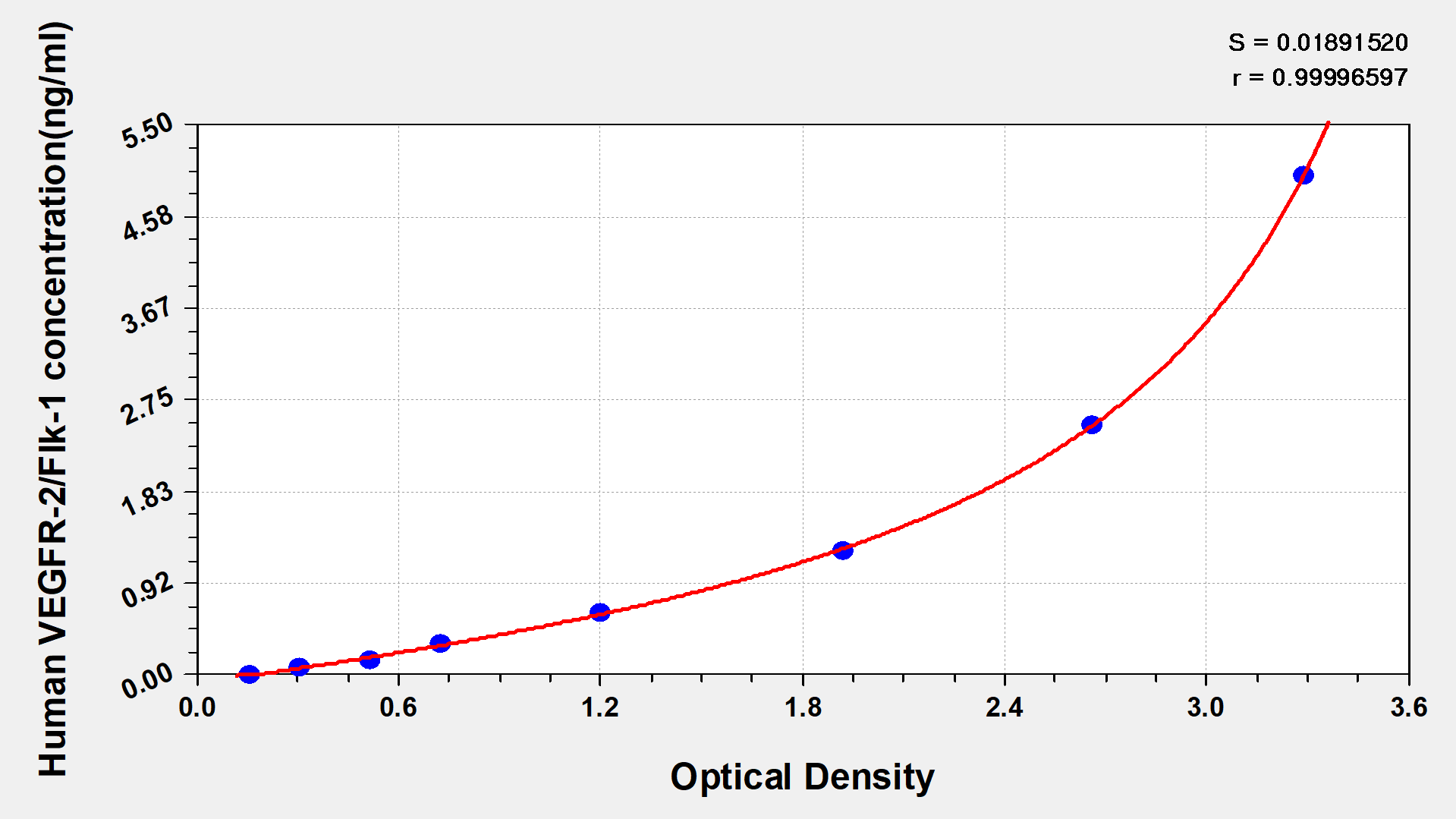 | ||||||
ng/ml | OD1 | OD2 | Average | Corrected | ||
5 | 3.168 | 3.334 | 3.251 | 3.081 | ||
2.5 | 2.596 | 2.667 | 2.632 | 2.461 | ||
1.25 | 1.830 | 1.978 | 1.904 | 1.734 | ||
0.625 | 1.163 | 1.229 | 1.196 | 1.026 | ||
0.312 | 0.738 | 0.721 | 0.729 | 0.559 | ||
0.156 | 0.535 | 0.513 | 0.524 | 0.354 | ||
0.078 | 0.306 | 0.334 | 0.320 | 0.150 | ||
0 | 0.168 | 0.172 | 0.170 |
| ||
To assess the linearity of the assay, samples were spiked with high concentrations of human VEGFR-2/Flk-1 in various matrices and diluted with the Sample Diluent to produce samples with values within the dynamic range of the assay. | ||||||
| Sample | Serum(n=4) | ||||
1:1 | Average % | 93 | ||||
Range % | 89-98 | |||||
1:2 | Average % | 101 | ||||
Range % | 96-107 | |||||
1:4 | Average % | 90 | ||||
Range % | 86-96 | |||||
1:8 | Average % | 98 | ||||
Range % | 91-103 | |||||
The recovery of human VEGFR-2/Flk-1 spiked to levels throughout the range of the assay in various matrices was evaluated. Samples were diluted prior to assay as directed in the Sample Preparation section. | ||||||
Sample Type | Average % Recovery | Range | ||||
Serum (n=5) | 91 | 86-96 | ||||
EDTA plasma (n=4) | 99 | 90-108 | ||||