.jpg "/Content/Upload/Product/Human_ELISA_kits_Diagnocine_1200_1200(423).jpg")
Human Fibroblast growth factor 19(FGF19) ELISA kit
The Ultimate 1-Stop ELISA Marketplace:
60,000+ ELISA kits Available to Serve Scientists from All Fields of Life Science
Always Powered by Diagnocine for Precision Research.
Most comprehensive buffers, reagents and detection agents are provided with each kit to optimize data output.
All-inclusive format covers everything from sample preparation to signal detection. Every step can be customized and optimized for your precision research.
DiagnoCine Precision buffers and reagents are Made in USA ISO 13485 Certified
Why waste time searching for your ELISA kit when you can get everything in one place? Diagnocine can provide you with all the ELISA needs you have (customized ELISAs also available) on the planet through a single, streamlined ordering process.
* all types of species
* HRP and AP detection
* Low target signal enhancement
* Inquire about a trial version or a customized version
4 core reagents below are included with every order, plus 1 of the 2 detection-specific reagents (matched automatically to your kit type) — 5 components, every time.
+ the 5th component, matched to your kit's detection method:
If you have any questions or need additional information, please call us at 551-245-1033 or email us at support@diagnocine.com. Our team will be happy to assist you.
Universal Compatibility
All buffers and detection reagents work seamlessly across target proteins, bridging the gap in assay consistency.
1-Stop Convenience
Consolidate your lab's purchasing. Source all ELISA needs and experience optimal buffers and reagents in a single shipment.
Enhanced Precision
Designed by scientists for scientists, all components are engineered to deliver sharper results and an optical signal.
Human Fibroblast growth factor 19(FGF19) ELISA kit
Sandwich quantitative immunoassay for fibroblast growth factor 19 in human serum, plasma, tissue homogenates available in multiple catalog sizes:
Note: Please send inquiries regarding Trial 24T orders to support@diagnocine.com.
| Target name | fibroblast growth factor 19 |
| Uniprot No. | O95750 |
| Species | Homo sapiens (Human) |
| Sample types | serum, plasma, tissue homogenates |
| Detection range | 25 pg/mL-1600 pg/mL |
| Sensitivity | 6.25 pg/mL |
| Assay time | 1-5h |
| Sample loading volume | 50-100μL |
| Detection wavelength | 450 nm |
| Assay principle | Sandwich (Quantitative) |
| Data analysis | Standard curve + Curve Expert software |
| Research area | Signal Transduction |
| Storage condition | 2-8°C (see protocol for full details) |
| Shipping condition | 4 °C |
| Shelf life | 6 months |
10 business days
Processing + 3-5 days shipping
In Stock : USA
Worldwide shipping available
Antibody capture
450 nm detection
Standard curve
Quantification
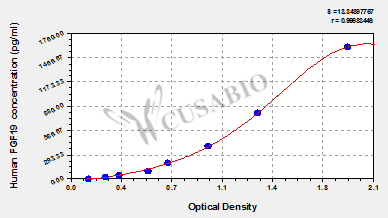
In this sandwich ELISA, fibroblast growth factor 19 in the sample is captured between a pre-coated capture antibody and a detection antibody. Signal intensity is proportional to analyte concentration. Quantification uses a standard curve fitted with Curve Expert software, covering 25 pg/mL-1600 pg/mL with a minimum detectable dose of 6.25 pg/mL.
The human FGF19 ELISA Kit is used to quantitatively measure human FGF19 levels in serum, plasma, or tissue homogenates. It performs well in important characteristics, including sensitivity and specificity. This assay is based on the sandwich ELISA mechanism and enzyme-substrate chromogenic reaction. The solution color develops proportionally to the amount of FGF19 in the sample. And the intensity of the color can be measured at 450 nm via a microplate reader.
FGF19 is an ileum-derived postprandial enterokine that governs bile acid and nutrient metabolism. FGF19 mediates the negative feedback regulation of bile salt synthesis by bile salts. FGF19 is inducibly expressed by the terminal ileum in response to bile acids that are reabsorbed from the intestine. It is released to the portal blood and will bind to its receptor in the liver to down-regulate the rate-limiting enzyme in bile acid synthesis. β-Klotho enables FGF19 binding to FGFR4 and acts as the obligatory coreceptor that permits FGF19–FGFR4 signaling.
- The pathogenesis of intestinal failure associated liver disease is uncertain, we therefore investigated the role of FGF19 and pro-inflammatory cytokines has on this disease state. PMID: 25595885
- The data suggest that FGF19/FGF21 circulating levels and hepatic gene expression of the associated signaling pathway are significantly dysregulated in type 2 diabetes. PMID: 25664662
- Fibroblast growth factor 19 might be associated with biochemical recurrence after radical prostatectomy by promoting cell proliferation and epithelial-mesenchymal transition of prostate cancer PMID: 25854696
- In mice with humanized livers, expression of an FGF19 transgene corrects bile acid signaling defects, resulting in normalization of bile acid synthesis, the bile acid pool, and liver size. PMID: 26028580
- KL methylation is a characteristic of many breast cancer cases . However, the resulting or associated perturbation in FGFR4 expression, similar to FGF19, could be utilized as a biomarker for poor prognosis PMID: 26152288
- Suggest a potential connection between gallbladder cholangiocyte-derived FGF19 and bile acid metabolism that could lead to metabolic dysregulation following cholecystectomy. PMID: 26256900
- Bile acid and FGF19 levels increased after Roux-en-Y bypass, but not after intensive medial management in type 2 diabetic subjects who achieved similar improvement in glycemic control. PMID: 26259981
- FGF19 correlates with severity of liver disease and can potentially serve as an indicator of chronic cholestatic liver injury. PMID: 26293907
- Study shows that FGF19 can be secreted and promotes ovarian cancer progression such as proliferation and invasion by activating FGFR4. PMID: 26323668
- FGF-19 increment after OGL was positively associated with age, and negatively associated with abnormal glucose regulation and statin treatment PMID: 26343925
- High expression of FGF19 is associated with hepatocellular carcinoma. PMID: 26498355
- discusses current knowledge of the complex biology of the endocrine FGFs. PMID: 26567701
- we suggest that considerable mechanistic differences exist between humans and mice with regard to the nuclear receptors controlling the VitA-FGF15/19 axis. PMID: 26723851
- Amplification of FGF19 was validated in independent LSCC samples. Furthermore, FGF19 stimulated LSCC cell growth in vitro. These data implicate FGF19 as a potential driver gene in LSCC with clinic characteristics as smoking. PMID: 26943773
- FGF19 is able to enhance migration and invasion abilities of gastric cancer cells. PMID: 27053348
- FGFR4/FGF19 autocrine signaling mediates the survival of a subset of basal-like breast cancer cells PMID: 27192118
- FGF19 copy number may increase in hepatocellular carcinoma accompanying a complete response to sorafenib treatment PMID: 27384874
- This is the first study to elucidate FGF19/FGFR4 signaling in favor of hepatocellular carcinoma cells developing from fatty liver PMID: 27447573
- Fibroblast growth factor 19 levels in human portal blood are higher than in arterial blood. Fibroblast growth factor 19 is released by the portal-drained viscera under fasted steady state conditions. PMID: 28003563
- Study demonstrates that elevated FGF19 expression or hyperactivation of FGF19/FGFR4 signaling in hepatocellular carcinoma cells is one of the main mechanisms of sorafenib resistance. PMID: 28069043
- Intestinal sensing of highly elevated levels of conjugated bile acids in blood promotes FGF15/FGF19 signaling, reducing hepatic bile acid synthesis and modulating bile acid transporters. PMID: 28498614
- Administering FGF19, or suitable mimetic, as a pharmacological intervention to increase circulating levels of FGF19 and suppress BA synthesis by inhibiting CYP7A1 gene expression is likely to provide therapeutic benefits for many PBC patients PMID: 28570655
- Study showed that FGF19 amplification is a genetic event in Chinese lung squamous cell carcinoma (LSCC) patients, with a frequency of 37.5%. FGF19 amplified LSCC cells express relatively higher levels of FGF19 mRNA expression, and downregulation of FGF19 expression can induce significant cell killing effects in vitro and in vivo. PMID: 28906590
- Findings show that FGF19 provides a cytoprotective role against ER stress by activating a FGFR4-GSK3beta-Nrf2 signaling cascade, suggesting targeting this signaling node as a candidate therapeutic regimen for hepatocellular carcinoma (HCC) management. PMID: 28951455
| Intra-assay Precision (Precision within an assay): CV%<8% | |||||||
| Three samples of known concentration were tested twenty times on one plate to assess. | |||||||
| Inter-assay Precision (Precision between assays): CV%<10% | |||||||
| Three samples of known concentration were tested in twenty assays to assess. | |||||||
| These standard curves are provided for demonstration only. A standard curve should be generated for each set of samples assayed. | ||||||||||||||||||||||||||||||||||||||||||||||||||||||||||||||||||||||||
| ||||||||||||||||||||||||||||||||||||||||||||||||||||||||||||||||||||||||
| To assess the linearity of the assay, samples were spiked with high concentrations of human FGF19 in various matrices and diluted with the Sample Diluent to produce samples with values within the dynamic range of the assay. | |||||||
| Sample | Serum(n=4) | ||||||
| 1:1 | Average % | 92 | |||||
| Range % | 87-99 | ||||||
| 1:2 | Average % | 103 | |||||
| Range % | 99-104 | ||||||
| 1:4 | Average % | 93 | |||||
| Range % | 87-98 | ||||||
| 1:8 | Average % | 91 | |||||
| Range % | 89-97 | ||||||
| The recovery of human FGF19 spiked to levels throughout the range of the assay in various matrices was evaluated. Samples were diluted prior to assay as directed in the Sample Preparation section. | |||||||
| Sample Type | Average % Recovery | Range | |||||
| Serum (n=5) | 95 | 92-99 | |||||
| EDTA plasma (n=4) | 90 | 86-93 | |||||