.jpg "/Content/Upload/Product/Human_ELISA_kits_Diagnocine_1200_1200(414).jpg")
Human CD81 antigen(CD81) ELISA kit
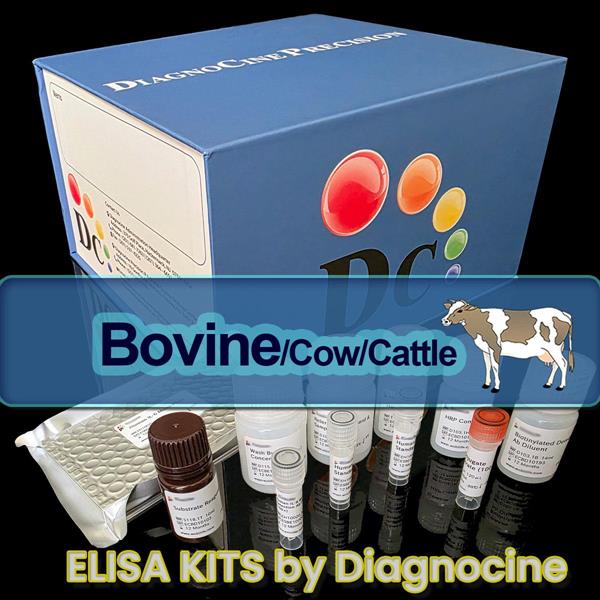
The Ultimate 1-Stop ELISA Marketplace:
60,000+ ELISA kits Available to Serve Scientists from All Fields of Life Science
Always Powered by Diagnocine for Precision Research.
Most comprehensive buffers, reagents and detection agents are provided with each kit to optimize data output.
All-inclusive format covers everything from sample preparation to signal detection. Every step can be customized and optimized for your precision research.
DiagnoCine Precision buffers and reagents are Made in USA ISO 13485 Certified
Why waste time searching for your ELISA kit when you can get everything in one place? Diagnocine can provide you with all the ELISA needs you have (customized ELISAs also available) on the planet through a single, streamlined ordering process.
* all types of species
* HRP and AP detection
* Low target signal enhancement
* Inquire about a trial version or a customized version
4 core reagents below are included with every order, plus 1 of the 2 detection-specific reagents (matched automatically to your kit type) — 5 components, every time.
+ the 5th component, matched to your kit's detection method:
If you have any questions or need additional information, please call us at 551-245-1033 or email us at support@diagnocine.com. Our team will be happy to assist you.
Universal Compatibility
All buffers and detection reagents work seamlessly across target proteins, bridging the gap in assay consistency.
1-Stop Convenience
Consolidate your lab's purchasing. Source all ELISA needs and experience optimal buffers and reagents in a single shipment.
Enhanced Precision
Designed by scientists for scientists, all components are engineered to deliver sharper results and an optical signal.
Human CD81 antigen(CD81) ELISA kit
Sandwich quantitative immunoassay for Human CD81 antigen(CD81) ELISA kit in human serum, plasma, cell lysates, tissue homogenates available in multiple catalog sizes:
Note: Please send inquiries regarding Trial 24T orders to support@diagnocine.com.
| Uniprot No. | P60033 |
| Species | Homo sapiens (Human) |
| Sample types | serum, plasma, cell lysates, tissue homogenates |
| Detection range | 23.5 pg/mL-1500 pg/mL |
| Sensitivity | 11.75 pg/mL |
| Assay time | 1-5h |
| Sample loading volume | 50-100μL |
| Detection wavelength | 450 nm |
| Assay principle | Sandwich (Quantitative) |
| Data analysis | Standard curve + Curve Expert software |
| Research area | Immunology |
| Storage condition | 2-8°C (see protocol for full details) |
| Shipping condition | 4 °C |
| Shelf life | 6 months |
10 business days
Processing + 3-5 days shipping
In Stock : USA
Worldwide shipping available
Antibody capture
450 nm detection
Standard curve
Quantification
In this sandwich ELISA, Human CD81 antigen(CD81) ELISA kit in the sample is captured between a pre-coated capture antibody and a detection antibody. Signal intensity is proportional to analyte concentration. Quantification uses a standard curve fitted with Curve Expert software, covering 23.5 pg/mL-1500 pg/mL with a minimum detectable dose of 11.75 pg/mL.
This ELISA kit provides quantitative measurement of CD81 (TAPA-1) in human serum, plasma, cell lysates, and tissue homogenates, supporting immunological research into this tetraspanin's roles in immune cell signaling and viral entry. Because CD81 is predominantly membrane-bound and shed at low levels into circulation, accurate quantification demands both high sensitivity and compatibility across soluble and cell-associated sample formats.
Detection Range: The 23.5–1500 pg/mL range accommodates the low picogram-level concentrations of soluble CD81 typically found in human plasma while also capturing elevated levels observed in hepatic inflammation and chronic HCV infection, minimizing the need for extensive sample concentration or dilution.
- These data revealed the crucial role played by His490 and His621 in hepatitis C virus infection, particularly during CD81 binding in cell entry. PMID: 25701820
- IFI6 inhibits HCV entry by impairing EGFR mediated CD81/CLDN1 interactions. This may be relevant to other virus entry processes employing EGFR. PMID: 25757571
- findings suggest that homozygous CD81 rs708564 TT may be a genetic modifier for avoiding HCV infection whether as a sole single nucleotide polymorphism or combined with the CLDN1 rs893051 GG genotype PMID: 25934191
- Data suggest that the intramolecular 188-196 bond restricts the intrinsic conformational dynamics of D-helix of cluster of differentiation 81 (CD81)-large extracellular loop (LEL), which is essential for hepatitis C virus entry. PMID: 26116703
- LDLR was not required for the degradation of CD81 by PCSK9, but its presence strengthened the PCSK9 effect. PMID: 26195630
- Results suggest that the CD81 antigen (CD81) expressed by B cells has differential effects on B cell proliferation or apoptosis according to Epstein-Barr virus (EBV) infection and the expression level of CD81. PMID: 26498453
- CD81 expression was lower in systemic sclerosis patients compared to controls independent of disease duration. PMID: 26926492
- Study used molecular dynamics simulations to gain insights into the role of local conformational flexibility in nanodomain formation in the plasma membrane, using the tetraspanin molecule CD81 as a model; suggest that exposing a flexible domain of CD81 enables binding to interaction partners by circumventing the restriction of orientation and conformational freedom of membrane proteins PMID: 27276264
- CD81 cell surface expression had a negative impact on survival in acute myeloid leukemia. PMID: 27566555
- The transmembrane segments of CD81 pack as two largely separated pairs of helices, capped by the large extracellular loop (EC2) at the outer membrane leaflet. The two pairs of helices converge at the inner leaflet to create an intramembrane pocket with additional electron density corresponding to a bound cholesterol molecule within the cavity. PMID: 27881302
- Results from crystallography and molecular dynamics of CD81 long-extracellular loop (LEL) show that its flexibility is an inherent molecular property likely to be tuned by variation in pH and redox conditions. This tuning mechanism would explain the priming role ascribed to CD81LEL in rendering the virus-receptor complex fusogenic during cell entry. PMID: 27916518
- A new link between HCV receptor molecules and the hepatocyte glycocalyx, namely, CD81 and Synd-1. PMID: 27930836
- CD81 is preferentially expressed in first trimester human placentas and progressively down-regulated with gestation advance in normal physiological conditions. CD81 up-regulation is detected in trophoblasts and cells in the villous core, and maternal sera of patients with early-onset severe preeclampsia. PMID: 28167787
- Studies have shown that CD81 regulates cell migration and invasion, and has therefore been implicated in tumor growth, cancer progression and metastasis. CD81 is expressed in most types of cancer, and the overexpression or down-regulation of this molecule has been correlated with either good or bad prognosis. [review] PMID: 28408492
- Free energy calculations indicated that the E2/CD81 binding process might follow a two-step model involving (i) the electrostatic interaction-driven initial binding of human-specific E2-site2, followed by (ii) changes in the E2 orientation to facilitate the hydrophobic and van der Waals interaction-driven binding of E2-site1 PMID: 28481946
- results demonstrate that the interaction of CD81 with SAMHD1 controls the metabolic rate of HIV-1 replication by tuning the availability of building blocks for reverse transcription, namely dNTPs.Together with its role in HIV-1 entry and budding into host cells, the data indicate that HIV-1 uses CD81 as a rheostat that controls different stages of the infection PMID: 28871089
- Tetraspanin hCD81 backbone domains are critical to signal for productive Hepatitis C Virus entry. A cholesterol-coordinating glutamate residue in CD81 promotes HCV infection. The backbone domains of hCD81 are additional HCV susceptibility-determining factors. PMID: 29677132
- CD81 might be a potential prognostic biomarker associated with poor patient prognosis in breast cancer. PMID: 30117494
Intra-assay Precision (Precision within an assay): CV%<8% | ||||||
Three samples of known concentration were tested twenty times on one plate to assess. | ||||||
Inter-assay Precision (Precision between assays): CV%<10% | ||||||
Three samples of known concentration were tested in twenty assays to assess. | ||||||
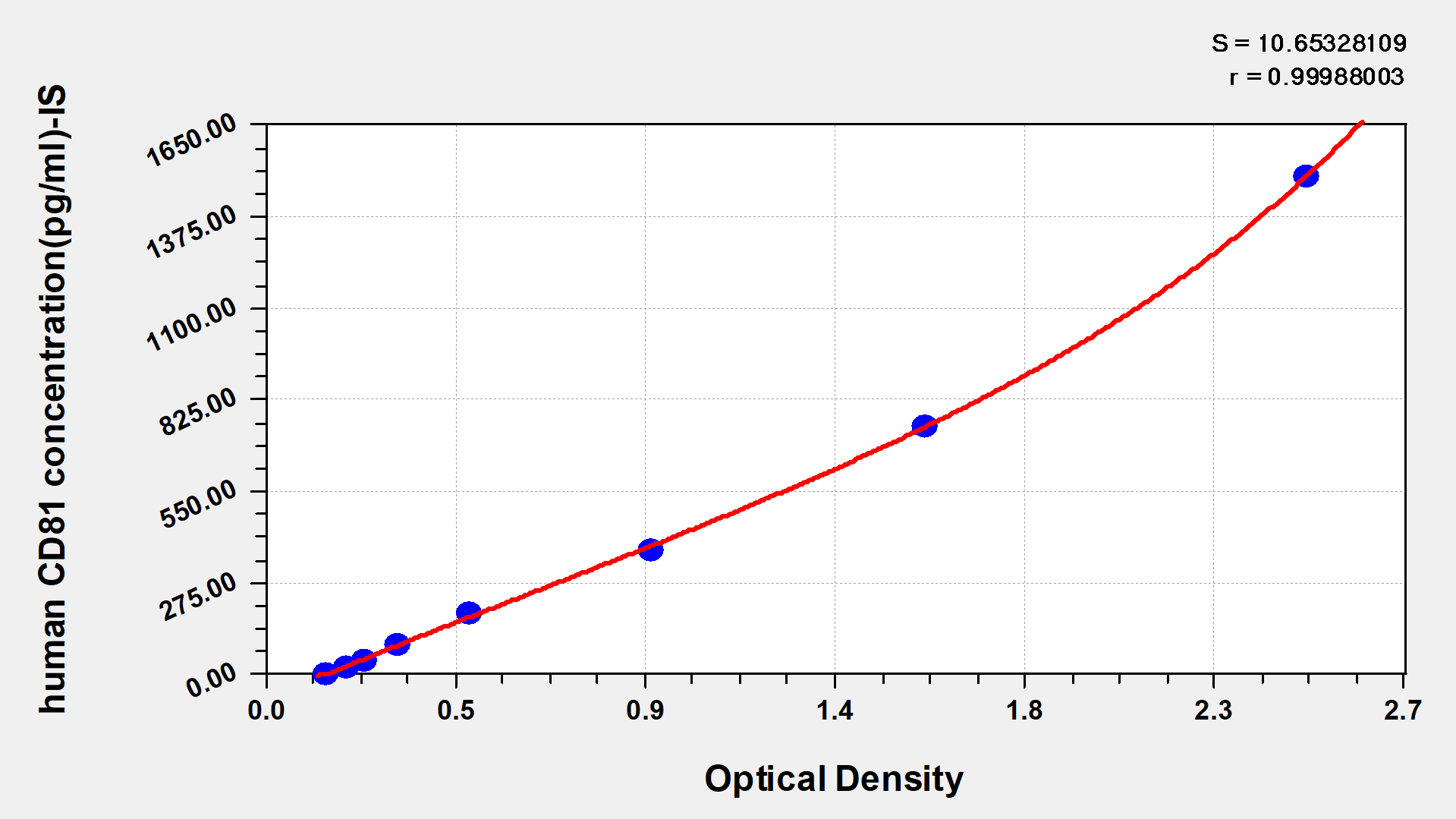
These standard curves are provided for demonstration only. A standard curve should be generated for each set of samples assayed. | |||||||
| |||||||
pg/ml | OD1 | OD2 | Average | Corrected | |||
1500 | 2.425 | 2.534 | 2.480 | 2.319 | |||
750 | 1.535 | 1.617 | 1.576 | 1.416 | |||
375 | 0.923 | 0.938 | 0.930 | 0.770 | |||
187.5 | 0.489 | 0.509 | 0.499 | 0.339 | |||
94 | 0.332 | 0.321 | 0.326 | 0.166 | |||
47 | 0.250 | 0.253 | 0.251 | 0.091 | |||
23.5 | 0.212 | 0.204 | 0.208 | 0.047 | |||
0 | 0.163 | 0.158 | 0.160 |
| |||
To assess the linearity of the assay, samples were spiked with high concentrations of Human CD81 in various matrices and diluted with the Sample Diluent to produce samples with values within the dynamic range of the assay. | ||||||
| Sample | Serum(n=4) | ||||
1:2 | Average % | 95 | ||||
Range % | 88-101 | |||||
1:4 | Average % | 102 | ||||
Range % | 97-106 | |||||
1:8 | Average % | 87 | ||||
Range % | 80-94 | |||||
1:16 | Average % | 93 | ||||
Range % | 86-98 | |||||
The recovery of Human CD81 spiked to levels throughout the range of the assay in various matrices was evaluated. Samples were diluted prior to assay as directed in the Sample Preparation section. | ||||||
Sample Type | Average % Recovery | Range | ||||
Serum (n=5) | 91 | 85-96 | ||||
EDTA plasma (n=4) | 99 | 92-107 | ||||