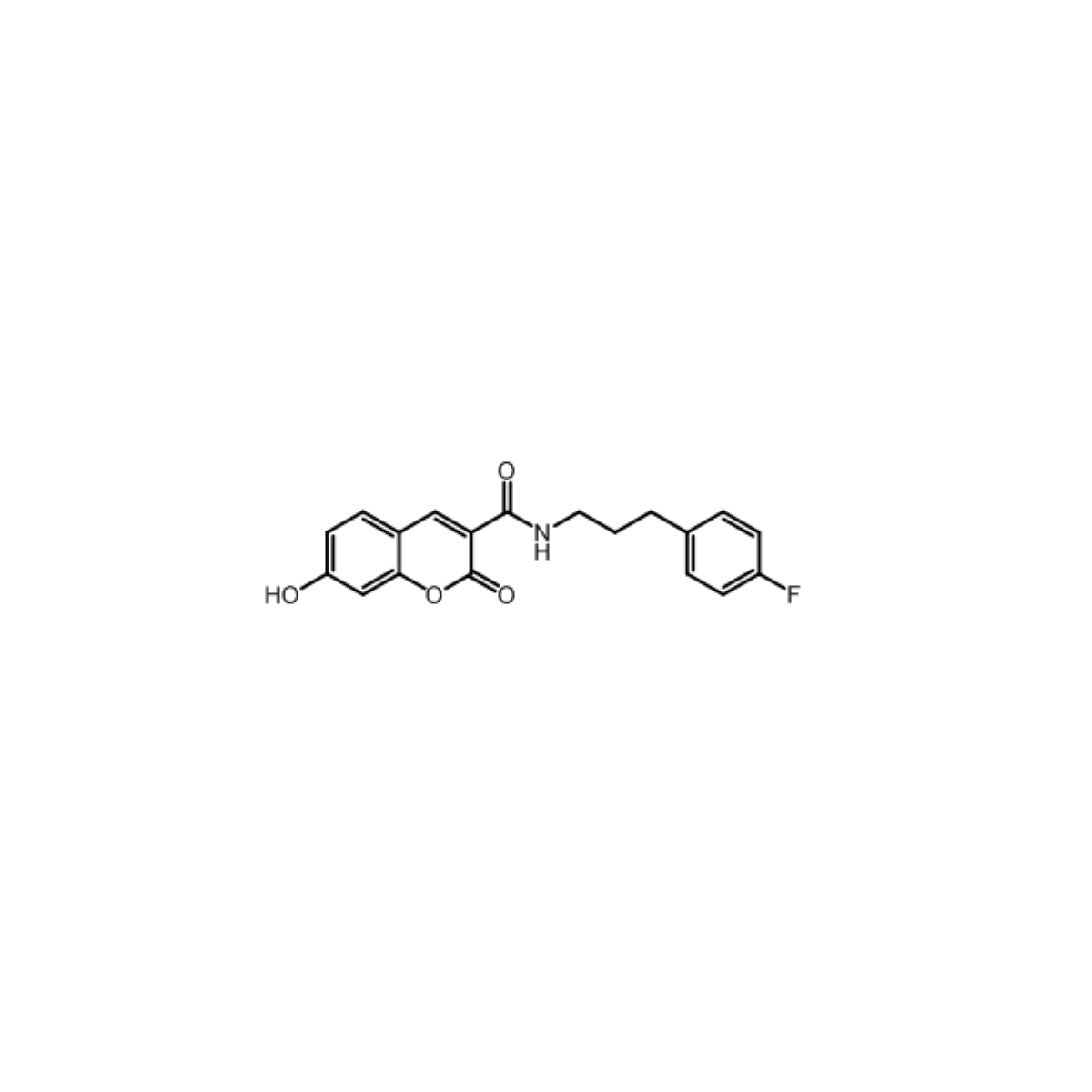
HCCFA (AKR1B10 inhibitor) (1mg)
HCCFA (AKR1B10 inhibitor)
Cat No: FNK-FDV-0016
Size: 1 mg
CAS: 2136579-33-2
Description
Selective Inhibitor of AKR1B10, HCCFA. Chemical structure:
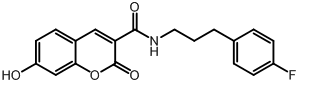
HCCFA is a potent and selective Inhibitor of Aldo-Keto Reductase family member 1B10 (AKR1B10).
AKR1B10 is a NADPH dependent reductase, and involved in metabolism of retinoid and isoprenoid.
After high expression of AKR1B10 in non-small cell lung cancer (NSCLC) was reported in 2005, such high expression was also found liver cancer, uterus cancer and bile duct cancer.
Therefore, AKR1B10 inhibitor was noted as a new target of anti-cancer drug development.
AKR1B10 shows 70.6% homology in amino-acid sequence to aldose reductase (AKR1B1, or AR), and both have similar structure and substrate specificity.
As a result, conventional inhibitors for AKR1B10 also inhibit AR to the same degree, selective inhibtor against AKR1B10 or AR has been searched.
HCCFA is a new compound which inhibits AKR1B10 selectively and strongly.
This product has been commercialized with the support of both the University of Toyama and Gifu Pharmaceutical University.
Product Background
A novel low-molecular compound, HCCFA, is a potent and selective Inhibitor of Aldo-Keto Reductase family member 1B10 (AKR1B10). The inhibitory effect of HCCFA on AKR1B10 is remarkably strong and IC50 value is 3.5 nM. In contrast, HCCFA has a low inhibitory potency toward aldose reductase (AR, also known as AKR1B1) whose structure is similar to AKR1B10. AKR1B10 is thought to be involved in the development,
progression, and survival of carcinomas. The inhibitor HCCFA is reported to suppress migration and proliferation of lung cancer A549 cells, to suppress metastasis of A549 cells into mouse lung, and to increase CDDP sensitivity of CDDP-resistant A549 cells.
Reconstitution and Storage
Reconstitution:
Centrifuge vial briefly prior to opening. For stock solution, this compound can be reconstituted in DMSO to a concentration of 10 mM.
Storage:
Store powder in the dark at -20 °C. After reconstitution, aliquot and store at -20 °C protected from light. Avoid repeated freeze-thaw cycles.
Features
- Selective and strong inhibitor of AKR1B10.
- Low inhibitory potency to AKR1B1 (AR, aldose reductase)
Chemical Information
- Chemical Name: 7-Hydroxy-2-oxo-2H-chromene-3-carboxylic acid [3-(4-fluorophenyl)propyl] amide
- Alternate Name: N-[3-(4-fluorophenyl)propyl]-7-hydroxy-2-oxo-2H-1-Benzopyran-3-carboxamide
- CAS No.: 2136579-33-2
- Molecular Formula: C19H16FNO4
- Molecular Weight: 341.33
- Melting Point: 207-209 °C (Recrystallization Solvent: Ethanol)
- Solubility: Soluble in DMSO
- Purity: >98% by HPLC
- Lot Number: see vial label
- Product Name: HCCFA
- Chemical Name: 7-Hydroxy-2-oxo-2H-chromene-3-carboxylic acid [3-(4-fluorophenyl)propyl]amide
- Alternate Name: N-[3-(4-fluorophenyl)propyl]-7-hydroxy-2-oxo-2H-1-Benzopyran-3-carboxamide
Product Data
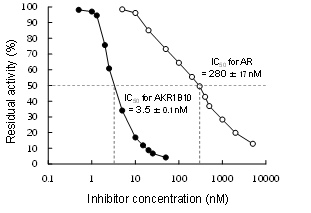
Fig.1 Inhibitory activity of HCCFA was measured by using recombinant AKR1B10 or AR. Data shows HCCFA inhibits AKR1B10 strongly and selectively.
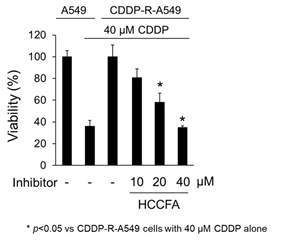
Fig.2 A549 cells or CDDP-R-A549 cells (cisplatin-resistant A549 cells) were treated with 0 to 40 μM of HCCFA for 2 hours and cultured for 24 hours under culture media containing CDDP (cisplatin) 40 μM.
Data shows that HCCFA recovers CDDP susceptibility of CDDP-R-A549 cells in a dose-dependent manner.
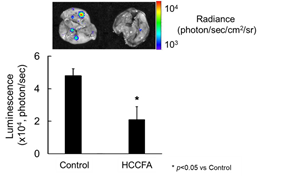
Fig.3 Luciferase transduced A549-Luc cells were cultured in DMSO (control) or 20 μM HCCFA containing medium for 24 hours, and transfered to BALB/c nude mouse by tail vein injection.
4 days after, luminescent in lung was observed. Data shows that HCCFA inhibits proliferation and metastasis of A549 cells in vivo.
Reference
- Endo S., et al., J. Med. Chem., 60:8441-8455 (2017). 10.1021/acs.jmedchem.7b00830