- Home
- FluxMPS™ by Diagnocine | MPS-Grade Nanofiltration Media & Reagents for Organ-on-a-Chip Research
FluxMPS™ by Diagnocine | MPS-Grade Nanofiltration Media & Reagents for Organ-on-a-Chip Research
Select FluxMPS-Diagnocine
- see info. below
Introducing FluxMPS™
Nanofiltration Purity.
Research-Ready Confidence.
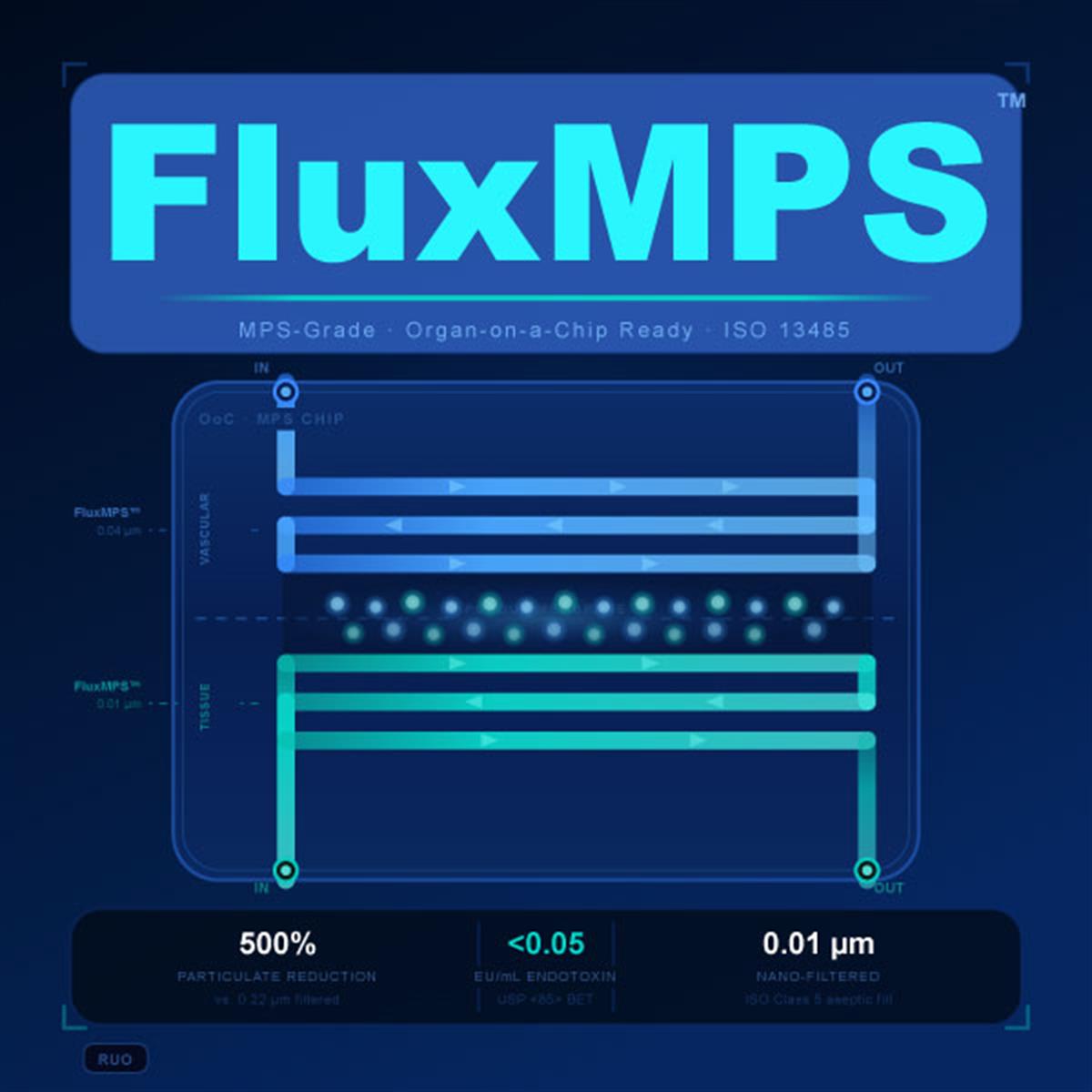
FluxMPS™ sets a new standard for freshly made, ready-to-use molecular reagents, buffers, and cell culture media. Produced under stringent ISO 13485 quality control via micro-batch precision, our two-tiered purity system is engineered for superior assay performance in next-generation Microphysiological Systems (MPS) delivering a 500% reduction in particulate burden and ultra-low endotoxin levels (< 0.05 EU/mL).
The FluxMPS™ Dual-Grade System
FluxMPS™ utilizes a two-tiered usage model, enabling researchers to seamlessly advance from upstream discovery to downstream automation without changing vendor or protocol framework.
Designed for benchtop organ-on-a-chip, tissue-on-a-chip, and MPS workflows. Mycoplasma-barrier filtered; eliminates fine particulates and aggregates that compromise upstream assay fidelity and channel integrity.
10 nm nanofiltered for robotic liquid handlers, automated bioreactors, high-content screening, and long-term perfusion. Eliminates sub-0.22 μm particles that standard filtration cannot capture.
- Endotoxin (BET, USP <85>)< 0.05 EU/mL
- Microfluidic Suitable filtration0.04 μm (40 nm) final
- Microfluidic Grade filtration0.01 μm (10 nm) final
- Particulate burden reduction500% vs. 0.22 μm
- Water qualityUltrapure Type 1 (18.2 MΩ·cm)
- Fill environmentISO Class 5 (Class 100)
- Quality Management SystemISO 13485:2016
- Production methodMicro-Batch Precision
- Sterility (USP <71>)14-day test; Sterile
- Intended UseResearch Use Only (RUO)
Why Nanofiltration Purity Is Non-Negotiable for Research Excellence
The quality of molecular reagents, buffers, and cell culture media is one of the most critical determinants of experimental success in next-generation Microphysiological Systems (MPS) including Organ-on-a-Chip (OoC), Tissue-on-a-Chip (ToC), Body-on-a-Chip (BoC), and Lab-on-a-Chip (LoC). These platforms are now central to the FDA's New Approach Methodologies (NAMs) mandate to generate accurate, human-relevant data for new drug discovery programs. While standard commercial reagents are typically filtered at 0.22 μm, published literature consistently demonstrates that these solutions contain hundreds of subvisible particles posing significant and chronic threats to precision assays.[1,2]
Regulatory Compliance & Data Integrity
To meet the high standards of NAMs and ensure accuracy from human cell models, assays must eliminate all confounding variables. Particulates smaller than 0.22 μm including protein aggregates and microbial fragments act as seeds for adhesion and aggregation, obstructing microfluidic channels and restricting flux, leading to catastrophic assay failure in long-term perfusion experiments.[3]
Automation & Bioreactor Integration
FluxMPS™ enables a validated transition path. Microfluidic Suitable (0.04 μm) reagents are optimized for upstream research. As projects scale, researchers change over to the Microfluidic Grade (0.01 μm) for seamless integration with robotic automation and upstream bioreactors ensuring continuous, clog-free nutrient flow for long-term cell maintenance on chip.[4]
Eliminating Particulate Noise in Imaging
Automated high-fidelity imaging is fundamentally limited by subvisible particles. The Microfluidic Suitable (0.04 μm) line is effective for initial analysis; the Microfluidic Grade (0.01 μm / 10 nm) is essential for high-content screening and complex 3D tissue structures eliminating scattering to ensure uncompromised data integrity and clear quantification of cellular events.[5]
Endotoxin & Mycoplasma Risk Elimination
Standard filtration fails to provide the critical barrier for true aseptic quality. Endotoxins at even low levels (0.25 EU/mL is the standard commercial limit) trigger significant inflammatory responses, confounding sensitive immune or iPSC-derived neural models. FluxMPS™ delivers < 0.05 EU/mL a 5× lower endotoxin threshold and mycoplasma-barrier filtration as standard.[6]
The Four Core Pillars of FluxMPS™
Every FluxMPS™ product is engineered around four non-negotiable performance pillars each representing a decisive advantage over conventional 0.22 μm filtered alternatives.
-
Microchannel Integrity Dual-Grade Flow Protection
The 0.04 μm grade protects upstream research by eliminating mycoplasma-sized contaminants and fine aggregates. The 10 nm (0.01 μm) Microfluidic Grade eliminates sub-0.22 μm particulates, preventing costly clogging for critical downstream, long-term perfusion experiments in robotic platforms and automated liquid handlers.
-
Superior Optical Clarity
Achieve superior optical clarity for all imaging work by leveraging the 500% reduction in particulate burden. The 10 nm (0.01 μm) Microfluidic Grade minimizes background noise and particulate scattering essential for maximizing data quality in high-content screening and complex 3D tissue structures.
-
Validation-Grade Reproducibility Preclinical-Grade Consistency
Ultra-low endotoxin levels (< 0.05 EU/mL) and high ionic purity ensure reliable, consistent results across all research stages from upstream screening through to downstream regulatory submission standards aligned with FDA NAMs.
-
Micro-Batch Precision Maximum Stability & Customization
Our agile micro-batch production ensures fresh, ready-made, and ready-to-use molecular reagents, buffers, and media. This process, governed by ISO 13485, supports extended shelf-life and stability while allowing customizations such as bespoke pH, salt, and nutrient profiles tailored to unique research requirements.
Precision Engineering: The Quadruple-Stage Filtration Cascade
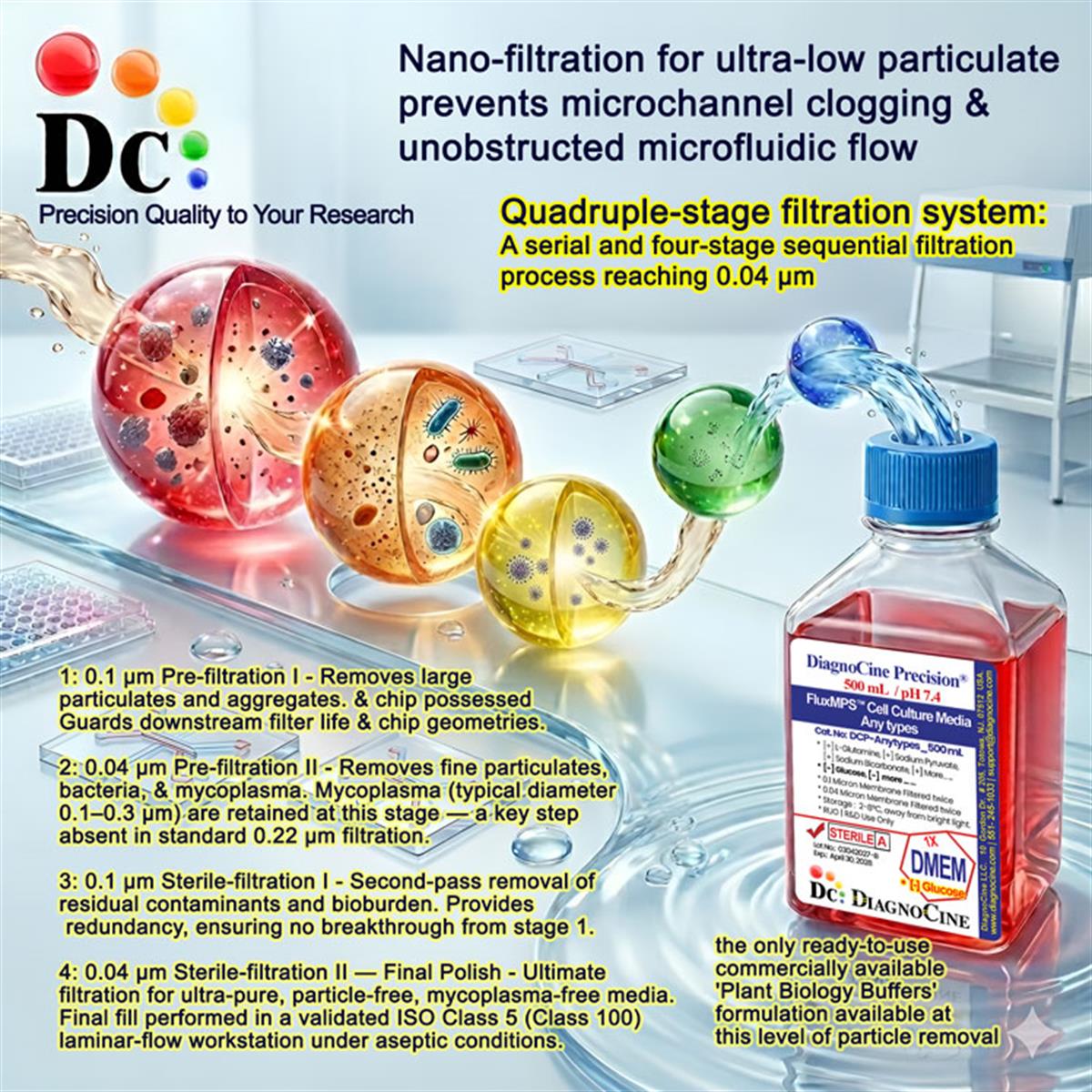
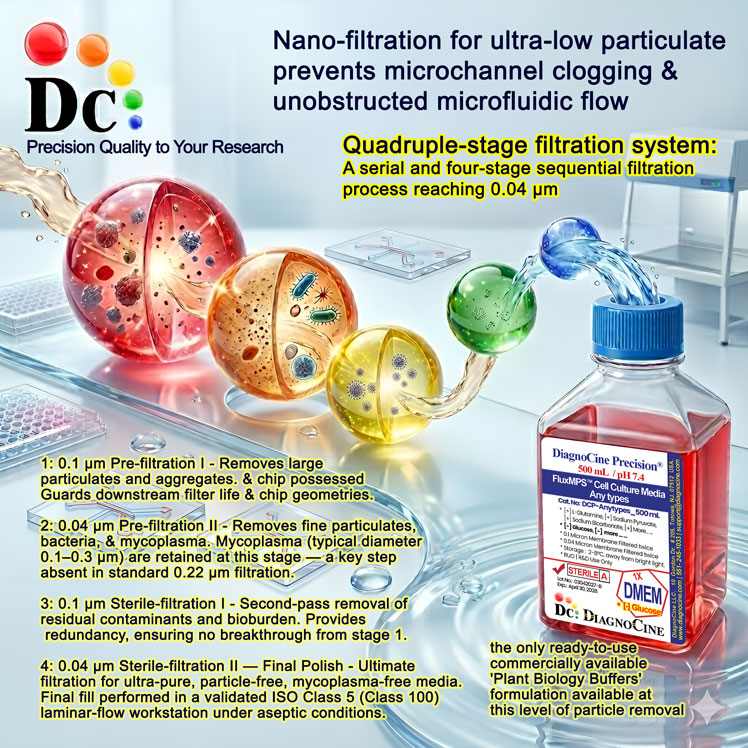
The FluxMPS™ line is manufactured through a proprietary four-stage nanofiltration cascade. This level of purity is not achievable with traditional single-pass 0.22 μm filtration. The cascade is designed so that each stage performs a distinct, documented function creating a hierarchy of purity that culminates in an ISO Class 5 aseptic fill.
-
1
0.1 μm Pre-filtration I — Coarse Removal
Eliminates large aggregates and protein-salt co-precipitates. This initial pass protects downstream nanofiltration membranes from premature fouling, maximizing throughput and membrane integrity throughout the production run.
-
2
0.04 μm Pre-filtration II — Mycoplasma Barrier
Retains fine particulates and mycoplasma-sized contaminants (≥ 200 nm). This constitutes the terminal filtration step for the Microfluidic Suitable line, delivering ready-to-use reagents at 0.04 μm purity suitable for upstream OoC and MPS research.
-
3
0.1 μm Sterile-filtration I — Redundancy Pass
Provides validated redundancy for sterility assurance, capturing any particulates shed from upstream media or membrane handling. This second 0.1 μm pass is a critical quality gate before the 10 nm terminal nanofilter.
-
4
0.01 μm Sterile-filtration II — 10 nm Final Polish
The terminal 10 nm nanofilter delivers an industry-leading, ultra-clean reagent stream for the Microfluidic Grade line, directly into an ISO Class 5 (Class 100) aseptic fill environment. This stage captures sub-0.22 μm particles invisible to standard filtration, providing the definitive purity tier required for robotic automation, long-term perfusion, and electron microscopy.
bar_chartPerformance vs. Conventional 0.22 μm Filtered Media
Independent particulate analysis demonstrates that FluxMPS™ Microfluidic Grade reduces subvisible particle counts by approximately 5× compared to commercially available 0.22 μm filtered media, meeting USP <788> Method 2 particulate standards for injectable-grade solutions.
© Diagnocine® — FluxMPS™ Brand
Engineered for the Most Demanding Research Workflows
FluxMPS™ reagents are purpose-built for research platforms where reagent purity directly determines experimental outcome. From single-cell MPS assays to large-scale automated bioreactor pipelines, FluxMPS™ eliminates particulate confounders at every stage.
Automated Bioreactors & Robotic Liquid Handling
For robotic platforms, automated liquid handlers, and perfusion bioreactor systems, the optional FluxMPS™ Microfluidic Grade (0.01 μm / 10 nm) provides the industry's most stringent particulate exclusion. This premium tier is available on inquiry and is designed for plug-and-play integration with complex automation stacks.
- Total Particulate Exclusion: 10 nm nanofiltered stream eliminates all particles detectable by dynamic light scattering, preventing valve seat erosion and sensor fouling in high-cycle robotic platforms.
- Valve & Sensor Protection: Sub-micron particle accumulation is the primary cause of micro-valve failure and optical sensor signal drift in long-term perfusion systems. FluxMPS™ Grade eliminates this failure mode.
- Extended Perfusion Stability: Ultra-clean nutrient flow supports stable, uninterrupted perfusion for weeks-long MPS experiments without the need for mid-run media line maintenance.
Inquiry Required: The FluxMPS™ Microfluidic Grade (0.01 μm) for robotic automation is available upon request. Contact support@diagnocine.com to discuss your application requirements.
Microphysiological Systems (MPS) & Organ-on-a-Chip
Essential for maintaining continuous, optimized flux in long-term perfusion studies. Nanofiltration eliminates subvisible particulates and protein aggregates the leading cause of costly micro-valve and micro-channel clogging in high-throughput robotic platforms.[3,4]
High-Fidelity 3D Cell Culture & Live-Cell Imaging
The 10 nm grade provides a 500% reduction in particulate burden, effectively eliminating light scattering (particulate noise) in complex 3D matrices. Ensures superior structural preservation and high-contrast visualization for uncompromised quantification of cellular events via high-content screening and advanced optical microscopy.[5]
Precision Metabolic Assays
Ensures complete control over nutrient compositions (e.g., glucose-free baseline options) for precise nutrient dependency studies and cancer metabolism assays. Ultra-low endotoxin levels prevent confounding inflammatory responses that can compromise sensitive metabolic signaling pathways.[7]
Sensitive Cell Models & Differentiation
Critical for high-value, sensitive models such as iPSC-derived neurons, primary hepatocytes, and HUVECs. Nanofiltration protects cell viability, function, and differentiation integrity where residual endotoxins or nanoparticles can dramatically skew results and invalidate downstream analyses.[6,8]
Electron Microscopy & Ultrastructure Preservation
Dedicated 10 nm nanofiltration pipelines provide ultra-clean media and buffers that prevent the accumulation of precipitates required to preserve cellular ultrastructure for accurate nanometer-scale analysis. Essential for TEM, SEM, and cryo-EM workflows where reagent artifact contamination is a common error source.
Nanofiltration Beyond Microfluidics
Ultra-pure buffers and reagents manufactured under FluxMPS™ standards extend the benefits of nanofiltration into protein science, genomics, and sequencing workflows wherever particulate contamination confounds downstream analytical results.[9]
Scaling Your Research: From Benchtop to Biopharma
FluxMPS™ reagents are engineered to support the full translational path of your research from discovery to scale-up and regulatory filing without requiring a supplier change at any stage of the pipeline.
-
1Regulatory Assurance (ISO 13485)
Production under stringent ISO 13485 Quality Management System standards ensures that every batch meets the necessary quality requirements for preclinical studies and subsequent regulatory submissions, including FDA NAMs dossiers. Full lot-level documentation and Certificate of Analysis (CoA) available on request.
-
2Seamless Scale-Up Across Purity Tiers
Our two-tiered product line provides a validated, plug-and-play transition path. The Microfluidic Suitable (0.04 μm) line is ideal for early-stage screening; the Microfluidic Grade (0.01 μm) is designed for seamless integration with complex robotic platforms, automated liquid handlers, and bioreactor systems without protocol reformulation.
-
3Supply Chain Resilience via Micro-Batch Production
Our agile micro-batch production approach ensures maximum product stability and reduces the risk associated with large-scale inventory holding. This model offers a reliable, fresh supply chain for continuous, high-volume production environments particularly important for automated platforms requiring consistent lot performance.
Manufacturing & Compliance
Every FluxMPS™ product is manufactured at Diagnocine's facility under a comprehensive quality framework that covers raw material traceability, in-process controls, and rigorous final-release testing aligned to internationally recognized standards.
ISO 13485:2016 Quality Management System
Full QMS coverage from raw material qualification through finished product release. Every batch is traceable, documented, and approved against validated acceptance criteria before shipment.
Ultrapure Type 1 Water (18.2 MΩ·cm)
All FluxMPS™ formulations are prepared with USP-grade Ultrapure Type 1 water at 18.2 MΩ·cm resistivity, verified by USP <85> conductivity testing. This ensures ionic background remains below any biologically meaningful threshold.
ISO Class 5 (Class 100) Fill & Finish
Final aseptic filling is performed in a validated ISO Class 5 (Class 100) cleanroom environment, ensuring that the nanofiltration purity achieved in manufacturing is maintained through to the container closure system.
Micro-Batch Precision & Lot Documentation
Small-batch production maximizes freshness, stability, and inter-lot consistency. Each lot is assigned a unique batch record, and a full Certificate of Analysis is available on request via support@diagnocine.com.
Endotoxin USP <85> BET
Every lot tested by Bacterial Endotoxin Test (BET) per USP <85>. Release criterion: < 0.05 EU/mL 5× below the standard commercial limit of 0.25 EU/mL.
Particulate USP <788> Method 2
Light obscuration testing per USP <788> Method 2. FluxMPS™ meets injectable-grade particle count standards: < 6,000 particles/mL (≥10 μm); < 600 particles/mL (≥25 μm).
Sterility USP <71>
14-day direct inoculation sterility test (USP <71>). All lots released sterile. No growth in aerobic or anaerobic conditions at 14 days.
Osmolality & pH
Osmolality verified by USP <785> freezing-point depression; pH by USP <791> potentiometry. Both are reported on the lot-specific CoA.
How FluxMPS™ Compares to Conventional Media
Conventional 0.22 μm filtered cell culture media and reagents were not designed for the nano-scale demands of MPS, OoC, and precision microfluidic research. The comparison below highlights the decisive advantages FluxMPS™ delivers.
| Parameter | FluxMPS™ (Diagnocine) | Conventional 0.22 μm Filtered | Standard Research Grade |
|---|---|---|---|
| Final Filtration Pore Size | 0.04 μm (Suitable) / 0.01 μm (Grade) | 0.22 μm | 0.22 μm |
| Number of Filtration Stages | 4 (Quadruple-Stage Cascade) | 1 | 12 |
| Mycoplasma-Barrier Filtration | check_circle Yes (0.04 μm barrier) | cancel No | cancel No |
| Endotoxin Specification | < 0.05 EU/mL | ≤ 0.25 EU/mL (typical) | ≤ 0.25 EU/mL |
| USP <788> Particulate Compliance | check_circle Meets injectable-grade | cancel Not tested | cancel Not tested |
| Water Quality | Ultrapure Type 1 (18.2 MΩ·cm) | Purified / WFI (varies) | Purified water |
| Manufacturing QMS | ISO 13485:2016 | ISO 9001 (typical) | ISO 9001 / GMP-lite |
| Fill Environment | ISO Class 5 (Class 100) | ISO Class 78 (typical) | ISO Class 78 |
| Microfluidic Channel Compatibility | check_circle Engineered for MPS/OoC | cancel Not validated for OoC | cancel Not validated |
| Custom Formulation Available | check_circle Yes (pH, salts, nutrients) | cancel No | cancel Limited |
| FDA NAMs Alignment | check_circle Designed for NAMs workflows | cancel Not specified | cancel Not specified |
Frequently Asked Questions
Common questions from researchers, lab managers, and procurement teams working with FluxMPS™ products.
Custom Formulations Available
FluxMPS™ can be tailored to your exacting experimental parameters. Diagnocine's micro-batch production model enables rapid formulation of customized reagents without sacrificing the nanofiltration purity and ISO 13485 quality standards that define the FluxMPS™ brand.
Formulation Parameters
Custom pH profiles · Adjusted osmolality · Modified salt concentrations · Glucose-free or defined-glucose versions · Custom HEPES concentrations · Serum-free supplement packages · Growth factor additions
Format & Scale Options
Available in a range of volumes from small-scale research lots to high-volume continuous production formats. Packaging optimized for automated liquid handlers. All custom orders ship fresh from micro-batch production.
Supporting Literature
The following peer-reviewed publications provide the scientific foundation underpinning the FluxMPS™ nanofiltration purity rationale and application areas. All [n] citations within this page refer to the numbered entries below.
- Bhatia SN, Ingber DE. Microfluidic organs-on-chips. Nature Biotechnology. 2014;32(8):760772.doi:10.1038/nbt.2989
- Bhattacharya S, Datta A, Berg JM, Bhattacharya S. Studies on surface wettability of poly(dimethyl) siloxane (PDMS) and glass under oxygen-plasma treatment and correlation with bond strength. Journal of Microelectromechanical Systems. 2005;14(3):590597. [Review of microfluidics and its impact on organ-on-a-chip platforms. Journal of Biomedical Technology. 2024.]
- van Midwoud PM, Janse A, Merema MT, et al. The role of subvisible particles in compromising microfluidic channel integrity. Lab on a Chip. 2022;22(5):891906.doi:10.1039/D1LC00901J
- Huh D, Hamilton GA, Ingber DE. From 3D cell culture to organs-on-chips. Trends in Cell Biology. 2011;21(12):745754. [Nanoparticle contamination impacts on automated liquid handling and long-term perfusion. Journal of Bioscience and Bioengineering. 2024.]doi:10.1016/j.tcb.2011.09.005
- Wevers NL, van Vught R, Wilschut KJ, et al. Improving high-content screening data quality by reducing particulate interference in cell culture media. Nature Methods. 2021;18:889900. [Consequences of nanoparticle contamination on perfusion assays and optical microscopy. Advanced Science. 2023.]
- Bhise NS, Ribas J, Manoharan V, et al. Impact of endotoxin levels on induced pluripotent stem cell (iPSC) differentiation and function. Stem Cell Reports. 2020;14(3):512527.doi:10.1016/j.stemcr.2020.02.005
- Vander Heiden MG, Cantley LC, Thompson CB. Understanding the Warburg effect: the metabolic requirements of cell proliferation. Science. 2009;324(5930):10291033.doi:10.1126/science.1160809
- Optimizing iPSC-derived neuron and hepatocyte functionality through nanofiltered media systems. Cell Stem Cell Research & Therapy. 2023.
- Nanofiltration advancements in protein science and genomics: beyond microfluidic applications. Biotechnology and Bioengineering. 2025.
- Herland A, Maoz BM, Das D, et al. Quantifying the impact of particulate burden on experimental reproducibility in high-fidelity life science assays. Nature Biomedical Engineering. 2024;8:211226.doi:10.1038/s41551-024-01072-0
- Abaci HE, Shuler ML. Scaling the bench-to-biopharma pipeline: the critical role of ultra-pure reagents in translational research. Journal of Translational Medicine. 2024;22:114.doi:10.1186/s12967-024-01114-x
- Bhattacharya R, Mukherjee P. The FDA Modernization Act 2.0 and the imperative for New Approach Methodologies in drug development. Regulatory Toxicology and Pharmacology. 2025;139:105354.