FluxMPS™ | Microfluidic-Ready, 100 mM MES Buffer
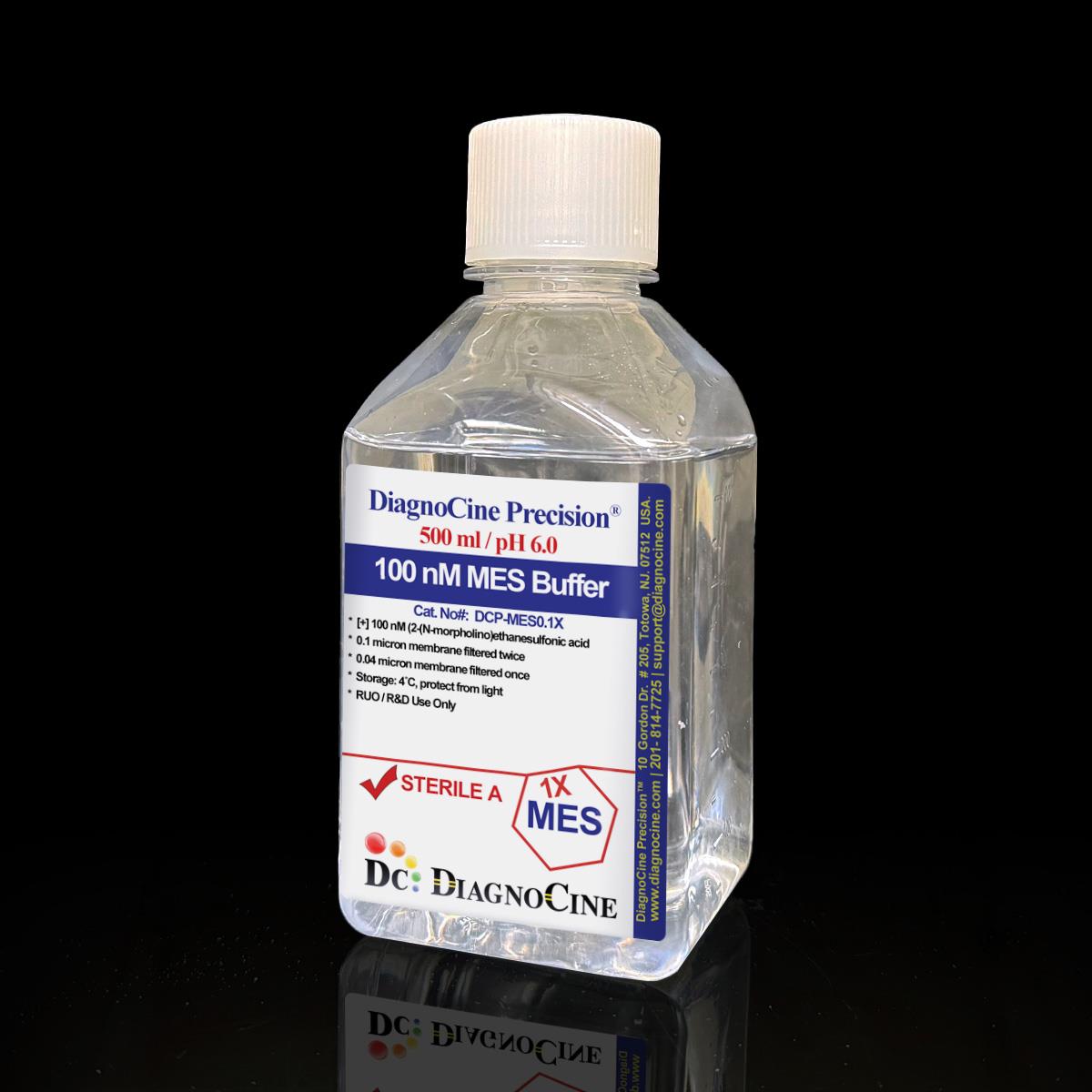
FluxMPS™ 100 mM MES Buffer
A ready-to-use MES buffer at pH 6.0, providing stable, low ionic strength buffering in the mildly acidic range. Ideal as a base buffer for plant protoplast solutions, enzyme assays, and biochemical reactions requiring precise pH control. MES (2-(N-morpholino)ethanesulfonic acid) offers minimal metal binding, low UV absorbance, and excellent chemical stability.
- 4-stage filtration process (0.1 µm → 0.04 µm, followed by sterile 0.1 µm → 0.04 µm)
- Centered near the pKa of MES, providing optimal buffering capacity for assays and buffers requiring pH around 6.0.
- Low metal chelation and low UV absorbance help minimize interference in metal-dependent enzymes and spectrophotometric readouts.
- Strong buffering with moderate ionic strength; easily diluted to common working concentrations (e.g., 10-50 mM).
- pH adjusted with NaOH, yielding a sodium salt form broadly compatible with biological systems and downstream formulations.
- Ultrapure Type 1 water (18.2 MΩ·cm)
- ISO Class 5 laminar-flow fill & finish
- Customizable formulation available upon request
- pH6.0
- AppearanceClear Solution
- Filtration0.1µm×2 + 0.04µm×2
- Storage2-8 °C
- Shelf Life2 years
Engineered for maximum purity & performance
Standard laboratory reagents filtered at 0.22 µm leave sub-micron particulates, mycoplasma, and aggregates that interfere with sensitive downstream applications. FluxMPS™ 100 mM MES Buffer is manufactured under ISO 13485 quality systems with multi-stage ultra-filtration to eliminate these failure modes.
Optimal pKa match
pH 6.0 is centered near the pKa of MES, delivering maximum buffering capacity for mildly acidic protocols.
Minimal assay interference
Low metal chelation and low UV absorbance minimize interference in enzyme-dependent and spectrophotometric workflows.
Versatile base buffer
Easily diluted to 10–50 mM working concentrations and supplemented with salts, osmolytes, or other components.
Plant protoplast optimized
The standard pH 6.0 buffer component for W5, MMG, and PEG-Ca² protoplast transformation workflows.
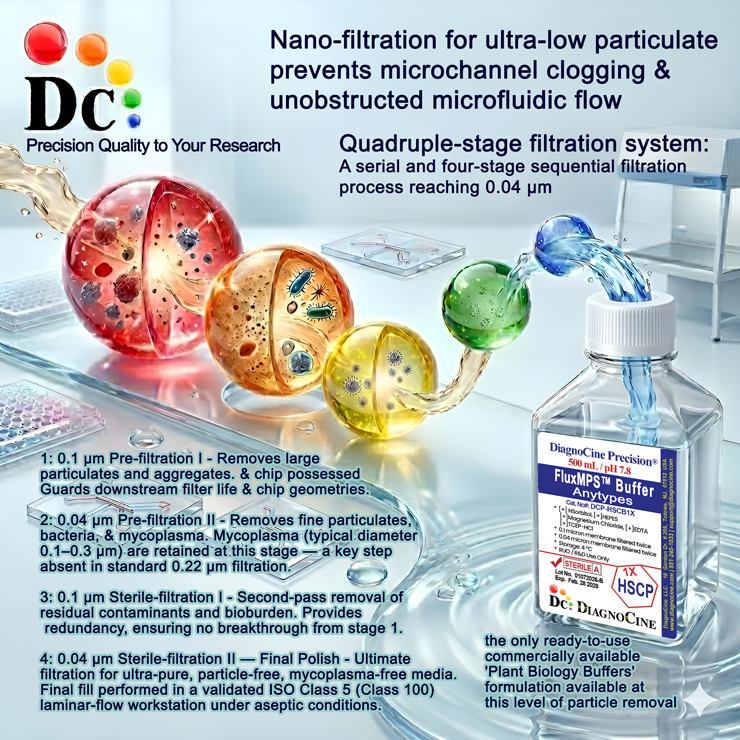
Quadruple-stage filtration system
A serial four-stage sequential filtration process reaching 0.04 µm—the only commercially available buffer at this level of particle removal.
-
1
0.1 µm Pre-filtration I
Removes large particulates and aggregates. Primary guard to extend downstream filter lifetime.
-
2
0.04 µm Pre-filtration II
Removes fine particulates, bacteria, and mycoplasma (0.1–0.3 µm)—a key step absent in standard 0.22 µm filtration.
-
3
0.1 µm Sterile-filtration I
Second-pass removal of residual contaminants and bioburden with full redundancy.
-
4
0.04 µm Sterile-filtration II — Final Polish
Ultimate filtration for particle-free, mycoplasma-free product. Final fill in validated ISO Class 5 laminar-flow workstation.
Performance vs. conventional reagents
Standard 0.22 µm single-pass filtration leaves particles in the 0.05–0.22 µm range. FluxMPS™ removes these contaminants for cleaner results and higher reproducibility.
Validated applications
- Base buffer for plant-related solutions (e.g., protoplast buffers such as W5 and MMG) that require a mildly acidic environment.
- Enzyme assays and biochemical reactions optimized around pH 6.0.
- Preparation of custom media, wash buffers, or reaction mixtures where stable pH 6.0 is needed.
- General laboratory use wherever a well-characterized Good’s buffer at pH 6.0 is preferred.
Protocol & usage instructions
- Use as supplied or dilute to the desired working concentration with high-purity water or compatible solutions.
- Adjust ionic strength and composition by adding salts or other components as required by your protocol.
- If needed, fine-tune pH at the working temperature with small additions of NaOH or acid.
Quality assurance & logistics
ISO 13485:2016 Certified
Manufactured under certified QMS with full traceability and lot documentation.
Made in USA
All manufacturing, QA testing, and final assembly at DiagnoCine Precision, Totowa, NJ.
Supporting literature
- Good NE, Winget GD, Winter W, et al. Hydrogen ion buffers for biological research. Biochemistry. 1966;5(2):467-477.
- Yoo SD, Cho YH, Sheen J. Arabidopsis mesophyll protoplasts: a versatile cell system for transient gene expression analysis. Nat Protoc. 2007;2(7):1565-1572.