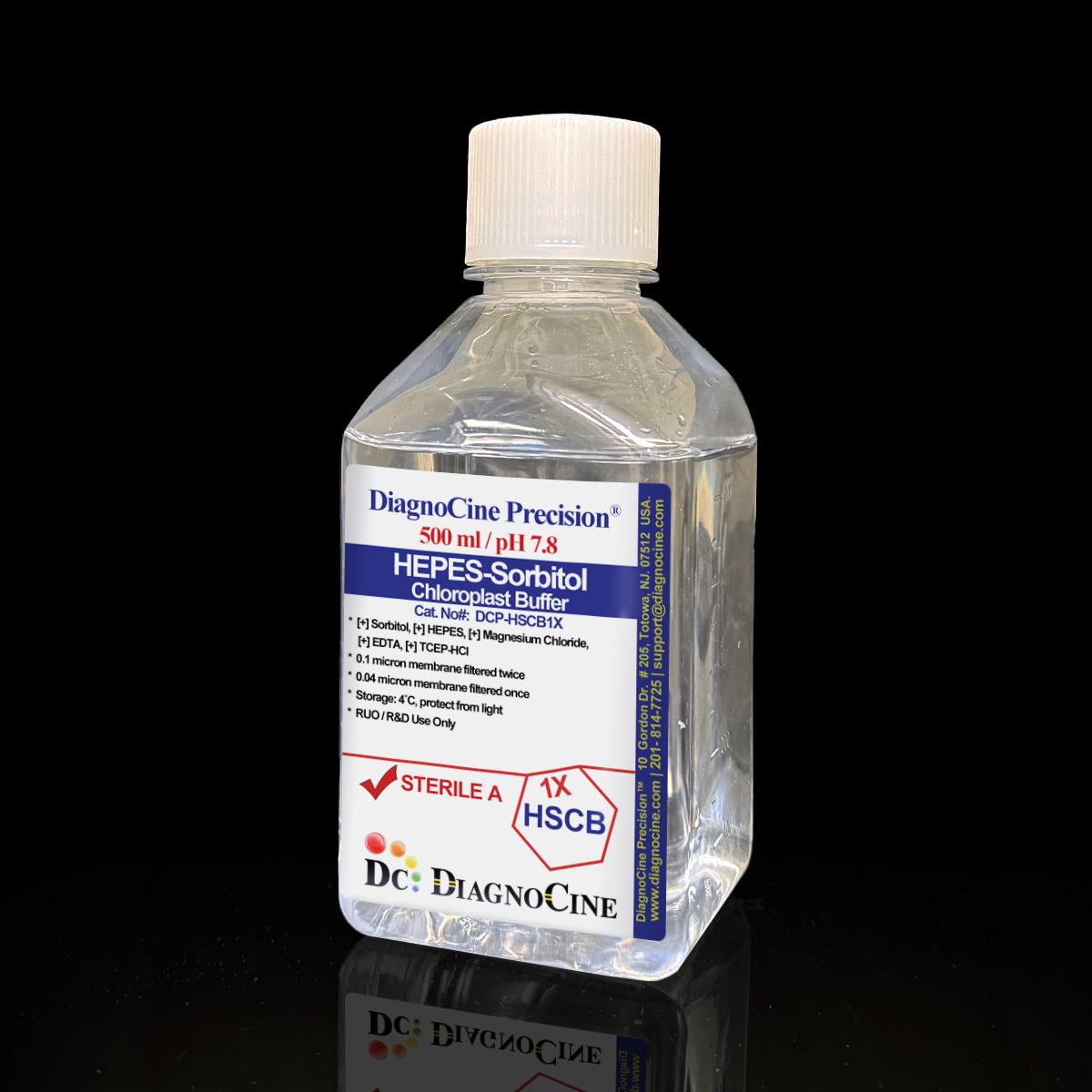
FluxMPS™, HEPES-Sorbitol Chloroplast Buffer
FluxMPS™ HEPES-Sorbitol Chloroplast Buffer
A ready-to-use, iso-osmotic buffer formulated for isolation, washing, and short-term handling of intact chloroplasts from plant tissues. Combines sorbitol osmotic support with HEPES buffering, MgCl₂ membrane stabilization, and TCEP-HCl reducing agent.
- 4-stage filtration process (0.1 µm → 0.04 µm, followed by sterile 0.1 µm → 0.04 µm)
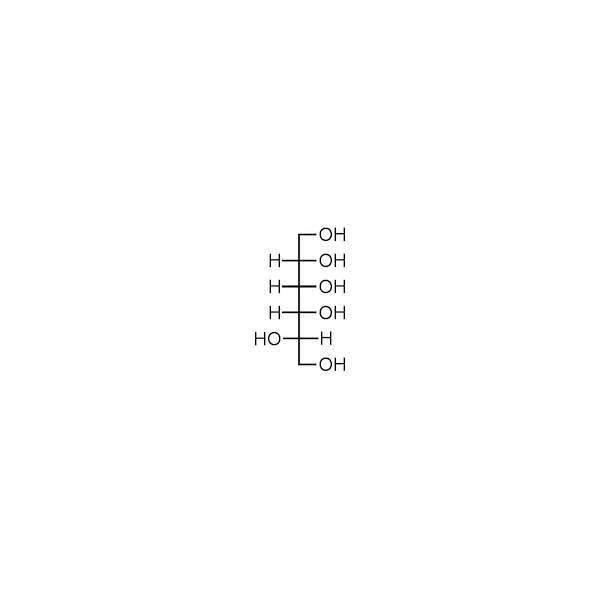
- Sorbitol maintains osmotic balance during tissue disruption and pelleting, reducing swelling and rupture and improving recovery of intact chloroplasts.
- HEPES provides a stable, mildly alkaline environment compatible with stromal conditions, supporting functional integrity of photosynthetic enzymes.
- MgCl2 helps stabilize thylakoid structure and protein-pigment complexes, supporting downstream measurements such as electron transport or chlorophyll fluorescence.
- EDTA chelates trace divalent metals that can drive oxidative reactions, helping preserve pigments, lipids, and proteins during processing on ice.
- Ultrapure Type 1 water (18.2 MΩ·cm)
- ISO Class 5 laminar-flow fill & finish
- Customizable formulation available upon request
- pH7.8
- AppearanceClear Solution
- Filtration0.1µm×2 + 0.04µm×2
- Storage2-8 °C
- Shelf Life1 year
Engineered for maximum purity & performance
Standard laboratory reagents filtered at 0.22 µm leave sub-micron particulates, mycoplasma, and aggregates that interfere with sensitive downstream applications. FluxMPS™ HEPES-Sorbitol Chloroplast Buffer is manufactured under ISO 13485 quality systems with multi-stage ultra-filtration to eliminate these failure modes.
Sorbitol osmotic balance
0.33 M sorbitol maintains chloroplast integrity during tissue disruption and centrifugation, reducing swelling and rupture.
HEPES pH stability
50 mM HEPES provides mildly alkaline conditions compatible with stromal enzyme function and photosynthetic activity.
Membrane-protective ions
3 mM MgCl₂ stabilizes thylakoid structure and protein–pigment complexes; 1 mM EDTA chelates oxidation-catalyzing trace metals.
Functional chloroplasts
Suitable for chlorophyll fluorescence assays, electron transport measurements, enzymatic studies, and chloroplast proteomics.
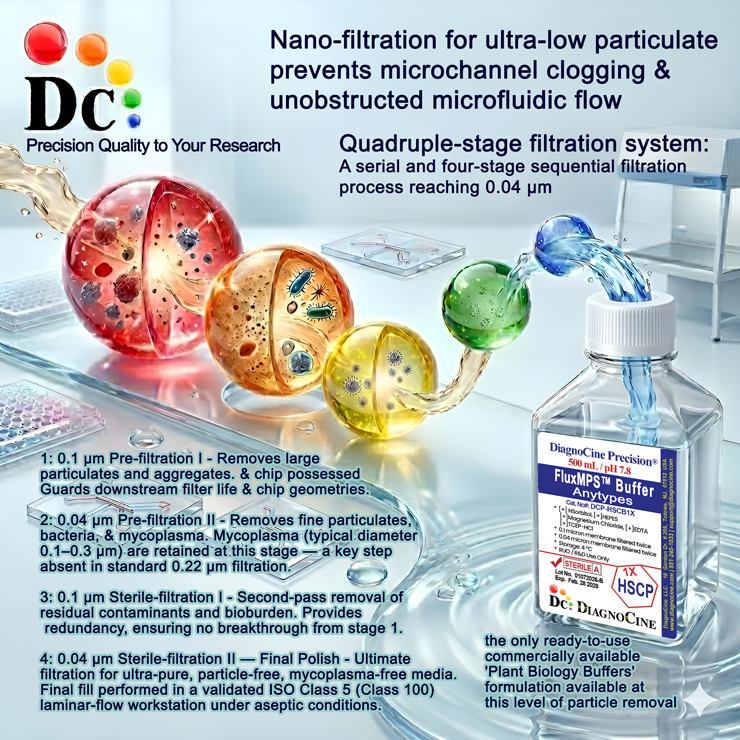
Quadruple-stage filtration system
A serial four-stage sequential filtration process reaching 0.04 µm—the only commercially available buffer at this level of particle removal.
-
1
0.1 µm Pre-filtration I
Removes large particulates and aggregates. Primary guard to extend downstream filter lifetime.
-
2
0.04 µm Pre-filtration II
Removes fine particulates, bacteria, and mycoplasma (0.1–0.3 µm)—a key step absent in standard 0.22 µm filtration.
-
3
0.1 µm Sterile-filtration I
Second-pass removal of residual contaminants and bioburden with full redundancy.
-
4
0.04 µm Sterile-filtration II — Final Polish
Ultimate filtration for particle-free, mycoplasma-free product. Final fill in validated ISO Class 5 laminar-flow workstation.
Performance vs. conventional reagents
Standard 0.22 µm single-pass filtration leaves particles in the 0.05–0.22 µm range. FluxMPS™ removes these contaminants for cleaner results and higher reproducibility.
Validated applications
- Isolation and washing of intact chloroplasts from green plant tissues (e.g., leaves, seedlings).
- Short-term storage of chloroplasts on ice during fractionation, gradient purification, or assay setup.
- Use as a base buffer for: Chlorophyll fluorescence or electron transport assays (with user added donors/acceptors).
- Enzymatic activity measurements from chloroplast preparations.
- Preparation of chloroplasts for protein extraction and proteomics workflows.
Composition & specifications
| Component | Concentration |
|---|---|
| Sorbitol | 0.33 M |
| HEPES | 50 mM |
| Magnesium Chloride | 3 mM |
| EDTA | 1 mM |
| TCEP-HCl | 2 mM |
Quality assurance & logistics
ISO 13485:2016 Certified
Manufactured under certified QMS with full traceability and lot documentation.
Made in USA
All manufacturing, QA testing, and final assembly at DiagnoCine Precision, Totowa, NJ.
Supporting literature
- Seigneurin-Berny D, Salvi D, Dorne AJ, et al. Percoll-purified and photosynthetically active chloroplasts from Arabidopsis thaliana leaves. Plant Physiol Biochem. 2008;46(11):951-955.
- Kunst L. Preparation of physiologically active chloroplasts from Arabidopsis. Methods Mol Biol. 1998;82:43-48.
- van Wijk KJ. Plastid proteomics. Plant Physiol Biochem. 2004;42(12):963-977.