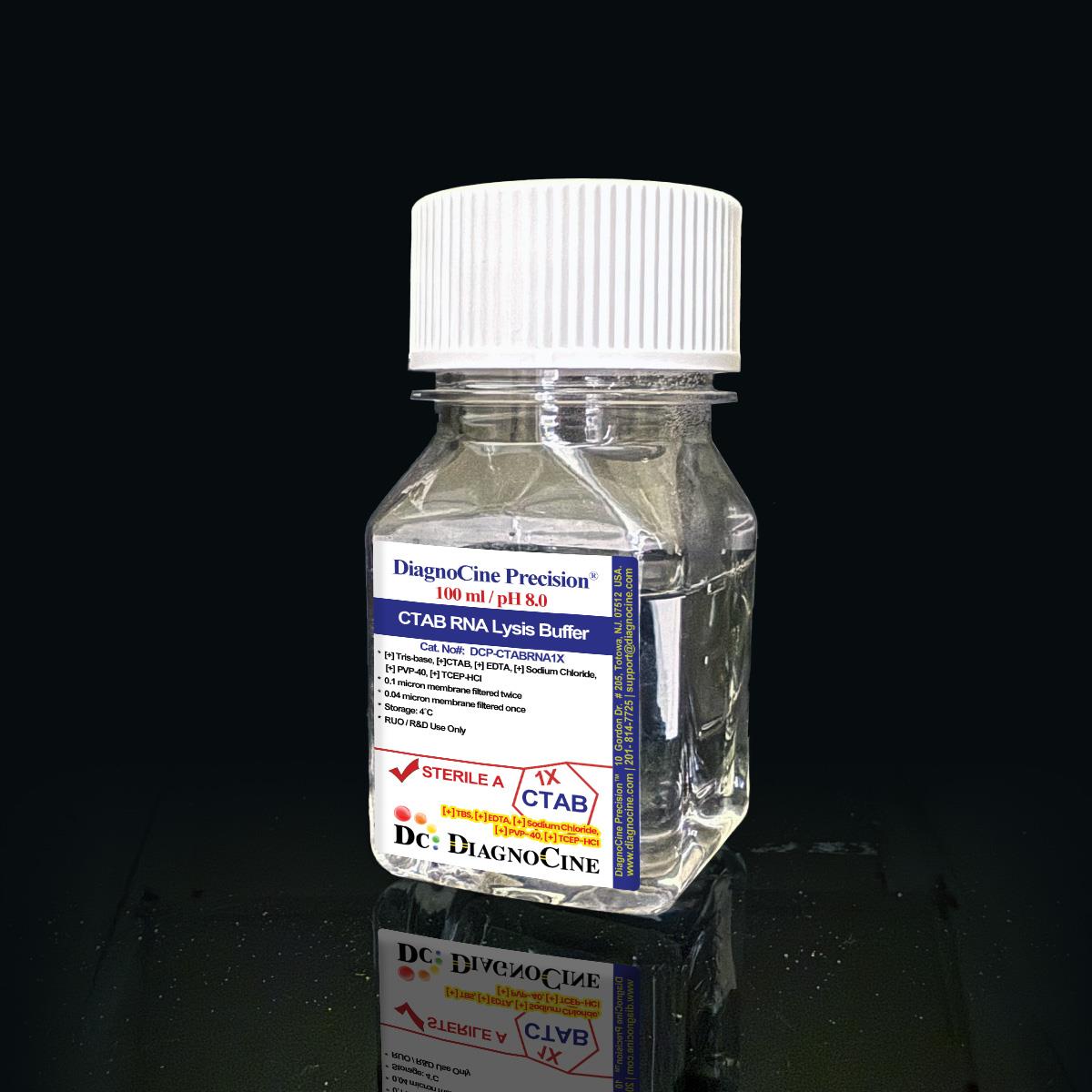
FluxMPS™, CTAB RNA Lysis Buffer
FluxMPS™ CTAB RNA Lysis Buffer
A specialized CTAB-based lysis buffer engineered for high-quality RNA isolation from polysaccharide- and polyphenol-rich plant tissues. Combines CTAB, PVP-40, and TCEP-HCl for clean RNA from leaves, roots, seeds, and woody samples.
- 4-stage filtration process (0.1 µm → 0.04 µm, followed by sterile 0.1 µm → 0.04 µm)
- CTAB, NaCl formulation for efficient disruption of cells and separation of nucleic acids from polysaccharides in challenging matrices.
- PVP-40 to complex polyphenols and minimize oxidation-induced RNA damage in phenolic-rich tissues.
- Tris and EDTA to provide strong buffering and chelation of divalent cations, inhibiting nuclease activity.
- Compatible with standard CTAB RNA protocols involving chloroform extraction and LiCl or alcohol precipitation.
- Ultrapure Type 1 water (18.2 MΩ·cm)
- ISO Class 5 laminar-flow fill & finish
- Customizable formulation available upon request
- pH8.0
- AppearanceClear Solution
- Filtration0.1µm×2 + 0.04µm×2
- Storage2-8 °C
- Shelf Life1 year
Engineered for maximum purity & performance
Standard laboratory reagents filtered at 0.22 µm leave sub-micron particulates, mycoplasma, and aggregates that interfere with sensitive downstream applications. FluxMPS™ CTAB RNA Lysis Buffer is manufactured under ISO 13485 quality systems with multi-stage ultra-filtration to eliminate these failure modes.
CTAB + high-salt RNA isolation
2% CTAB with 2 M NaCl disrupts cells and separates nucleic acids from polysaccharides in challenging plant matrices.
PVP-40 polyphenol protection
2% PVP-40 binds and removes polyphenolic compounds that cause RNA degradation and adduct formation in phenolic-rich tissues.
Stable reducing environment
10 mM TCEP-HCl inactivates RNases without the odor or instability of β-mercaptoethanol, yielding cleaner RNA preparations.
Downstream versatility
Compatible with chloroform extraction, LiCl precipitation, and alcohol precipitation for RT-qPCR, RNA-Seq, and transcriptome analyses.
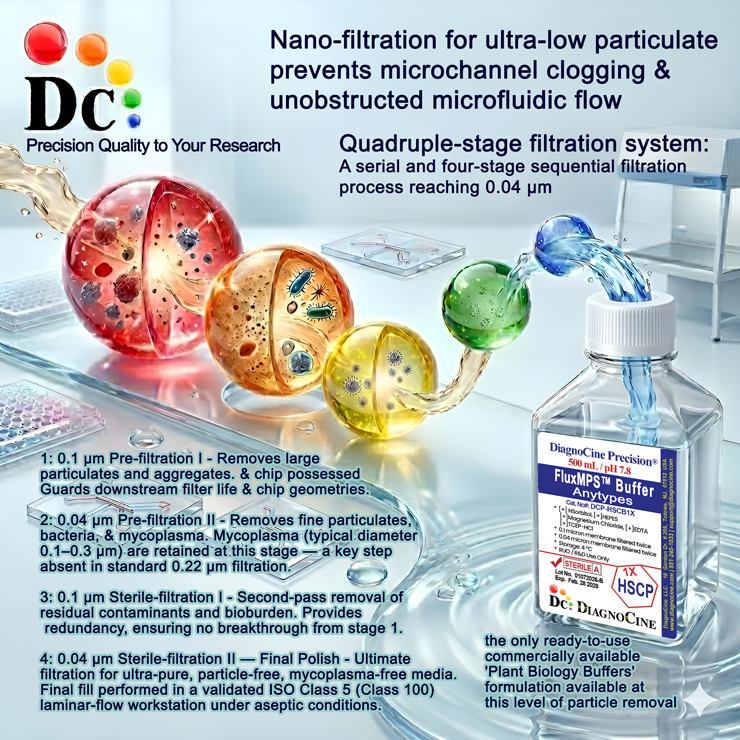
Quadruple-stage filtration system
A serial four-stage sequential filtration process reaching 0.04 µm—the only commercially available buffer at this level of particle removal.
-
1
0.1 µm Pre-filtration I
Removes large particulates and aggregates. Primary guard to extend downstream filter lifetime.
-
2
0.04 µm Pre-filtration II
Removes fine particulates, bacteria, and mycoplasma (0.1–0.3 µm)—a key step absent in standard 0.22 µm filtration.
-
3
0.1 µm Sterile-filtration I
Second-pass removal of residual contaminants and bioburden with full redundancy.
-
4
0.04 µm Sterile-filtration II — Final Polish
Ultimate filtration for particle-free, mycoplasma-free product. Final fill in validated ISO Class 5 laminar-flow workstation.
Performance vs. conventional reagents
Standard 0.22 µm single-pass filtration leaves particles in the 0.05–0.22 µm range. FluxMPS™ removes these contaminants for cleaner results and higher reproducibility.
Validated applications
- Plant tissues rich in polysaccharides and polyphenols (leaves, roots, seeds, woody tissues).
- Other complex samples where standard guanidinium reagents may give low yield or contaminated RNA (user validation required).
- Pre-warm CTAB RNA Lysis Buffer to 60-65 °C before use for optimal performance.
- Add 1 volume of hot buffer (typically 500-1000 µL) to finely ground, frozen tissue (~50-200 mg) in RNase-free tubes.
- Immediately mix thoroughly by vortexing or inversion and incubate at 60-65 °C for 10-30 minutes, depending on tissue type.
Protocol & usage instructions
- Pre-warm CTAB RNA Lysis Buffer to 60-65 °C before use for optimal performance.
- Add 1 volume of hot buffer (typically 500-1000 µL) to finely ground, frozen tissue (~50-200 mg) in RNase-free tubes.
- Immediately mix thoroughly by vortexing or inversion and incubate at 60-65 °C for 10-30 minutes, depending on tissue type.
- Proceed with chloroform or chloroform:isoamyl alcohol extraction, followed by LiCl or ethanol/isopropanol precipitation according to your preferred CTAB RNA protocol.
Composition & specifications
| Component |
|---|
| CTAB |
| Tris base |
| EDTA |
| Sodium Chloride |
| PVP-40 |
| TCEP-HCl |
Quality assurance & logistics
ISO 13485:2016 Certified
Manufactured under certified QMS with full traceability and lot documentation.
Made in USA
All manufacturing, QA testing, and final assembly at DiagnoCine Precision, Totowa, NJ.
Supporting literature
- Chang S, Puryear J, Cairney J. A simple and efficient method for isolating RNA from pine trees. Plant Mol Biol Rep. 1993;11(2):113-116.
- Gambino G, Perrone I, Gribaudo I. A rapid and effective method for RNA extraction from different tissues of grapevine and other woody plants. Phytochem Anal. 2008;19(6):520-525.
- Jaakola L, Pirttila AM, Halonen M, Hohtola A. Isolation of high quality RNA from bilberry (Vaccinium myrtillus L.) fruit. Mol Biotechnol. 2001;19(2):201-203.