DNA Topoisomerase I (Vaccinia Virus)
Cat. No.: SB-G3401-1000U
Size: 1000U
Description
The DNA topoisomerase I produced by our company is a type I eukaryotic topoisomerase derived from vaccinia virus. The DNA Topoisomerase I has the activity of unwinding (DNA Relaxing), which can unwind the double-strand covalently closed circular positive or negative supercoiled DNA, thereby forming double-stranded DNA containing less positive or negative supercoils. chain-shaped DNA molecule. Vaccinia DNA Topoisomerase I can also make double-stranded DNA form a knot (knotting) or unknot (unknotting), so that the complementary single-stranded circular DNA becomes double-stranded circular DNA.
In addition, Vaccinia DNA Topoisomerase I can specifically recognize the 5'-...(C/T)CCTT...-3' sequence in double-stranded DNA, and can open after the 5'-...(C/T)CCTT↓ sequence on one strand Phosphodiester bond, and the energy released by breaking the phosphodiester bond can catalyze the formation of a covalent ester bond between the 3' phosphate group at the DNA cut and the 274th tyrosine (Try) hydroxyl group of topoisomerase, which also forms covalent complexes of DNA and enzymes. At the same time, the covalent ester bond formed can be attacked by the 5' hydroxyl of the cut single-stranded DNA. Without the need for ATP and DNA ligase, the phosphodiester bond before the formation can be restored, that is, the DNA can be reconnected. , while releasing Vaccinia DNA Topoisomerase I.
At present, DNA Topoisomerase I (vaccinia virus) is often used as a new tool enzyme for DNA recombination ligation, used for ligation of DNA vectors and recombination fragments, nick repair, adapter ligation, etc.
- Features: DNA unwinds supercoils and specifically opens the connecting phosphodiester bonds.
- Source: Escherichia coli strain carrying Vaccinia virus topoisomerase gene; its molecular weight is about 37KDa;
- Definition of enzyme activity: the amount of enzyme required to unwind 1 µg of the pUC19 vector after incubation at 37°C for 30 minutes is defined as one enzyme activity unit.
- Purity and concentration: SDS-PAGE detection purity ≥ 95%; endogenous nucleic acid residue < 1 pg/μL (qPCR detection); 10 U/μL.
- Inactivation or inhibition: DNA Topoisomerase I can be fully inactivated by heating at 80°C for 20 minutes.
- Enzyme storage buffer: 50 mM Tris-HCl, 1 mM DTT, 0.1 mM EDTA, 0.1 M NaCl, 0.1% Triton X-100, 50% glycerol, pH 7.5.
- 10х Reaction buffer: 500 mM Tris-acetate, 1 M NaCl, 25 mM MgCl2 , 1 mM EDTA, pH 7.5.
Storage and Handling Conditions
Transport with wet ice; Store at -20℃, valid for 12 months.
Composition
| Component Number |
Component |
1000U |
| G3401-1 |
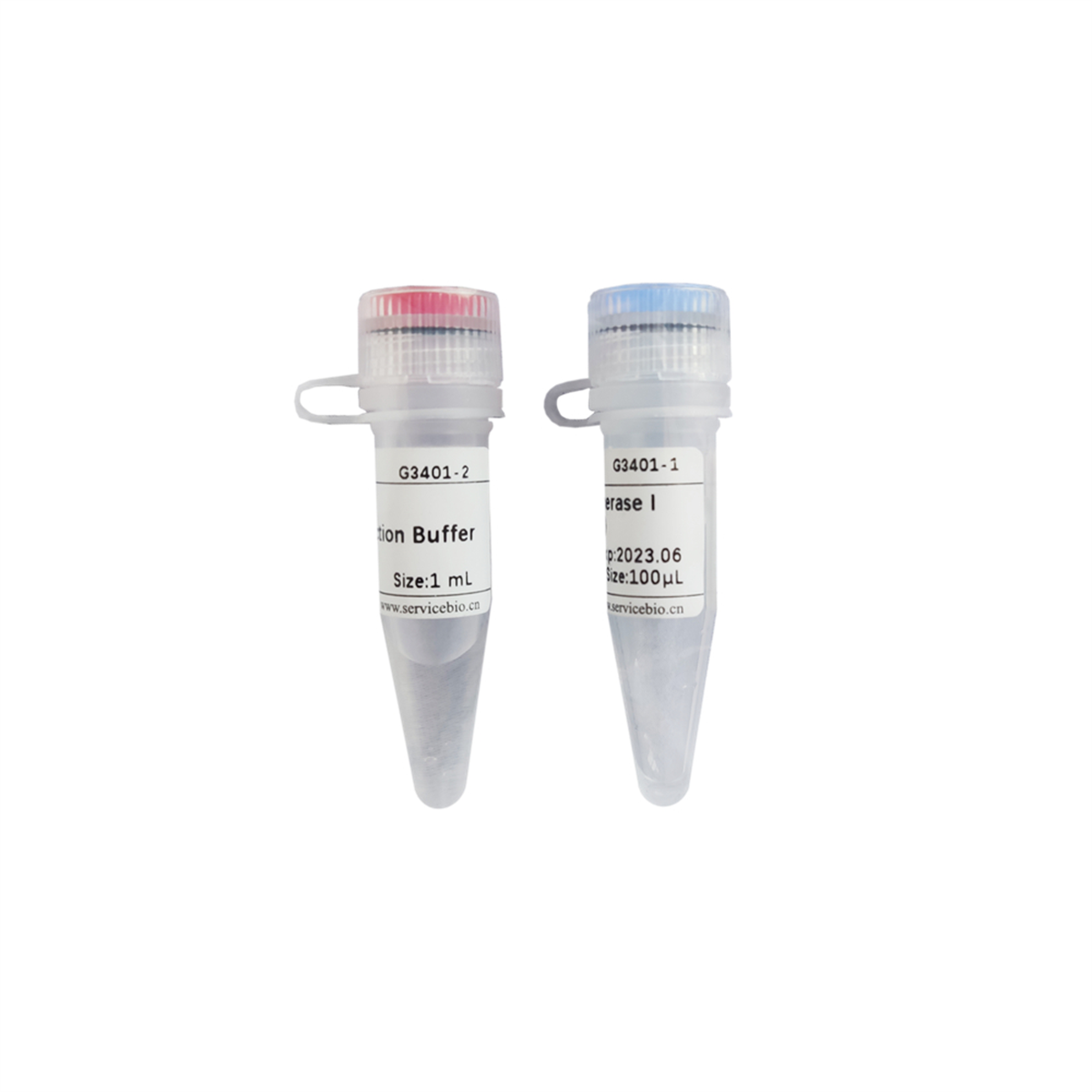
DNA Topoisomerase I (10U/μL) |
100 μL |
| G3401-2 |
10X Topo Reaction Buffer |
1 mL |
| Product Manual |
1 copy |
Reference use
1. Reference reaction system:
| Component |
Volume |
| DNA |
1 μg |
| 10X Topo Reaction Buffer |
2 μL |
| DNA Topoisomerase I (10U/μL) |
0.1 μL |
| Nuclease-Free Water |
To 20 μL |
2. After setting up the above system, mix gently, and then centrifuge the liquid to the bottom of the tube.
3. Incubate at 37°C for 30 minutes, and place on ice to terminate the reaction after the reaction is complete.
4. When performing agarose gel electrophoresis to detect reaction products, it is necessary to use agarose gel without ethidium bromide (EB), and then perform nucleic acid staining and gel imaging observation after electrophoresis.
Precautions
1, because when the gel contains ethidium bromide, ethidium bromide will bind between the bases of DNA and catalyze the formation of supercoils. Therefore, when detecting plasmid products treated with DNA Topoisomerase I (vaccinia virus) by agarose gel electrophoresis, gels without ethidium bromide (EB) should be used for electrophoresis, and ethidium bromide or other gels should be used after electrophoresis is completed. Appropriate nucleic acid dyes for nucleic acid staining of gels.
2. When using this product, it is advisable to store the enzyme in an ice box or on an ice bath, and store it at -20ºC immediately after use.
3. For your safety and health, please wear a lab coat and disposable gloves for operation.