Can Get Signal ® (Set)
Can Get Signal ® (Set)
Can Get Signal® is a solution containing an accelerator for antigen-antibody reactions. This reagent improves sensitivity, specificity, and signal-to-noise ration (S/N) for Western blotting, dot blotting, enzyme-linked immunosorbe…
| Product Name | Cat. No. | Size | Storage | Order |
|---|---|---|---|---|
| Can Get Signal ® (Set) | TYB-NKB-101 | Solution 1 (250 ml) +Solution 2 (250 ml) | 4°C | Current page |
Can Get Signal ®
DESCRIPTION
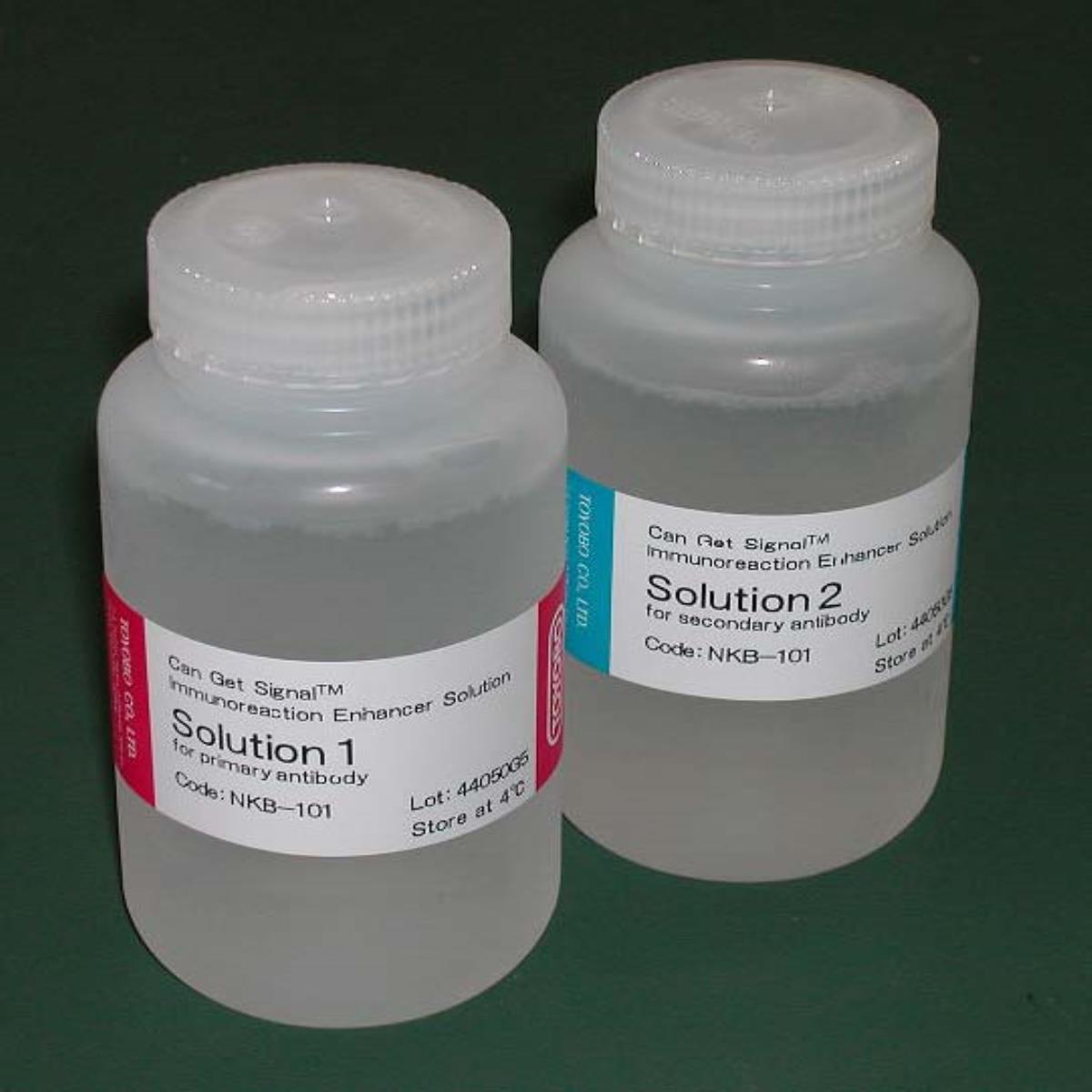
Can Get Signal® is a solution containing an accelerator for antigen-antibody reactions. This reagent improves sensitivity, specificity, and signal-to-noise ration (S/N) for Western blotting, dot blotting, enzyme-linked immunosorbent assay (ELISA), etc. Solutions 1 and 2 refer to the reactions of the primary and secondary antibodies, respectively.
FEATURES
Enhances immunoassay signals up to several dozen times by maintaining low background signals.
Can be used in combination with secondary antibodies labeled with peroxidase or alkaline phosphatase, etc.
Can be used directly without dilution (ready-to-use).
APPLICATIONS
- Western blotting, dot blotting
- Enzyme-linked immunosorbent assay (ELISA),
COMPONENTS
This kit includes the following components. All reagents should be stored at 4ºC, and protected from light.
| Reagent Name | Code No. | ||
|---|---|---|---|
| TYB-NKB-101 (Set) | TYB-NKB-201 (Solution 1) | TYB-NKB-301 (Solution 2) | |
| Solution 1 for primary antibody | 250 ml | 250 ml | - |
| Solution 2 for secondary antibody | 250 ml | - | 250 ml |
| Link | current page |  |
|
TYPICAL REACTION FLOW
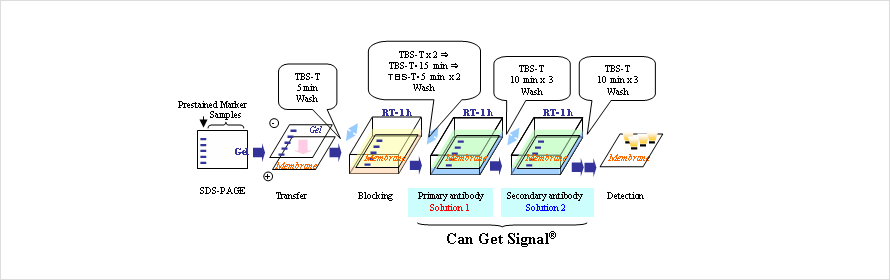
Flow chart of western blotting with Can Get Signal®
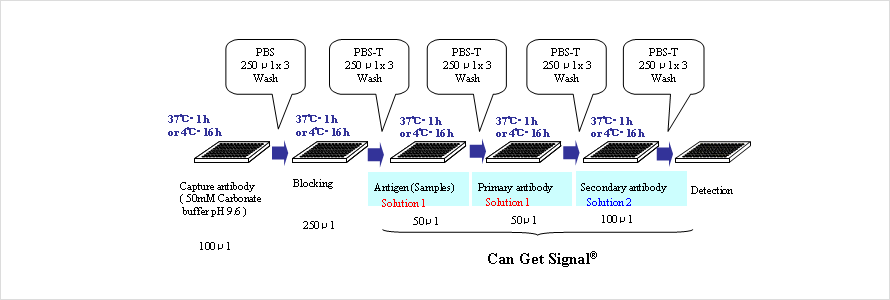
Flow chart of ELISA with Can Get Signal®
APPLICATION DATA
Example 1. Detection of phosphorylated proteins by Western blotting
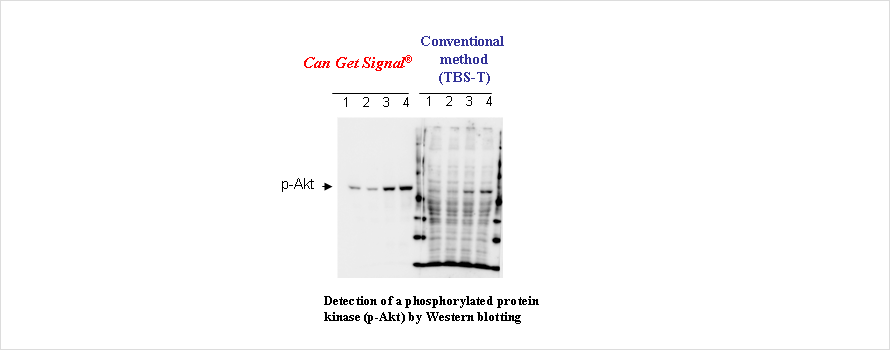
Phosphorylated Akt and ERK were detected by Western blotting analysis using Can Get Signal® and a conventional method (TBS-T). As a result, the signal intensities of the target bands obtained with Can Get Signal® were greater than those of the conventional method. The background level of the experiment with Can Get Signal® was also significantly lower than that of the conventional method. The results suggest that Can Get Signal® improves the sensitivity and specificity of Western blotting analysis.
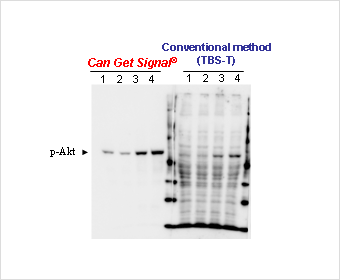
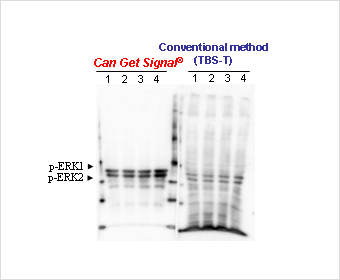
Fig. 1. Detection of phosphorylated protein kinases (p-Akt, p-ERK1 and p-ERK2) by Western blotting with Can Get Signal® and a conventional method
Sample:Cultured bovine adrenal medulla cells
- Control (H2O)
- Insulin (1 nM, stimulated for 5 min)
- Insulin (10 nM, stimulated for 5 min)
- Insulin (100 nM, stimulated for 5 min)
Antibodies:
<p-Akt>
Primary antibody:Anti Phospho-Akt rabbit polyclonal antibody (1:2,000 dilutioin) Secondary antibody:Anti rabbit-HRP antibody (1:20,000 dilution)
<p-ERK>
Primary antibody:Anti Phospho-ERK monoclonal antibody (1:2,000 dilutioin) Secondary antibody:Anti mouse-HRP antibody (1:20,000 dilution)
*The data was kindly provided by Dr. Yanagita from the Department of Pharmacology, Faculty of Medicine, University of Miyazaki.
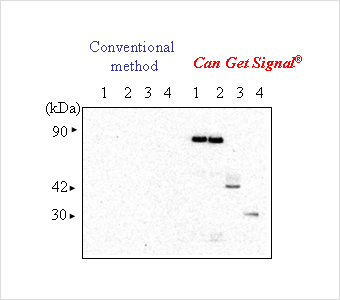
Example 2. Detection of His-tagged proteins by Western blotting
His-tagged recombinant proteins were detected with Can Get Signal® and a conventional method (TBS-T). Can Get Signal® showed excellent greater sensitivity than the conventional method.
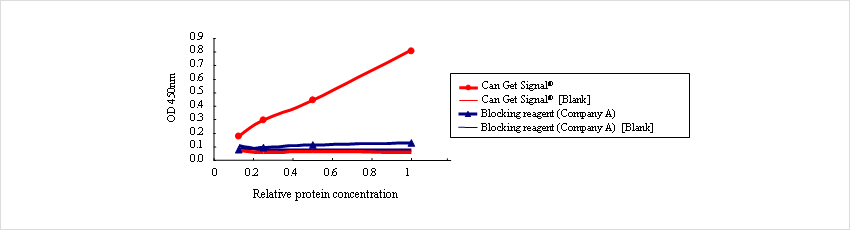
Example 3. Detection of His-tagged proteins by ELISA
Sandwich ELISA (solid phase antibody: anti-ERK2 monoclonal antibody, primary antibody: anti-His tag polyclonal antibody, secondary antibody: anti-rabbit IgG-HRP antibody) was performed to detect his-tagged human MAP kinase (His-ERK2) synthesized by a cell-free protein synthesis system. Can Get Signal® showed an excellent quantitative curve as a function of antigen concentration whereas the conventional method with TBS-T resulted in low signals.