Anti Human ROR common mouse monoclonal antibody (H3925)
Product#: FNK-PP-H3925-00
$501.52
Availability:
Ships in 1-2 Weeks
Anti Human ROR common mouse monoclonal antibody (H3925)
ROR: RAR-related orphan receptor
General information
| Cat. No. | :FNK-PP-H3925-00 |
| Size | :100 ul |
| Antigen Species | :Human |
| Host Species | :Mouse |
| Cross Reactivity | :Human/ Rat |
| Purification | :Ammonium sulfate fractionation. |
| Clone No | :H3925 |
| Lot. | :A-2 |
| Concentration | :1 mg/mL |
| Ig Class | :G2a |
| Nomenclature | :NR1F1 |
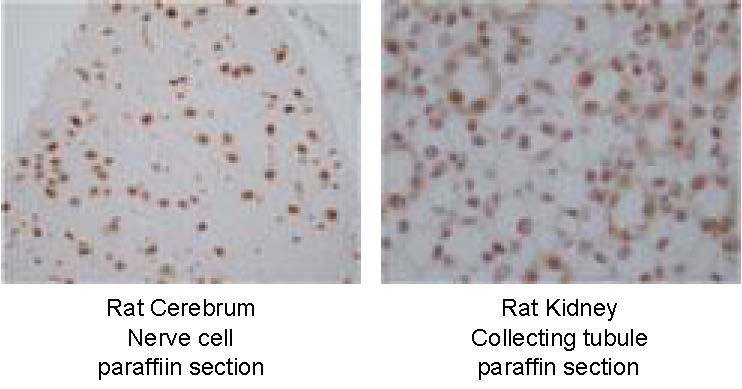
| Application | :ELISA : 0.2 ug/mL :Western Blot : 1 ug/mL :Immunohistochemistry: 10-20 ug/mL |
| Specificity |
:This antibody specifically recognizes human ROR alpha, beta and gamma, and cross reacts with mouse
and rat ROR alpha, beta and gamma. |
| Storage | :Store at 2 - 8 ºC up to one month. For long-term storage, the solution may be frozen in working aliquots. Repeated freezing and thawing is not recommended. Storage in a frost-free freezer is not recommended. |
| Form | :Physiological saline with 0.1% NaN3 as a preservative |
| Genbank | :U04897 |
Description
Retinoic acid-related orphan receptor (ROR; NR1F group) is a member of orphan nuclear receptor.
Origin
Produced in BALB/c mouse ascites after inoculation with hybridoma of mouse myeloma cells (NS-1) and spleen cells derived from a BALB/c mouse immunized with Baculovirus-expressed recombinant ROR alpha (136-236 aa) .
Note
Sodium azide may react with lead and copper plumbing to form explosive metal azides. Flush with large amounts of water during disposal.