Anti Human ApoER2 Antibody Monoclonal, CyB-5G7
Product#: FNK-BML036
$495.39
Availability:
Ships in 1-2 Weeks
Anti Human ApoER2 Antibody Monoclonal, CyB-5G7
General information
| Cat. No. | :FNK-BML036 |
| Size | :50µg |
| Clone | :CyB-5G7 |
| Antigen | :Human |
| Host Animal | :Mouse |
| Cross Reactivity | :Human |
| Labeled | :Unlabeled |
| Preparation | :Produced in mice immunized with synthetic peptides, aa873-898 (EDPAPALKELFVLPGEPRSQLHQLPK), which is corresponding to the insert site of cytosolic domain of human apoE receptor 2 (apoER2). ApoER2 specific IgG was purified from mouse ascites fluid with a proteinA-Sepharose. |
| Formulation | :0.2 µm filtered PBS solution |
| Specificity | :This antibody has been selected for its ability to bind for human apoER2 expressed in CHO cells (ldl-A7). No cross-reactivity with human LDL receptor and VLDL receptor was confirmed (see ref. 1) |
| Application |
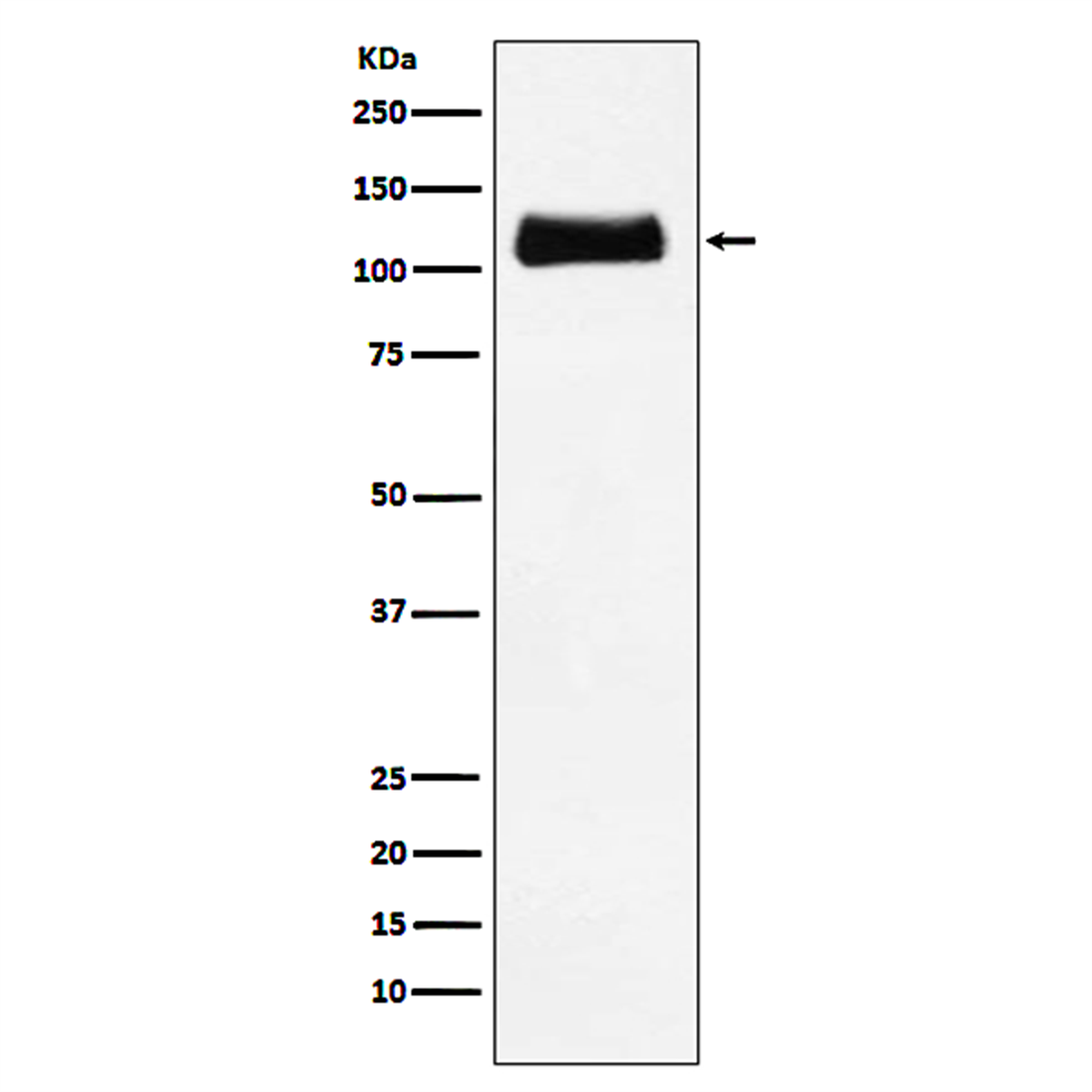
:Western Blot – This antibody can be used at 1.0 µg/mL for western blot analysis. :Histology – This antibody can be used as a 1st antibody for immunohistochemistry. Please see reference (1) for details. Optimal dilutions should be determined by each laboratory for each application. |
| Immunogen | :synthetic peptide |
| Ig Type | :IgG2b |
| Storage | :IgG in PBS solution are stable for twelve months from the date of receipt when stored at-80˚C. Avoid repeated freeze-thaw cycles. |
Antigen Characterization
| Type | :Recombinant protein |
| Application | :Western Blotting (WB), IP (Immunoprecipitation) |
| Species | :Human, Mouse, Rat |
| Recombinant | :Yes |
ApoER2 in the Cell
- Functions as a cell surface receptor for signal transduction and endocytosis
- Expressed in neurons' apical dendrites, cell bodies, and dendritic processes
- Participates in synaptic plasticity and long-term potentiation
- Interacts with proteins like Reelin, Apolipoprotein E, and Selenoprotein P
- Contains a unique cytoplasmic tail with a proline-rich insert
- Binds to PSD-95 and JIP-2, important for NMDA receptor signaling and JNK pathway modulation
ApoER2 in the Human Body
- Vital for brain development and function
- Regulates cortical lamination and neuronal migration during embryonic development
- Critical for learning and memory processes in the adult brain • Highly expressed in the neocortex, cerebellum, hippocampus, and olfactory bulb
- Found in non-neural tissues: placenta, testis, ovary, and platelets
- Essential for selenium transport to organs like the brain and testes
- Crucial for preventing neurodegeneration and maintaining male fertility
- Alterations in ApoER2 associated with neurological disorders, including Alzheimer's disease
Aliases for LRP8 Gene

References
- Motoi et al., Apolipoprotein E receptor 2 is involved in neuritic plaque formation inAPPsw mice.Neurosci Lett,2004;368:144-147.
- Hinrich, Anthony J et al. “Therapeutic correction of ApoER2 splicing in Alzheimer's disease mice using antisense oligonucleotides.” EMBO molecular medicine vol. 8,4 (2016): 328-45. doi:10.15252/emmm.201505846
- Dlugosz, P.; Nimpf, J. The Reelin Receptors Apolipoprotein E receptor 2 (ApoER2) and VLDL Receptor. Int. J. Mol. Sci. 2018, 19, 3090. https://doi.org/10.3390/ijms19103090
- Omuro, Kerilyn Casey et al. “Human APOER2 Isoforms Have Differential Cleavage Events and Synaptic Properties.” The Journal of neuroscience : the official journal of the Society for Neuroscience vol. 42,20 (2022): 4054-4068. doi:10.1523/JNEUROSCI.1800-21.2022
- Gallo, Christina M., et al. “ApoER2: Functional Tuning through Splicing.” Frontiers in Molecular Neuroscience, vol. 13, 30 July 2020, doi:10.3389/fnmol.2020.00144.
- “LRP8 LDL Receptor Related Protein 8 [Homo Sapiens (Human)] - Gene - NCBI.” National Center for Biotechnology Information, U.S. National Library of Medicine, www.ncbi.nlm.nih.gov/gene/7804.