

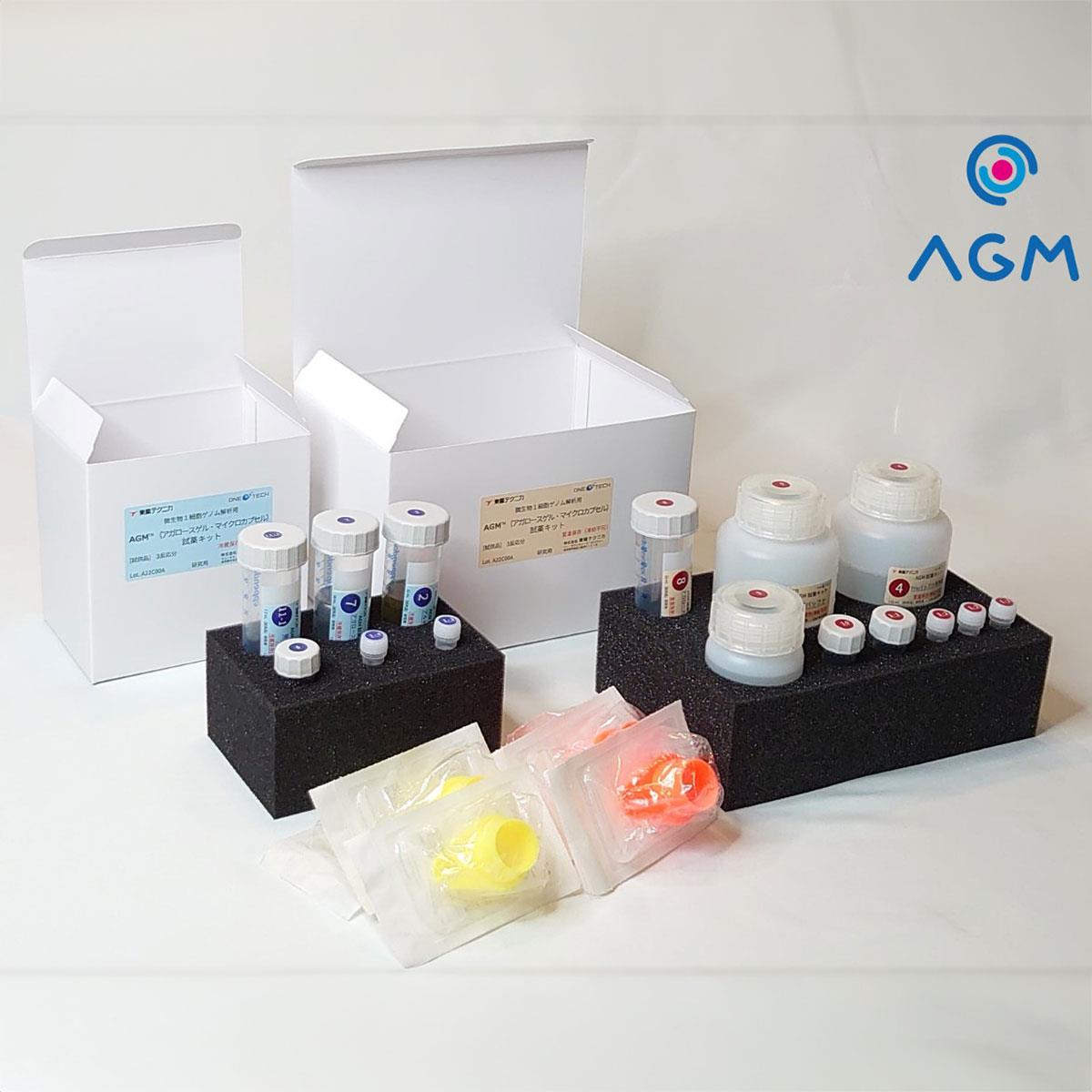
AGM (Agarose Gel Microcapsules) Reagents Kit
Product#: FNK-MCM-3
$1,502.66
Availability:
Ships in 24 hours
AGM (Agarose Gel Microcapsules) Reagents Kit
Cat. No.: FNK-MCM-3
Storage: RT,4°C, Don't freeze
size: 1 Kit
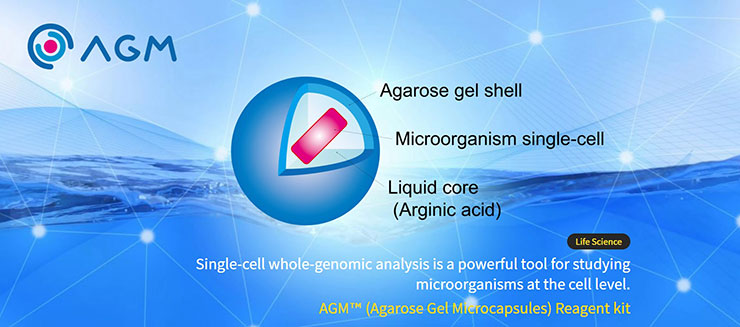
Pioneering approach for single-cell whole-genome analysis. “Single-cell whole-genome analysis,” which decodes individual genomic information in detail at the single-cell level, is attracting attention in the field, due to its high complementarity with “Metagenomic analysis,” which examines the collective genomic information of multiple microorganisms in a sample.
Single-cell whole-genome analysis of microorganisms presents a challenge due to the limited amount of DNA available. In order to perform genome analysis, it is necessary to amplify the DNA to an adequate quantity. However, this amplification process can result in bias depending on the region of the genome being amplified, making it difficult to accurately analyze the entire genome. A significant goal in single-cell whole genome analysis is to eliminate this amplification bias and achieve closer to 100% genome coverage.
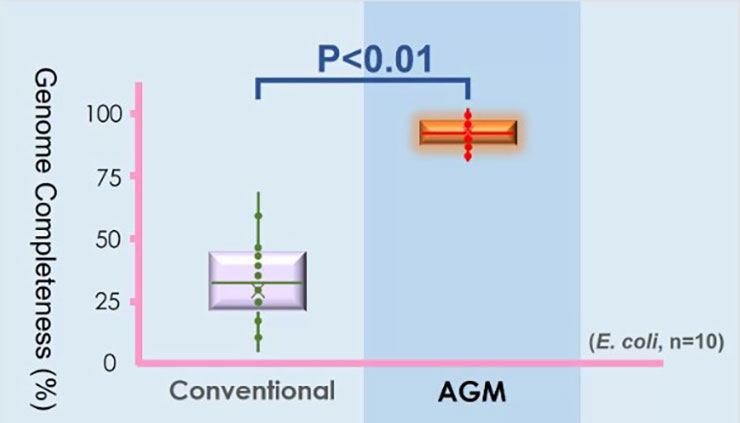
The miniaturization of reaction vessels has been found to be an effective way to reduce amplification bias in single-cell whole genome analysis. AGM (agarose gel microcapsules) has been particularly successful in achieving this. The figure below compares the genome coverage in DNA amplification by MDA*. By enclosing one cell in a picoliter-scale microcapsule, AGM minimizes amplification bias and achieves a genome coverage of over 90% in this E. coli case, overcoming the challenges faced by traditional methods.
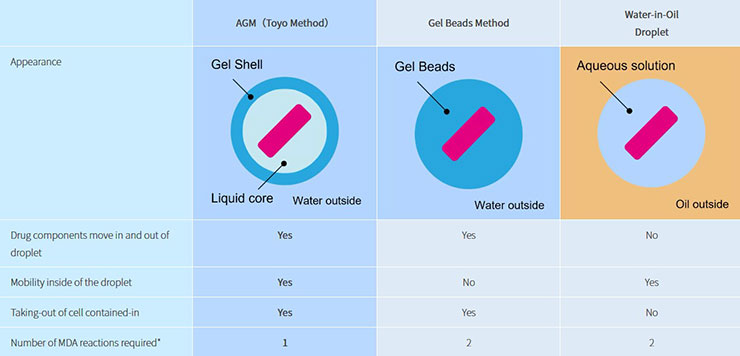
Technologies for the optimal containment of single cells. To increase genome completeness, various technologies for miniaturizing reaction vessels have been developed. These include micro containers that utilize MEMS technology, and microfluidic-based microdroplets in oil. Both approaches aim to optimize the reaction conditions and improve the efficiency of the analysis.
Despite their potential, these approaches face several challenges. One issue is that microorganisms are embedded in gel, which restricts their movement. Another is that the necessary drug components are not supplied from outside. They lead to in incomplete genome coverage. Additionally, there are practical barriers to using these approaches, such as the high cost of specialized equipment, the time and effort required, and the difficulty in extracting samples after the reaction. These factors contribute to the entry barriers for using these techniques.
The AGM™ reagent kit offers a solution to these challenges and enables the achievement of high genome coverage through the use of general physics and chemistry instruments commonly found in biological laboratories, without the need for costly specialized equipment. This kit facilitates the realization of analysis with a high degree of accuracy and efficiency.
Key Benefits
- Requires Small Sample Volume. Because whole genome analysis can be performed with a minimal sample size, the AGM reagent kit can also be used to analyze VNC (Viable but Non-Culturable) microorganisms. This ability to work with small sample volumes makes it a versatile and useful tool for a variety of applications.
- Achieves High-Level of Genome Completeness. Enables the achievement of a high genome completeness rate that is not possible with traditional methods. This is particularly valuable for identifying and analyzing new and previously unknown species
- Provides Affordable and Convenient Solution. To begin single-cell whole genome analysis, you can purchase a reagent kit which allows you to perform experiments using standard physics and chemistry equipment found in most biological laboratories, without the need for costly specialized equipment. This makes it easy to get started with this type of analysis, regardless of the resources available to you

DNA amplification using E.coli Single Cell by MDA
(Images taken by fluorescence Microscope DNA stained)
Left: E.coli single cell contained by AGM (Green) Right: DNA amplified by MDA inside the AGM (Green)
【 Examples of AGM™ Reagent Kit Uses 】
