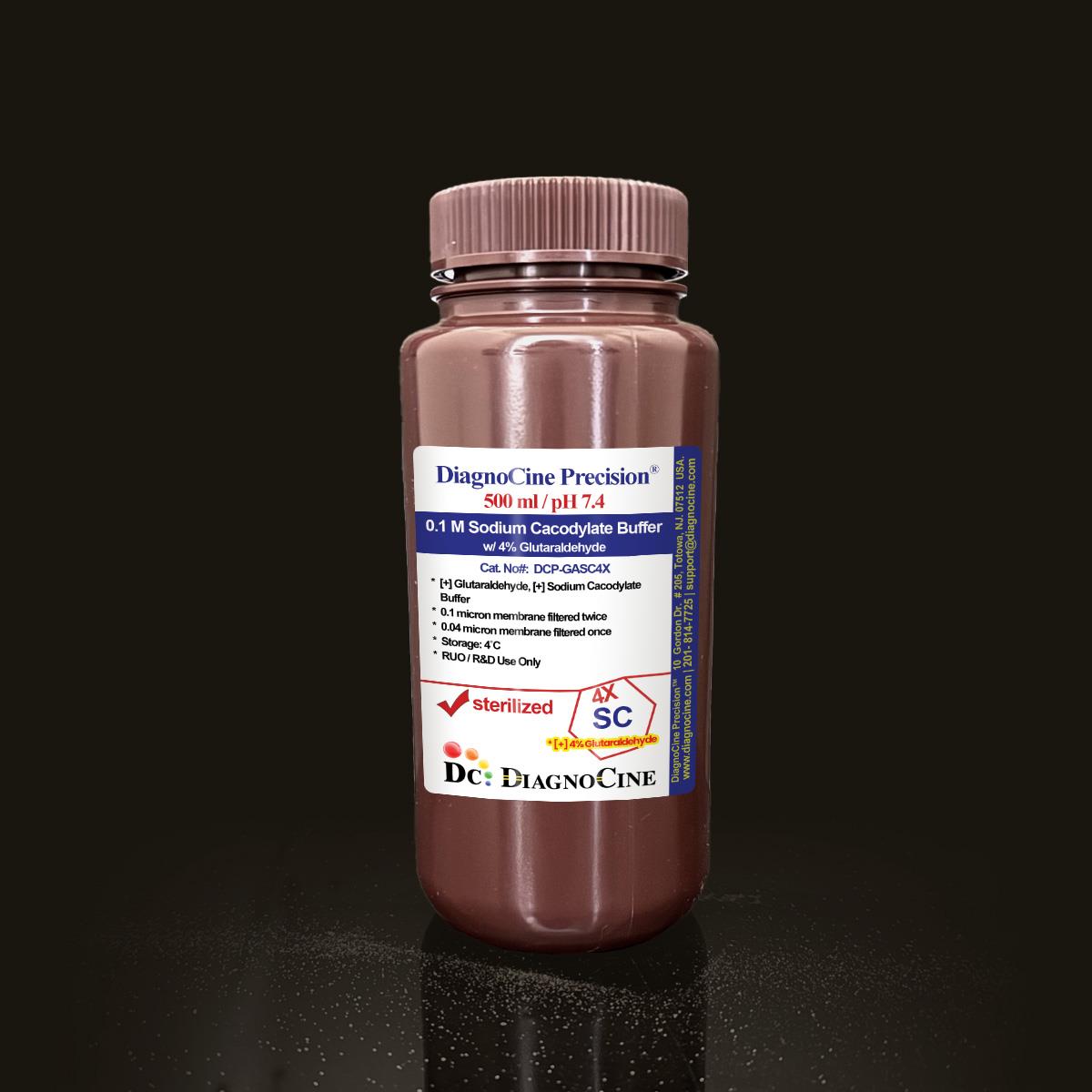
4% Glutaraldehyde in 0.1 M Sodium Cacodylate Buffer
Cat No.: DCP-GASC4X
Size: 500 mL
Sterile, Ultrapure, Filtered 0.1-micron membrane TWICE and 0.04-micron membrane ONCE.
Description:
This premium 4% glutaraldehyde solution, formulated in 0.1 M sodium cacodylate buffer at physiological pH 7.4, represents the industry standard for ultrastructural preservation in biological research. Designed for researchers requiring consistent, artifact-free fixation, this ready-to-use reagent ensures exceptional cellular and subcellular preservation for advanced microscopy and biochemical applications.
The solution combines 4% glutaraldehyde, a potent crosslinking agent, with 0.1 M sodium cacodylate buffer, a pH-stable arsenic-based buffer system. The pH of 7.4 is meticulously calibrated to match physiological conditions, minimizing osmotic shock and structural distortion during fixation. Pre-filtered through a 0.04 μm membrane, the preparation guarantees sterility and particulate-free consistency, making it ideal for high-resolution imaging techniques like transmission electron microscopy (TEM).
Applications:
- Electron Microscopy: As the gold-standard fixative for TEM and SEM workflows, this solution rapidly stabilizes proteins, lipids, and nucleic acids, preserving organelles and membrane systems with nanometer-scale fidelity. Its rapid penetration (reaching depths of 0.4–0.5 mm/hour) ensures uniform fixation even in dense tissues, critical for correlative light and electron microscopy (CLEM) studies requiring precise spatial registration.
- Biochemical Research: Beyond microscopy, researchers employ this formulation for enzyme immobilization, protein crosslinking assays, and histochemical stabilization. The glutaraldehyde-mediated amine crosslinking creates stable molecular networks, enabling the study of protein interactions while retaining enzymatic activity in immobilized systems.
Advantages:
The sodium cacodylate buffer component provides superior buffering capacity compared to phosphate-based alternatives, maintaining pH stability even during prolonged fixation periods. This prevents acidification artifacts commonly seen with unbuffered glutaraldehyde solutions. Users report 20–30% improvement in membrane contrast compared to formaldehyde-based fixatives, particularly when paired with post-fixation osmium tetroxide treatments.
Composition:
| Ingredients |
Concentration |
| Glutaraldehyde |
4% |
| Sodium Cacodylate |
0.1M |
Usage Instructions:
Immersion Fixation
For immersion fixation, tissue samples (ideally no larger than 1 mm³ for optimal penetration) are placed directly into the 4% glutaraldehyde solution. The specimens typically remain in the fixative for at least one hour at room temperature, though longer periods may be necessary depending on tissue type and research requirements. After fixation, samples are generally washed with buffer solution to remove excess glutaraldehyde before subsequent processing steps.
Quality Control:
- Appearance: Clear solution
- pH: 7.4
- Sterility: Filtered 0.1 micron Twice and 0.04 micron once.
- DNase activity: None was detected after incubation of plasmid DNA, and this product was used for 18 hours at room temperature.
- RNase activity: No RNase activity was detected after incubation of ribosomal RNA and this product for 18 hr at room temperature.
Storage and Shelf Life:
- Store at 4°C away from bright light (amber).
- Shelf life is 12 months from manufacture date when unopened; 3 months post-opening
- Use before expiry date given on the product label.
Hazard Mitigation:
As both glutaraldehyde (acute toxicity Category 2) and sodium cacodylate (containing arsenic) pose health risks, users must employ:
- PPE: Nitrile gloves, lab coats, and ANSI-approved eye protection.
- Engineering Controls: Fume hoods for aliquoting or large-volume handling.
- Spill Protocol: Neutralize with 1 M glycine solution before disposal.
CUSTOMIZATION: Please INQUIRE if other concentrations, additions of chemicals/compounds/proteins/supplements, different pH, and modifications are needed.
All DiagnoCine Precision Sterile buffers are filtered-sterilized with a 0.1-micron filtration two times and 0.04-micron filtration one time. Thus, mycoplasma contamination is prevented. The smallest size mycoplasma type can be about 0.2 microns.
* This product is manufactured under ISO 13485-certified and CE-approved facilities (Suppliers of DiagnoCine Precision). All final packaging, quality assurance, and testing are done at the DiagnoCine R&D and Quality Testing Center. All specific customization requests and assembly were accomplished at DiagnoCine Precision in Totowa, New Jersey, USA.